

Imagine waking up tomorrow and deciding not to go to work for the next 15 days.
No office visits.
No customer calls.
No WhatsApp replies.
No checking invoices.
No approving employee requests.
Just complete silence.
Now ask yourself one simple question.
What happens to your business?
Do customers still receive responses?
Are orders delivered on time?
Does your team continue working confidently?
Do sales continue without your involvement?
Or does everything suddenly come to a halt?
If your business cannot function without you for even a few days, there is an uncomfortable truth that many entrepreneurs avoid accepting.
You may not actually own a business.
You may have simply created a job for yourself.
This isn't meant to discourage you.
In fact, almost every entrepreneur starts this way.
The problem is that many never move beyond it.
They become the salesperson.
The customer support executive.
The HR manager.
The accountant.
The operations manager.
The marketing head.
And sometimes even the delivery person.
Instead of building a company, they unknowingly become the busiest employee inside it.
Working harder might increase today's income.
Building systems creates tomorrow's business.
Brief Summary
- Understand the real difference between a business and self-employment.
- Discover why long working hours don't always create successful companies.
- Learn the 15-Day Test used to identify owner-dependent businesses.
- See why systems are more valuable than hard work.
- Explore practical steps to build a business that works even when you don't.
Table of Contents
Why Most Entrepreneurs Stay Busy Forever
Ask almost any entrepreneur why they started a business, and you'll hear similar answers.
They wanted freedom.
Freedom to earn more.
Freedom to make their own decisions.
Freedom to spend time with family.
Freedom to build something meaningful.
Ironically, after a few years, many entrepreneurs find themselves with less freedom than they had while working a regular job.
Instead of reporting to one manager, they now answer customers, suppliers, employees, landlords, accountants, banks, and vendors.
Every problem reaches them.
Every approval waits for them.
Every customer expects to speak directly with them.
Initially, this feels like dedication.
Eventually, it becomes dependency.
When every decision depends on one person, growth naturally slows down.
The business becomes limited by the owner's time, energy, and availability.
That's why many businesses remain the same size for years despite the owner working 12 to 14 hours every single day.
Being busy is not proof that you're building a successful company.
Sometimes, it's proof that you've become the biggest bottleneck inside your own business.
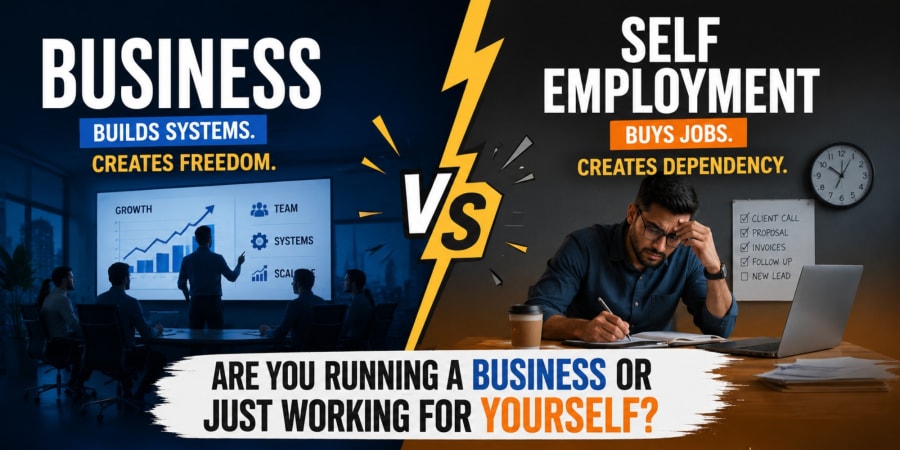
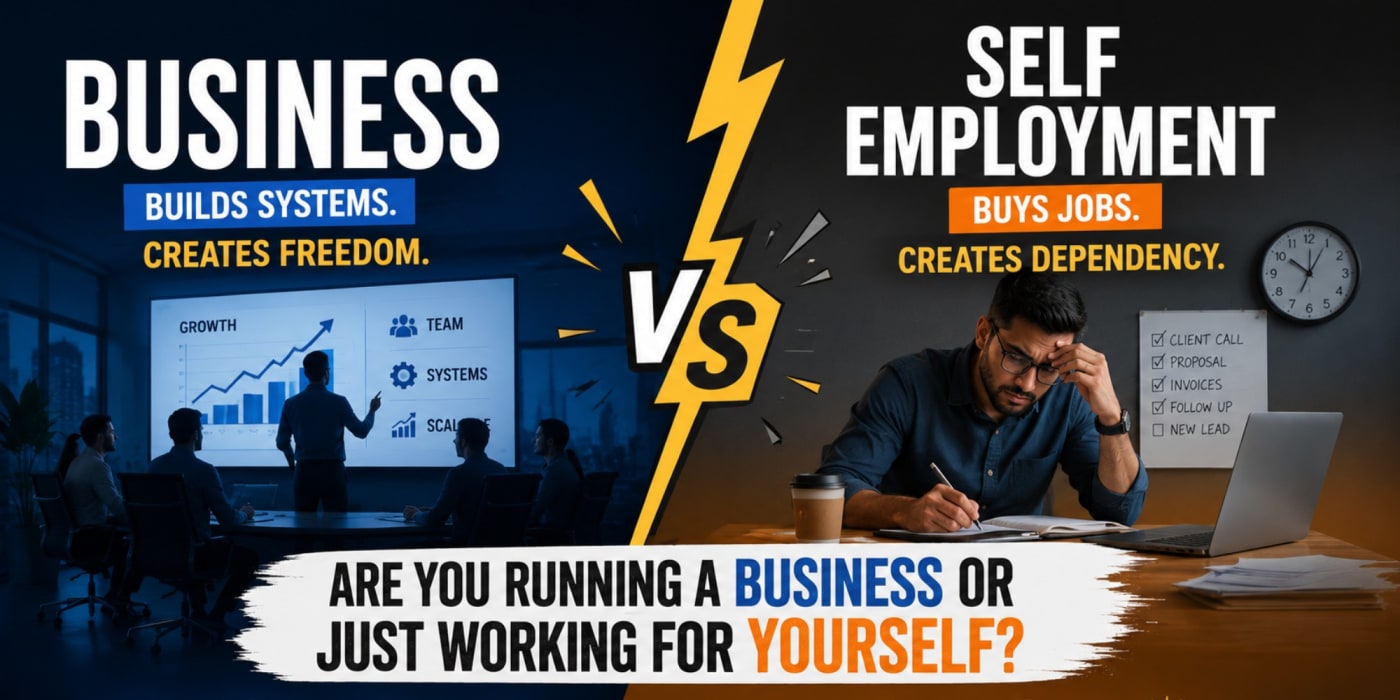
Business vs Self Employment
Many people believe that registering a company automatically makes them a business owner.
It doesn't.
The real difference lies in how income is generated.
What Is Self Employment?
In self-employment, your income depends directly on your personal effort.
If you stop working, revenue stops.
If you don't answer customer calls, sales reduce.
If you don't supervise employees, operations slow down.
Your business depends on your presence every single day.
You own the work.
But the work also owns you.
What Is a Real Business?
A real business is built on systems, processes, and people.
Customers receive consistent service whether the owner is present or not.
Employees understand their responsibilities.
Sales continue through defined processes.
Operations follow documented workflows.
The owner spends more time improving the business than operating it.
That is what creates scalability.
That is what creates freedom.
The 15-Day Business Test
Here's a simple exercise every entrepreneur should try.
Imagine taking a complete 15-day vacation.
No calls.
No WhatsApp.
No approvals.
No emails.
Would your company continue functioning?
Ask yourself these questions honestly.
- Will customers still receive timely replies?
- Will employees know what to do?
- Will invoices continue to be generated?
- Will marketing campaigns continue running?
- Will sales continue without your supervision?
- Will customer complaints be resolved?
If the answer to most of these questions is "No," then your business depends on you rather than on systems.
And dependency is the biggest obstacle to sustainable growth.
Why Hard Work Alone Doesn't Build Businesses
One of the most celebrated statements among entrepreneurs is, "I work 14 hours a day."
While dedication is important, working longer hours doesn't automatically mean you're building a successful business.
The real question isn't how many hours you work.
The real question is what those hours are creating.
Are you spending your day building systems that will continue generating income tomorrow?
Or are you simply completing today's tasks so the business can survive another day?
There's a huge difference between the two.
Imagine two entrepreneurs.
The first entrepreneur spends 14 hours answering customer calls, preparing invoices, managing staff, checking deliveries, solving complaints, and following up with payments.
The second entrepreneur spends 6 hours improving sales systems, automating follow-ups, training employees, documenting processes, and reviewing business performance.
Who do you think will build a bigger company after five years?
The answer is obvious.
The first entrepreneur becomes more tired every year.
The second entrepreneur becomes more valuable every year.
Hard work creates income.
Systems create wealth.
The Supermarket Lesson Every Business Owner Should Learn
Think about a large supermarket.
Thousands of customers visit every day.
Products are stocked continuously.
Billing happens without delays.
Employees know their responsibilities.
Suppliers deliver inventory on schedule.
Customer complaints are handled efficiently.
Now ask yourself one question.
Does the supermarket owner personally sit at the billing counter every day?
Of course not.
Does the owner arrange products on shelves every morning?
No.
Does the owner personally answer every customer query?
No.
So how does the business continue operating?
Because everything follows a process.
Billing Has a Process
Cashiers follow standardized billing procedures.
Software records every transaction automatically.
Inventory Has a Process
Stock levels are monitored regularly.
Reorders happen before products run out.
Customer Service Has a Process
Employees know exactly how to resolve complaints.
Escalation happens only when necessary.
Hiring Has a Process
New employees receive training before serving customers.
Performance is measured using predefined standards.
The owner doesn't run the supermarket.
The systems do.
That's what every entrepreneur should aim to build.
Why Systems Create Freedom
Most business owners think systems are only for large corporations.
That's completely wrong.
Small businesses benefit even more from systems because every minute saved creates additional capacity for growth.
A simple checklist can eliminate repeated mistakes.
A CRM can automatically remind your sales team to follow up with leads.
Accounting software can generate invoices in seconds.
WhatsApp automation can instantly answer common customer questions.
Project management software keeps employees aligned without requiring constant supervision.
Each system removes one dependency on the owner.
As dependencies decrease, business freedom increases.
The goal isn't to remove yourself completely.
The goal is to remove yourself from repetitive work that someone else—or technology—can handle.
Common Mistakes That Keep Businesses Owner-Dependent
Doing Everything Yourself
Many entrepreneurs believe nobody can perform tasks as well as they can.
While that may be true initially, refusing to delegate limits long-term growth.
Making Every Decision Personally
If every employee waits for your approval before taking action, your business will always move at your speed.
Not Documenting Processes
When knowledge exists only inside the owner's mind, employees struggle whenever the owner is unavailable.
Hiring Without Training
Hiring people isn't enough.
Businesses need documented systems that help employees perform consistently.
Ignoring Technology
Many repetitive tasks can now be automated using affordable software.
Businesses that embrace automation
Five Practical Steps to Build a Business That Runs Without You
1. Document Every Repetitive Task
Write down every recurring activity inside your business.
Create simple step-by-step processes that anyone on your team can follow.
2. Delegate Responsibilities
Instead of assigning tasks, assign ownership.
Give employees responsibility along with accountability.
3. Use Technology Wherever Possible
CRM software, accounting platforms, inventory systems, WhatsApp automation, and project management tools reduce manual work while improving consistency.
4. Measure Performance Using Numbers
Track sales, customer satisfaction, response time, revenue, employee productivity, and operational efficiency.
Businesses improve when performance is measured.
5. Work On Your Business Instead of Only In It
Reserve dedicated time every week for strategy.
Think about improving customer experience.
Explore new revenue opportunities.
Develop better systems.
Train your team.
That's how businesses become scalable.
Key Takeaways
- A business should continue operating even when the owner isn't present.
- Long working hours don't necessarily create successful companies.
- Systems and processes are more valuable than constant supervision.
- Delegation increases business capacity.
- Technology helps eliminate repetitive manual work.
- Business owners should focus on growth rather than daily operations.
The Bottom Line
Every entrepreneur starts by doing everything.
That's completely normal.
But successful entrepreneurs don't stay there forever.
They gradually replace effort with systems.
They replace constant supervision with accountability.
They replace dependency with documented processes.
Most importantly, they stop measuring success by how busy they are.
Instead, they measure success by how well their business performs without them.
So ask yourself one final question.
If you disappeared for the next 15 days, would your business continue to grow?
If the answer is no, don't feel discouraged.
Use it as motivation.
Because every great business was once owner-dependent.
The difference is that great entrepreneurs build systems before they build scale.
Frequently Asked Questions
What is the difference between a business and self-employment?
A self-employed person earns income primarily through personal effort, while a business generates income through systems, processes, and a capable team that can operate independently.
How do I know if my business depends too much on me?
If sales, customer support, operations, or employee decisions stop whenever you're unavailable, your business is likely owner-dependent.
Why are business systems important?
Systems improve consistency, reduce errors, simplify training, increase productivity, and allow the business to grow without relying on one individual.
Can a small business implement systems?
Absolutely. Even simple SOPs, CRM software, task management tools, and automated customer communication can significantly improve efficiency.
What should business owners focus on every week?
Business owners should dedicate time to strategy, process improvement, team development, customer experience, and identifying new growth opportunities rather than only managing day-to-day operations.
Remember: Your goal shouldn't be to become the hardest-working person in your company. Your goal should be to build a company that delivers value consistently—even when you're not there.