
Brief Summary
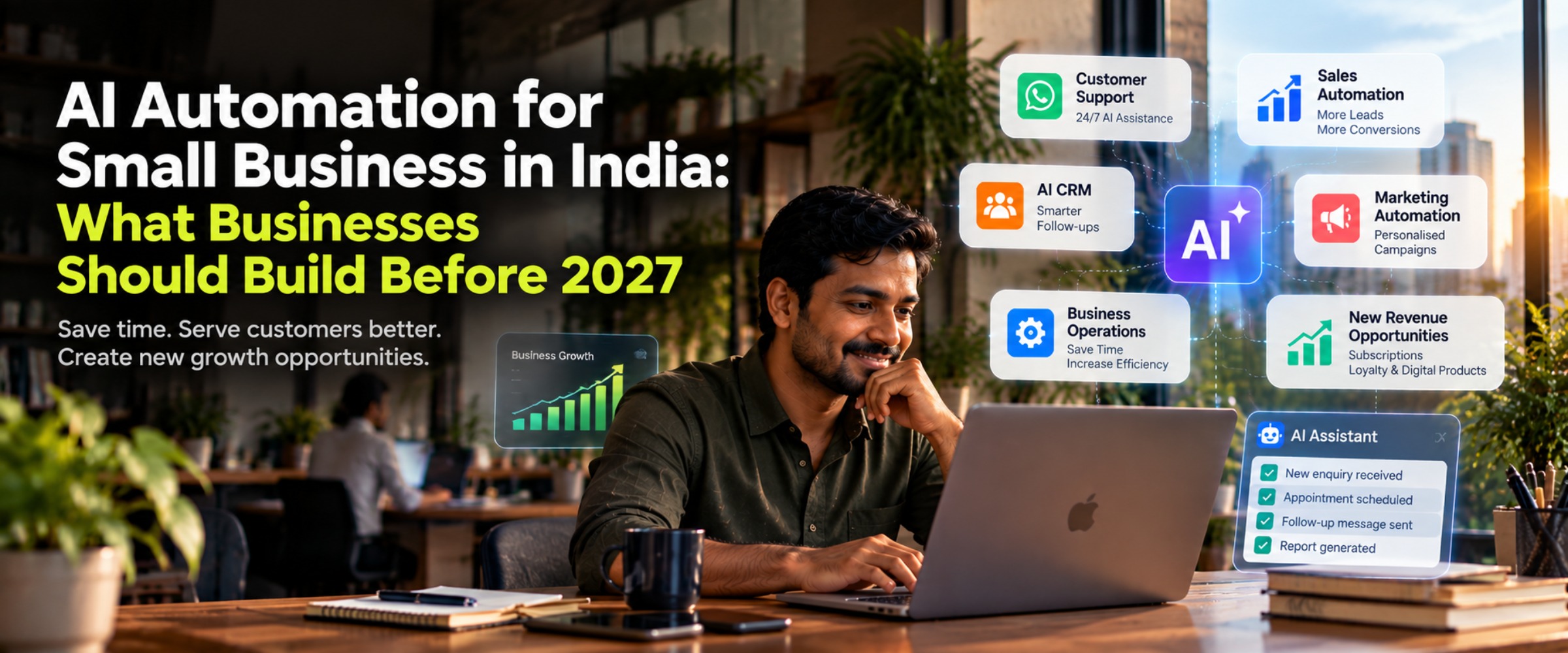
Artificial intelligence is moving beyond chatbots and content generation. For Indian businesses, the next opportunity is using AI to automate customer communication, sales follow-ups, lead management, marketing, operations, reporting and everyday decision-making.
This creates a major opportunity for small and medium businesses. A company does not need to become an AI company to benefit from AI. Its existing website, CRM, mobile app, WhatsApp communication, sales process or internal operations can become AI-powered.
India's mobile ecosystem is also moving toward deeper monetisation. Sensor Tower reported that India's in-app purchase revenue increased 34% year over year in H1 2026, while app downloads increased 3%. The shift suggests that engagement, retention and monetisation are becoming increasingly important alongside user acquisition.
At the same time, the Government of India is actively promoting AI adoption among MSMEs through the IndiaAI Mission, which has an approved outlay of ₹10,371.92 crore.
The question for business owners is no longer simply "Should we use AI?"
The more important question is:
"Where can AI create a new business advantage inside our existing business?"
Table of Contents
- Why AI Automation Matters Now
- The Biggest Change Is Not ChatGPT
- What Is an AI Agent?
- AI Customer Support
- AI for Sales and Lead Follow-Up
- AI-Powered CRM
- AI Marketing Automation
- AI for Business Operations
- AI-Powered Business Apps
- Which Businesses Can Use AI?
- How AI Can Create New Revenue
- How to Start AI Automation
- What Businesses Could Look Like in 2027
- Key Takeaways
- Bottom Line
- FAQ
Why AI Automation Matters Now
India already has one of the world's largest digital user ecosystems. Businesses increasingly communicate with customers through websites, mobile applications, WhatsApp, social media, digital payments
The next stage is connecting these systems with intelligence.
Instead of employees manually checking every enquiry, copying information between systems, preparing reports and following up with customers, AI can increasingly become part of these workflows.
For example:
- A customer submits an enquiry.
- AI understands the requirement.
- The lead is automatically added to the CRM.
- The correct employee receives the lead.
- AI prepares a personalised response.
- The customer receives a WhatsApp message.
- Follow-ups are scheduled automatically.
- The sales manager receives a summary.
This is where AI becomes more than a chatbot.
It becomes part of the business workflow.
The Government's IndiaAI Mission specifically includes initiatives around AI application development, future skills, startup financing and safe and trusted AI, with MSME adoption identified as part of the broader objective. Government of India / PIB
The Biggest Change Is Not ChatGPT
When people hear AI, they often think about ChatGPT-style conversations.
But businesses can use AI in much deeper ways.
Imagine a business application where AI can:
- Read incoming enquiries
- Understand customer requirements
- Classify leads
- Recommend products
- Generate quotations
- Schedule appointments
- Answer customer questions
- Summarise calls
- Generate reports
- Predict follow-up requirements
- Assist employees
- Trigger automated workflows
That is a completely different approach to business software.
The application is no longer just a place where employees enter information.
The application can actively help employees perform their work.
What Is an AI Agent?
An AI agent can be thought of as an intelligent software layer that can understand a task, work with business data and perform actions within defined workflows.
For example, consider a real-estate company.
A traditional CRM might store:
- Customer name
- Phone number
- Property preference
- Budget
- Lead status
An AI-enabled CRM could go further.
It could analyse the enquiry, identify the customer's property requirements, recommend matching properties, prepare a response, schedule a follow-up and alert the salesperson when the lead shows strong buying intent.
The CRM becomes an intelligent sales assistant rather than simply a database.
AI Customer Support
Customer support is one of the easiest areas for businesses to explore AI automation.
An AI system can be connected to a company's knowledge base, services, products, policies and frequently asked questions.
Customers could ask:
- "What services do you provide?"
- "How much does this service cost?"
- "Can I book tomorrow?"
- "Where is my order?"
- "Can I change my appointment?"
- "What documents do I need?"
Instead of forcing every customer to wait for an employee, the AI layer can handle suitable conversations and transfer complex cases to the right employee.
This can be integrated into:
- Website
- Mobile app
- CRM
- Customer portal
- Voice systems
AI for Sales and Lead Follow-Up
One of the biggest opportunities for AI automation is sales.
Many businesses receive enquiries through multiple channels:
- Website forms
- Phone calls
- Google Business
- Online marketplaces
An AI-powered system can bring these enquiries into one workflow.
For example:
Enquiry → AI qualification → CRM → Employee assignment → Follow-up → Conversion
AI can also help sales teams prepare responses based on the customer's previous interactions.
This creates an opportunity for businesses to build much more structured sales systems without completely changing their existing operations.
AI-Powered CRM
The traditional CRM records what happened.
An AI CRM can help determine what should happen next.
For example:
- Which leads need follow-up today?
- Which customers have not responded?
- Which leads are becoming inactive?
- Which sales employees need attention?
- Which customers may be ready for another purchase?
- Which enquiries require immediate attention?
This creates a new category of business software where CRM, automation and AI work together.
AI Marketing Automation
AI can also become part of the marketing engine.
A business could connect its customer database with its marketing system and create automated campaigns based on customer behaviour.
For example:
- New customer → Welcome campaign
- Previous customer → Repeat purchase reminder
- Inactive customer → Re-engagement campaign
- High-value customer → Premium offer
- Birthday → Personalised message
- Subscription ending → Renewal reminder
AI can help generate the communication while business rules determine when and where it should be delivered.
This is particularly useful for businesses that already have a large customer base but want stronger digital engagement.
AI for Business Operations
AI does not have to face the customer.
Some of the biggest opportunities can exist inside the company.
Consider a business with multiple employees, branches or delivery teams.
AI can assist with:
- Daily reports
- Employee performance summaries
- Inventory analysis
- Order monitoring
- Task allocation
- Document processing
- Invoice extraction
- Management dashboards
- Operational alerts
Instead of managers spending time searching through dashboards, the system can present the information that requires attention.
AI-Powered Business Apps
This is where the opportunity becomes particularly interesting for existing businesses.
A company that already operates through a traditional business model can build an application around its existing customers and services.
The app could combine:
- Customer accounts
- Bookings
- Payments
- Orders
- Memberships
- Subscriptions
- Loyalty
- Customer support
- AI assistant
- CRM
- Analytics
India's app ecosystem is already moving toward higher-value usage. Sensor Tower reported that non-gaming apps are increasingly contributing to consumer spending, while AI, productivity, finance, shopping and other utility categories continue to shape India's mobile market.
Sensor Tower – State of India Mobile App Market 2026
The opportunity for businesses is therefore not simply to "have an app".
The opportunity is to create a digital layer around the existing business.
Which Businesses Can Use AI?
Almost any business with repetitive communication, customer management or operational workflows can explore AI automation.
Retail
AI can assist with customer recommendations, loyalty, offers, inventory insights and repeat purchases.
Restaurants
AI can support ordering, customer communication, recommendations, loyalty programmes and personalised offers.
Healthcare
AI can assist with appointment workflows, reminders, patient communication and administrative processes, subject to appropriate privacy and professional safeguards.
Real Estate
AI can qualify property enquiries, recommend listings, automate follow-ups and support sales teams.
Education
AI can support student communication, course discovery, reminders, learning assistance and administrative workflows.
Home Services
AI can help manage bookings, customer communication, worker allocation, service recommendations and repeat-service reminders.
Manufacturing and Distribution
AI can support quotations, order processing, inventory information, documentation and management reporting.
Professional Services
Law firms, consultants, agencies, accountants and other professional businesses can explore AI for enquiry management, documentation, scheduling and customer communication.
How AI Can Create New Revenue
AI is not only about reducing manual work.
It can also support new business models.
1. Subscriptions
A business can introduce premium memberships, service subscriptions or recurring digital services.
2. Personalised Offers
Customer behaviour can be used to create more relevant offers and improve repeat engagement.
3. Premium Services
An AI-powered application can create new service packages that were previously difficult to deliver manually.
4. Digital Products
Existing business expertise can potentially become digital tools, reports, calculators, assistants or subscription products.
5. Marketplace Models
Businesses can connect customers with suppliers, professionals, service providers or partners and create transaction-based revenue models.
The important idea is that AI can become part of the product itself rather than simply being an internal tool.
How to Start AI Automation
A business does not need to automate everything at once.
A practical roadmap can start with one high-value workflow.
Step 1: Identify Repetitive Work
List tasks employees perform every day.
Step 2: Identify Customer Friction
Look at where customers repeatedly ask questions, wait for responses or require manual assistance.
Step 3: Identify Revenue Opportunities
Look for opportunities around subscriptions, repeat purchases, memberships, premium services and digital products.
Step 4: Connect Existing Systems
Bring CRM, website, WhatsApp, payments, applications and internal systems into a connected technology architecture.
Step 5: Add AI
Use AI where it creates genuine business value rather than adding AI simply because it is fashionable.
Step 6: Measure the Business Impact
Track customer engagement, response time, lead movement, repeat purchases, employee productivity and other business metrics relevant to the workflow.
What Could Businesses Look Like in 2027?
The business of 2027 may look very different from the traditional software model.
Instead of:
Customer → Employee → Software
we may increasingly see:
Customer → AI → Business System → Employee
The employee remains important, but the software layer becomes much more intelligent.
A customer could interact with a business through an app or WhatsApp, receive an immediate response, complete a booking or purchase, receive personalised recommendations and continue the relationship through automated engagement.
Meanwhile, the business owner could open one dashboard and ask:
"What happened in my business today?"
The system could summarise sales, leads, customers, operations and important actions instead of requiring the owner to manually inspect multiple reports.
That is the bigger opportunity behind AI automation.
Key Takeaways
- AI is moving beyond simple chatbots.
- AI agents can become part of business workflows.
- CRM systems can become more intelligent and action-oriented.
- Customer support can be automated across multiple channels.
- Sales teams can use AI for lead qualification and follow-up.
- Existing businesses can add AI without changing their entire business model.
- Mobile apps can become intelligent digital platforms rather than simple service interfaces.
- Subscriptions, memberships and personalised services can create new digital revenue opportunities.
- The most valuable AI strategy starts with the business problem, not the technology.
Bottom Line
AI is creating a new opportunity for Indian businesses.
The biggest opportunity may not belong only to companies building the next large AI platform. It may also belong to traditional businesses that understand how to use AI to make their existing business more connected, intelligent and scalable.
A restaurant can become an AI-enabled restaurant.
A real-estate company can build an AI-powered sales platform.
A retailer can create an intelligent customer app.
A service company can automate bookings, communication and repeat business.
A professional company can turn its expertise into a digital product.
The future opportunity is not simply building an AI application. It is discovering where AI can create a completely new digital layer around an existing business.
For Indian business owners, 2027 could be the year when AI moves from something they hear about to something their customers and employees actually use every day.
Frequently Asked Questions
What is AI automation for small businesses?
AI automation uses artificial intelligence within business workflows such as customer support, sales, CRM, marketing, reporting, operations and customer engagement.
Can a small business build an AI-powered app?
Yes. An AI-powered application can be designed around the specific requirements of a business instead of trying to build a large general-purpose AI platform.
Can AI be connected to an existing CRM?
Yes. AI can be integrated with CRM systems to assist with lead qualification, summaries, recommendations, follow-ups and workflow automation.
Can AI automate WhatsApp customer communication?
AI can be integrated into approved WhatsApp Business workflows to assist with customer conversations, FAQs, lead qualification, notifications and support processes.
Which businesses should consider AI automation?
Retailers, restaurants, real-estate companies, healthcare businesses, educational organisations, home-service companies, manufacturers, distributors and professional-service businesses can all identify potential AI automation opportunities.
Does an AI project always require a mobile app?
No. Depending on the business, the best solution could be a website, CRM, WhatsApp automation, internal dashboard, mobile application, API integration or a combination of these systems.
How should a business decide what AI to build?
The starting point should be the business workflow. Identify repetit