
Brief Summary
For years, a mobile app was often considered something only large companies needed.
That thinking is changing.
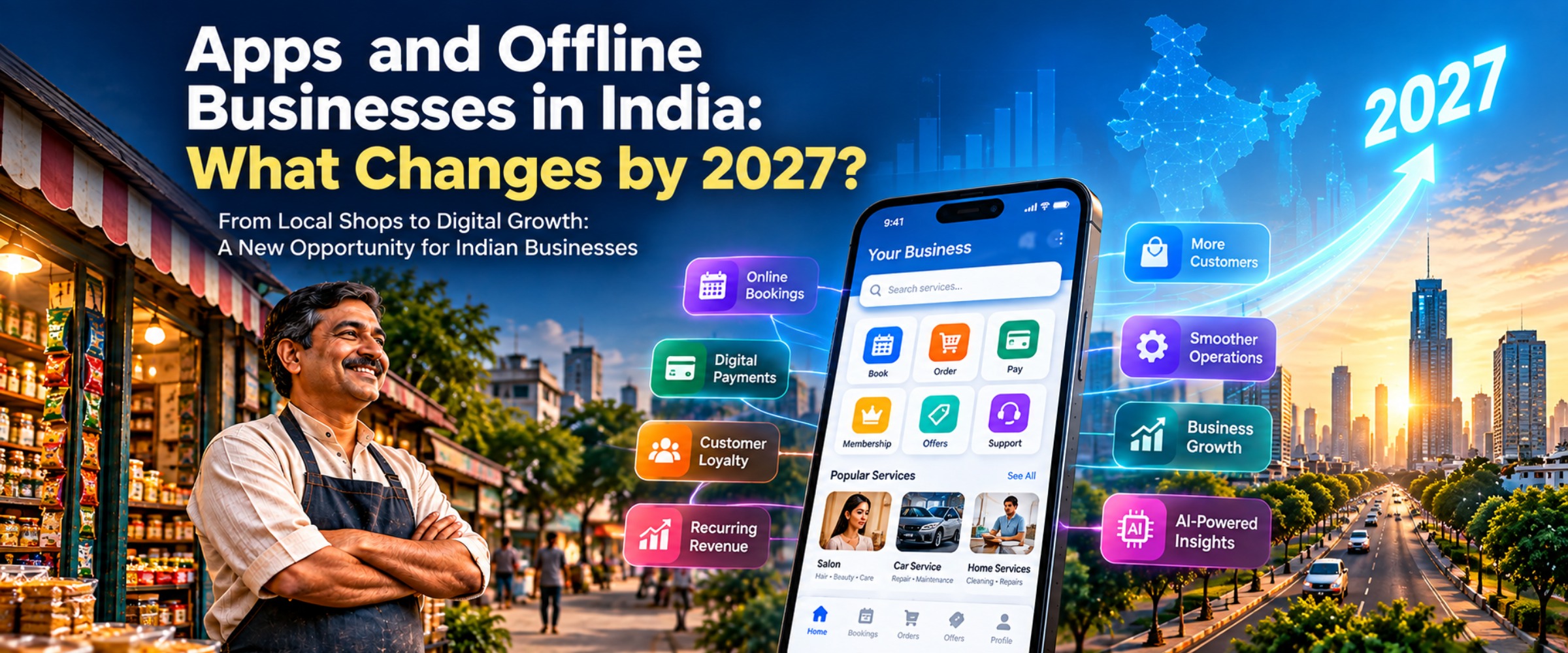
By 2027, the bigger opportunity for Indian offline businesses may not be simply having an app. It will be using technology to create a stronger connection between the physical business and the digital customer.
A salon can allow customers to book appointments, purchase memberships and receive personalised offers. A garage can maintain digital vehicle histories and automatically remind customers about servicing. A clinic can manage appointments and follow-ups. A restaurant can create its own ordering and loyalty channel. A local service company can manage bookings, workers, payments and recurring customers through one digital system.
The physical business does not disappear.
The customer relationship becomes digital.
This article looks at what could change for offline businesses in India by 2027, which businesses can benefit from apps, how apps can create new revenue opportunities, how AI and automation fit into the picture, what a modern business app should contain and how business owners can approach digitalisation strategically.
Table of Contents
- Why 2027 Could Be an Important Year for Offline Businesses
- India Already Has the Digital Foundation
- The Real Change Is Not the App
- The Customer Journey Is Becoming Digital
- Your App Can Become Your Second Storefront
- From Local Visibility to Digital Discovery
- Bookings and Appointments
- Payments Become Connected to the Business
- Turning One-Time Customers Into Repeat Customers
- The Subscription Opportunity for Offline Businesses
- Your Customer Data Becomes a Business Asset
- Apps Can Become Business Automation Engines
- Adding AI to the Business App
- Which Offline Businesses Can Benefit?
- How Can an App Create More Revenue?
- A Practical Business Scenario
- What Kind of App Does a Business Actually Need?
- Features a Modern Business App Can Include
- How Should a Business Think About App Investment?
- What Businesses Should Avoid
- A Practical Roadmap to Digitalise an Offline Business
- What Could the Offline Business Look Like in 2027?
- When Should You Speak to a Technology Consultant?
- Key Takeaways
- Bottom Line
- Frequently Asked Questions
Why 2027 Could Be an Important Year for Offline Businesses
India's digital ecosystem has reached a point where digital tools are no longer limited to technology companies or large enterprises.
Consumers increasingly use smartphones for discovery, communication, payments, entertainment, shopping and everyday services.
According to Reuters, India had approximately 1.02 billion internet users and around 750 million smartphones as of September 2025. India was also the world's second-largest smartphone market at that time. Reuters
This creates a fundamental opportunity for offline businesses.
The customer may still visit the physical business, but many of the interactions before and after that visit can happen digitally.
At the same time, research from ICRIER, based on a survey of 2,365 MSMEs across 12 states and more than 20 clusters, found that digitalisation is becoming a strategic business choice and that firms integrated with e-commerce platforms have experienced stronger growth opportunities.
That makes the next question much more interesting:
What happens when this digital behaviour moves deeper into traditional offline businesses?
India Already Has the Digital Foundation
Businesses do not have to build India's digital infrastructure from scratch.
They can build on top of systems that already exist.
Digital payments, smartphones, internet connectivity, online commerce, cloud software, messaging platforms and public digital infrastructure have created an environment where even relatively small businesses can participate in digital commerce.
The Government reported that, as of 31 December 2025, approximately 206,000 merchants had completed at least one transaction on the ONDC Network and around 600,000 service providers had made their services available on the network. Press Information Bureau
India's digital economy is also developing at different speeds across states. ICRIER's 2025 State of India's Digital Economy report places states into different levels of digital development, showing that digital adoption is progressing across the country but not uniformly. ICRIER
This matters for offline businesses because digitalisation does not have to happen in exactly the same way everywhere.
A business can start with the customer problem it understands best and gradually build its digital layer.
The Real Change Is Not the App
This is perhaps the most important point in the entire discussion.
An app by itself does not transform a business.
The transformation happens when the app changes how the business interacts with customers or operates internally.
For example:
| Traditional Process | Digital Opportunity |
|---|---|
| Customer calls to book | Instant online booking |
| Staff manually confirms | Automated confirmation |
| Customer forgets appointment | Automated reminder |
| Payment at counter | Digital payment |
| Customer leaves after purchase | Digital follow-up |
| No structured customer history | Customer profile and history |
| Offers sent to everyone | Personalised offers |
| Manual renewal calls | Automated renewal reminders |
The app is therefore only the visible part of a much larger system.
Behind it can be a combination of CRM + payments + automation + analytics + AI + business operations.
The Customer Journey Is Becoming Digital
Think about a customer visiting a traditional business.
Traditional Journey
Customer discovers business → visits → purchases → pays → leaves.
Connected Digital Journey
Customer discovers business → opens digital profile → checks services → books → receives reminder → pays → receives service → provides feedback → receives personalised offer → returns.
The physical service remains.
But the number of digital interactions around that service increases significantly.
That gives the business more opportunities to build trust, convenience and repeat business.
Your App Can Become Your Second Storefront
A physical shop has a location.
A digital business can have a second location inside the customer's phone.
Instead of waiting for customers to physically visit, a business can provide access to its products and services through an app.
A customer could open the application at any time and:
- View products
- Check services
- See pricing
- Check availability
- Book an appointment
- Make a payment
- Purchase a membership
- View previous transactions
- Contact the business
- Receive personalised offers
The business remains physical.
The relationship becomes accessible digitally at any time.
From Local Visibility to Digital Discovery
Location will continue to matter.
But it is no longer the only way a customer can discover a local business.
A customer can now find a business through:
- Google Search
- Google Maps
- YouTube
- Marketplaces
- Business websites
- Mobile applications
- Recommendations
This creates a new form of competition.
Two businesses can be located within the same neighbourhood, but the business with stronger digital visibility may have more opportunities to reach customers before they physically walk into either store.
That does not mean every business needs a large advertising budget.
It means that the digital presence surrounding the physical business increasingly becomes part of the customer acquisition strategy.
Bookings and Appointments
Businesses that depend on appointments can gain significant value from digital booking.
Consider a salon.
A customer wants an appointment.
Instead of calling:
Customer → Receptionist → Availability check → Confirmation
The customer can:
App → Service → Professional → Date → Time → Payment → Confirmation
The business also gains visibility into:
- Peak booking times
- Staff utilisation
- Popular services
- Repeat customers
- Cancellations
- Customer spending
The same concept can apply to clinics, gyms, consultants, repair businesses, tutors, beauty services, automotive workshops and many other appointment-based businesses.
Payments Become Connected to the Business
Digital payment adoption has already changed how Indian consumers transact.
But the next opportunity is connecting payments to the rest of the business journey.
For example:
Booking → Payment → Invoice → Customer Profile → Loyalty → Future Reminder
Instead of payment being the final step, it becomes one part of a connected customer record.
This can help businesses understand:
- Who purchased
- What they purchased
- How often they purchase
- How much they spend
- When they may return
That information can then support future customer engagement.
Turning One-Time Customers Into Repeat Customers
For many offline businesses, growth does not always require finding completely new customers.
There can also be significant value in increasing the relationship with existing customers.
An app can help create that relationship through:
- Personalised notifications
- Service reminders
- Reorder reminders
- Loyalty points
- Memberships
- Referral programmes
- Exclusive offers
- Digital receipts
- Customer history
Imagine a garage that knows a customer's vehicle service history.
Instead of waiting for the customer to remember the next service, the business can automatically communicate when maintenance may be due.
Imagine a salon that knows when a customer's preferred service is normally due.
Imagine a laundry business that offers a monthly package instead of waiting for individual orders.
These are not simply app features.
They are new ways of managing customer relationships.
The Subscription Opportunity for Offline Businesses
Subscriptions can be particularly interesting because they can change the revenue model of a traditional business.
Instead of:
Customer → One purchase → Relationship ends
The model can become:
Customer → Membership → Recurring payment → Repeated service → Long-term relationship
Consider some examples.
| Business | Possible Subscription |
|---|---|
| Salon | Monthly beauty membership |
| Gym | Monthly fitness membership |
| Laundry | Monthly laundry package |
| Car Service | Annual maintenance package |
| Home Maintenance | Recurring maintenance plan |
| Pet Care | Monthly care plan |
| Education | Monthly learning membership |
The app can become the infrastructure that manages these subscriptions.
Your Customer Data Becomes a Business Asset
One of the biggest differences between an offline-only business and a digitally connected business is the amount of structured customer information available to the business.
A digital customer profile can include:
- Purchase history
- Booking history
- Service preferences
- Membership status
- Last purchase
- Average spending
- Communication history
- Feedback
This allows the business to move from broad communication towards more relevant customer engagement.
Instead of sending one message to every customer, a business can create different customer segments and communicate based on their actual relationship with the business.
Apps Can Become Business Automation
The next step is connecting the application to internal workflows.
For example:
Customer books a service
↓
System checks availability
↓
Staff member is assigned
↓
Customer receives confirmation
↓
Payment is recorded
↓
Invoice is generated
↓
Customer receives service
↓
Feedback request is sent
↓
Future reminder is scheduled
This creates an automated business workflow around a single customer action.
That is where the value of a business application can expand significantly.
Adding AI to the Business App
Once a business has structured digital data, AI can add another layer of intelligence.
For example, AI could help the business:
- Answer common customer questions
- Recommend services
- Identify inactive customers
- Generate personalised messages
- Assist sales teams
- Analyse customer behaviour
- Summarise business performance
- Forecast demand
- Assist with quotations
The progression can therefore look like:
Mobile App → Customer Data → Automation → AI → Business Intelligence
This is why the app itself should not be considered the final product.
It can become the foundation for a much larger digital business system.
Which Offline Businesses Can Benefit?
Salons and Beauty Businesses
Appointments, memberships, loyalty, staff scheduling, offers and product sales can all be connected.
Clinics
Appointments, reminders, follow-ups, reports and customer communication can become more structured.
Gyms and Fitness Centres
Memberships, renewals, class schedules, trainer appointments and engagement can be managed digitally.
Garages and Automotive Businesses
Vehicle history, service reminders, bookings, invoices and customer communication can become part of a digital relationship.
Restaurants
Direct ordering, reservations, loyalty, memberships and customer engagement can create a direct digital channel.
Education and Training Businesses
Admissions, payments, attendance, communication, course access and progress tracking can be connected.
Home-Service Businesses
Bookings, worker assignment, payments, service history and recurring plans can be managed through one platform.
Retail Businesses
Product discovery, loyalty, direct ordering, repeat purchases and customer communication can extend beyond the physical store.
Professional Services
Consultants, agencies, accountants, legal professionals and other service providers can use digital platforms for appointments, document exchange, payments and client communication.
How Can an App Create More Revenue?
An app does not automatically generate revenue.
Its potential comes from the business opportunities it enables.
1. More Customer Touchpoints
Customers can interact with the business before, during and after the physical transaction.
2. More Repeat Purchases
Reminders, loyalty and personalised communication can encourage customers to return.
3. Higher Customer Value
Additional products, services and memberships can increase the value of an existing customer relationship.
4. Recurring Revenue
Subscriptions and memberships can create predictable customer relationships.
5. Direct Customer Relationships
A business can build a direct digital channel instead of depending entirely on third-party platforms.
6. Operational Efficiency
Automation can reduce repetitive manual work and allow employees to focus on higher-value activities.
7. New Digital Products
In some industries, an established offline business can eventually turn its internal technology into a platform or marketplace.
The opportunity therefore goes beyond simply increasing sales.
It can change the economics and structure of the business itself.
A Practical Business Scenario
Consider a hypothetical local service business generating ₹1 crore in annual revenue.
It already has:
- A strong local customer base
- Repeat customers
- Multiple services
- Staff
- Physical operations
Now imagine introducing a digital customer platform.
The business could gradually add:
- Online booking
- Digital payments
- Customer profiles
- Loyalty programme
- Memberships
- Automated reminders
- Referral programme
- Personalised offers
Suppose the business eventually creates an additional ₹10 lakh of annual revenue through increased repeat purchases, memberships and additional digital sales.
That would represent a 10% increase over its original ₹1 crore revenue.
This is an illustrative scenario, not a forecast.
The important point is that the business did not necessarily need another physical location to create the additional opportunity.
It used technology to increase the value of its existing customer base.
What Kind of App Does a Business Actually Need?
There is no single type of business app.
Customer App
Useful when customers regularly need to browse, book, order, pay or manage services.
Business Management App
Useful when the main requirement is internal operations such as staff, inventory, orders, tasks and reporting.
Customer + Business Platform
Useful when both sides need to interact digitally.
Marketplace
Useful when multiple businesses, service providers or sellers need to interact with customers through one platform.
Subscription Platform
Useful when recurring memberships or services are central to the business model.
AI-Powered Business Platform
Useful when the business has enough structured data and repeatable workflows to benefit from intelligent automation.
The right solution depends on the business model rather than the popularity of a particular technology.
Features a Modern Business App Can Include
Customer Side
- Registration and login
- Digital profile
- Products and services
- Booking
- Ordering
- Payments
- Memberships
- Loyalty
- Notifications
- Support
- Reviews
Business Side
- Customer management
- Order management
- Booking management
- Staff management
- Inventory
- Payments
- Membership management
- Offers
- Reports
- Analytics
Automation
- WhatsApp communication
- SMS
- Booking reminders
- Payment reminders
- Renewal reminders
- Customer follow-ups
AI
- AI customer support
- Lead qualification
- Recommendations
- Business insights
- Demand analysis
- Automated content
How Should a Business Think About App Investment?
Instead of looking at an app as a technology expense, business owners can look at it as a potential growth infrastructure.
The discussion should start with questions such as:
- How many customers do we currently serve?
- How often do they return?
- How much does an average customer spend?
- Where do we lose enquiries?
- How many customers need follow-up?
- Could we introduce memberships?
- Could we introduce subscriptions?
- Which manual processes consume the most employee time?
- Could customers book or purchase without calling?
- Could we create a direct digital relationship with our customers?
Once these questions are answered, the technology roadmap becomes much clearer.
A business may discover that it needs a mobile application.
Another may need a CRM and automation platform first.
Another may need an e-commerce layer.
Another may have an opportunity to create an entirely new digital business model.
The objective is not to build technology for the sake of technology. The objective is to build the digital infrastructure that can help the business grow.
What Businesses Should Avoid
Digitalisation works best when technology follows strategy.
Businesses can improve their chances of success by avoiding a few common mistakes.
Building Without a Clear Business Goal
Start with the opportunity: customer acquisition, repeat business, bookings, subscriptions, operational efficiency or another measurable objective.
Trying to Build Everything at Once
A focused first version can prove the business model and create a foundation for future expansion.
Ignoring the Business Dashboard
The customer experience and internal business operation should be designed together.
Forgetting Customer Adoption
The app should provide customers with a clear reason to use it — convenience, rewards, faster service, exclusive benefits, subscriptions or better access.
Ignoring Future Scalability
If the business grows to multiple branches, thousands of customers or several service categories, the technology should have a path to scale with it.
Building Only a Mobile App
A strong digital ecosystem may also require a website, admin dashboard, CRM, payment integration, automation and analytics.
A Practical Roadmap to Digitalise an Offline Business
Phase 1: Understand the Business
Map the existing customer journey and internal operations.
Phase 2: Identify the Biggest Opportunity
Find where technology can create the greatest improvement — customer acquisition, retention, bookings, subscriptions, payments or operations.
Phase 3: Design the Digital Customer Journey
Decide exactly what customers should be able to do digitally.
Phase 4: Build the Core Platform
Develop the customer application, website or business dashboard required for the first stage.
Phase 5: Connect Payments and Communication
Integrate payments, notifications, WhatsApp, email and other required services.
Phase 6: Introduce Automation
Automate repetitive customer and internal processes.
Phase 7: Introduce Loyalty and Recurring Revenue
Where appropriate, add memberships, subscriptions and customer retention programmes.
Phase 8: Add AI
Use customer and operational data to introduce intelligent recommendations, support and business insights.
Phase 9: Scale
Once the digital system proves its value, expand into new branches, services, customer segments or geographies.
What Could the Offline Business Look Like in 2027?
The most interesting possibility is not that offline businesses disappear.
It is that the boundary between online and offline becomes much less important.
A salon will still have chairs, professionals and customers.
A restaurant will still have tables and a kitchen.
A garage will still have mechanics and vehicles.
A clinic will still have doctors and patients.
A retailer will still have a physical store.
But the customer relationship surrounding those physical operations can become increasingly digital.
A customer may discover the business online.
Book through an app.
Pay digitally.
Receive the service physically.
Get a digital receipt.
Receive a personalised follow-up.
Join a membership.
Receive a reminder.
Return again.
That is the real transformation.
The physical business remains the destination. The digital platform becomes the relationship layer.
When Should You Speak to a Technology Consultant?
You do not need to wait until your business is large before exploring digitalisation.
A consultation can be useful when you are asking questions such as:
- Can my existing business become a digital platform?
- Should I build an app or a web platform?
- Can I introduce subscriptions?
- Can I automate my customer follow-ups?
- Can I create my own customer loyalty system?
- Can I reduce manual work through software?
- Can I connect my existing business systems?
- Can AI improve my operations?
- Can my business expand beyond one physical location?
The answers will be different for every business.
That is why the right starting point is not a technology quotation.
It is a business and technology discussion.
From there, a consultant can help map:
Current Business → Digital Opportunity → Product Strategy → Features → Technology → Implementation → Growth Roadmap
Key Takeaways
- Apps can become much more than digital versions of physical businesses.
- The biggest opportunity is connecting physical operations with digital customer relationships.
- India already has a strong foundation of smartphones, internet access, digital payments and digital commerce infrastructure.
- Apps can help businesses improve discovery, booking, payments, customer engagement and repeat business.
- Memberships and subscriptions can create new recurring-revenue opportunities.
- Customer data can help businesses build stronger and more personalised relationships.
- Automation can connect customer actions with internal business processes.
- AI can add intelligence to an existing digital business system.
- Not every business needs a mobile app; the right technology depends on the business model and customer journey.
- The best digitalisation strategies start with a business opportunity and then select the appropriate technology.
- Businesses can start small and expand their digital ecosystem over time.
Bottom Line
By 2027, the biggest change for India's offline businesses may not be how many apps are available in the App Store.
The bigger change could be how deeply technology becomes connected to everyday business operations.
A physical business can remain completely physical while building a powerful digital relationship with its customers.
Customers can discover the business digitally, book digitally, pay digitally, receive personalised communication digitally and return because the digital experience makes the physical business easier to use.
That creates a new opportunity for Indian business owners.
Your business may already have the most important ingredients:
- Customers
- Products
- Services
- Market knowledge
- Physical operations
- Existing demand
The next step may be building the digital layer around them.
Don't build an app simply because you need an app. Build the digital system that can help your existing business reach more customers, serve them better and create stronger long-term relationships.
Frequently Asked Questions
Will every offline business need an app by 2027?
No. The right technology depends on the business model and customer journey. Some businesses may benefit from a mobile app, while others may gain more from a website, CRM, automation, e-commerce system or internal business software.
How can an app help an offline business?
An app can help customers discover services, make bookings, place orders, pay, access memberships, receive personalised communication and stay connected with the business.
Can an app help increase repeat customers?
Yes. Features such as loyalty programmes, reminders, personalised offers, memberships and subscriptions can create more opportunities for customers to return.
Can offline businesses create subscription models?
Yes. Depending on the industry, businesses can explore recurring models for services such as beauty, fitness, maintenance, laundry, education, home services, automotive care and other repeat-use categories.
Does a business need its own app if customers already use WhatsApp?
Not necessarily. WhatsApp can be an effective digital channel for many businesses. However, a dedicated application can provide deeper functionality such as memberships, loyalty, customer history, booking systems, personalised experiences and integrated business workflows.
What is the difference between an app and digital transformation?
An app is one component of digital transformation. Digital transformation can include mobile applications, websites, CRM, payments, automation, analytics, AI and internal business systems working together.
How can AI improve a business app?
AI can assist with customer support, recommendations, lead qualification, business insights, demand analysis, personalised communication and workflow automation.
What should a business digitise first?
Start with the area where technology can create the clearest business opportunity. This could be bookings, customer retention, lead management, subscriptions, payments, inventory, delivery or internal operations.
Can a small business start with a limited digital system?
Yes. A business can start with one core workflow and gradually expand into a broader digital ecosystem as customer adoption and business requirements grow.
Is building an app a good investment for every business?
The answer depends on the business. The most useful approach is to first understand the customer journey, revenue model and operational requirements and then determine whether an app is the right technology solution.
What should a business owner do before developing an app?
Map the current business process, identify the biggest customer or operational opportunity, define the desired digital customer journey and prepare a practical product roadmap. This helps ensure that technology is designed around the business rather than the other way around.
How can a business identify the right digital strategy?
A business can begin with a consultation that examines its customers, services, revenue model, operations and growth plans. From there, the appropriate combination of app, website, CRM, automation, payments and AI can be identified.
The opportunity is not simply to put your business on a phone. It is to make your business more connected, accessible and scalable.