
Brief Summary
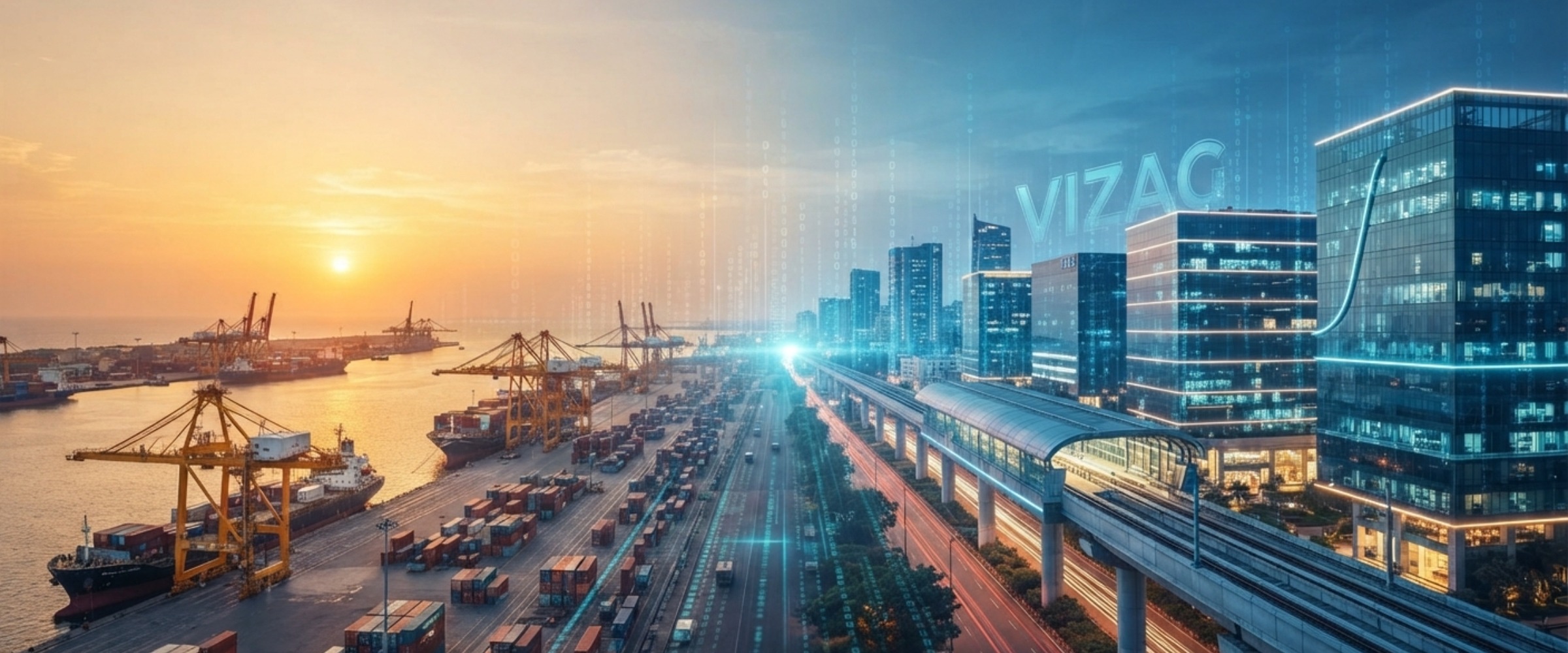
Visakhapatnam, traditionally celebrated as India's premier heavy industrial and maritime port hub, is undergoing a profound structural evolution. The city's economic engine is shifting from heavy capital expenditure engineering toward high-velocity digital intelligence and IT exports.
That creates a major digital opportunity.
Global technology enterprises, tier-1 software exporters, and product startups regularly need scalable infrastructure, specialized tech talent, and cloud-native frameworks to support their operations. At the same time, a vast pool of local engineering graduates and domain experts are looking for high-value careers, modern digital workspace environments, and global opportunities without migrating to traditional tech hubs.
The missing layer is a unified, software-driven infrastructure layer that connects this emerging tech park ecosystem with modern global enterprise demands.
This article examines the size of the opportunity, the existing problems, possible business models, digital infrastructure economics, technology requirements, and how Vizag's emerging tech ecosystem could potentially drive a ₹10,000+ crore software export economy at scale.
Table of Contents
- How Large Is Vizag's Digital Transition?
- Where Is the Real Digital Opportunity?
- The Problem Tech Enterprises Face Today
- Why the Existing Tech Hub Ecosystem Was Segmented
- What a Software Upgrade Could Change
- The Managed Tech Park Business Model
- How Vizag's Software Economy Could Reach ₹10,000+ Crore
- The Bigger Opportunity: B2B Enterprise Integration
- Subscription and Recurring Cloud Infrastructure Opportunities
- Understanding the Unit Economics
- What Existing Tech Hubs Tell Us
- Industries That Could Use the Platform
- How to Build the Market
- Key Challenges
- The Future of Vizag's Tech Landscape
- Key Takeaways
- Bottom Line
- Frequently Asked Questions
How Large Is Vizag's Digital Transition?
The scale of Visakhapatnam's industrial footprint has always been difficult to ignore.
According to economic data published by regional commerce divisions, Vizag anchors a massive industrial belt historically driving hundreds of thousands of jobs across shipping, steel production, petroleum refining, and heavy metallurgy.
That means roughly 80% of the city's historical GDP was tied strictly to asset-heavy industrial sectors.
The important point, however, is that raw tonnage and industrial output should not be treated as the only growth metrics for the modern economy.
The actual digital opportunity is the portion of this industrial economy that can be optimized around software ecosystems, specialized IT parks, cloud frameworks, data centers, and digital services.
Recent infrastructure analyses indicate that over 1,00,000 technology students graduate annually from surrounding regional academic corridors.
That creates a particularly interesting opportunity for modern tech parks and software networks serving global enterprises looking for cost-effective talent pools.
The state's dedicated IT initiatives and data center policies also demonstrate the scale of the effort to digitally position the city, with multi-million dollar investments flowing directly into the Rushikonda IT hills and Millennium Towers zones.
Where Is the Real Digital Opportunity?
The opportunity is not simply to build another cluster of commercial office complexes.
A traditional business park primarily provides brick-and-mortar office space for corporate tenants.
The modern software ecosystem works differently.
An enterprise today may need:
- High-throughput data center infrastructure with low-latency global fiber links
- Custom-configured hybrid workspaces for agile software sprint cycles
- Localized AI and machine learning engineering talent pipelines
- Cloud-native deployment capabilities tailored for heavy industrial automation
- Integrated digital workflows connecting maritime ports with predictive supply chains
- Scalable tech spaces for rapidly growing product engineering teams
- IoT network layers managing smart urban grid metrics
- Specialized cyber security frameworks protecting heavy enterprise operations
These requirements were previously solved by setting up distributed teams across tier-1 technology capitals, causing severe real estate and cost inflation.
That is where the digital opportunity exists.
A unified software upgrade can turn Vizag's maritime advantage into a structured digital springboard.
The Problem Tech Enterprises Face Today
For many companies, selecting a tier-2 city for expansion is not necessarily a capital problem.
The bigger problem is finding plug-and-play digital infrastructure aligned with reliable talent pipelines.
Businesses can face challenges such as:
- Unoptimized technical real estate layers
- Unpredictable network infrastructure redundancies
- Talent leakage to tier-1 technology centers
- Complex multi-vendor compliance management loops
- Dependence on outdated connectivity trunks
- Opaque commercial pricing metrics
- Poor baseline facility tech integration
- Difficulty managing remote developer operations
- Data compliance and security friction points
- No centralized regional talent database
These problems become significantly larger when an enterprise scales operations across both maritime logistics and software divisions.
Why the Existing Tech Hub Ecosystem Was Segmented
Vizag's technology footprint has historically grown through disconnected local pockets.
An IT firm could find opportunities through:
- Isolated real estate developer developments
- Fragmented boutique software consultancies
- Basic industrial automation vendor calls
- Scattered local technology associations
- Disconnected software training groups
- Independent commercial properties
- Direct out-of-state customer referrals
This system works at a micro-scale, but it becomes inefficient when hundreds of global entities and tech providers need to collaborate across smart IT parks.
Modern digital infrastructure can introduce cloud-managed spaces, verified skill registries, predictive connectivity management, standardized SLA frameworks, security audits, and enterprise asset management dashboards.
What a Software Upgrade Could Change
Imagine a global technology enterprise opening a deployment dashboard and configuring:
Cloud Zone → Network Bandwidth → Workspace Capacity → Tech Stack Alignment → Compliance Parameters → Development Duration → Operational Budget
The platform could then provision hyper-connected workspaces, align localized tech talent clusters, and initiate robust cloud operations instantly.
The enterprise could select resources, confirm compliance, and manage their remote software delivery cycles through a unified portal.
The local tech talent could access modern workspaces, collaborate on global codebases, and scale within their home state.
This creates a powerful economic engine.
For Tech Enterprises
- Instant infrastructure provisioning
- Predictive uptime management
- Integrated talent pipeline matching
- Dynamic space optimization layers
- Automated regulatory reporting tools
- Unified global compliance tracing
- Real-time network usage insights
- Centralized billing architectures
- Digital facility access protocols
- Historical performance metric logs
For Local Talent
- Global technical profile matching
- Core skill specialization tags
- Preferred digital workspace booking
- Unified knowledge sharing access
- Direct enterprise job streams
- Project milestones management
- Performance rewards logging
- Continuous learning pathways
- Peer architectural reviews
- Verified career trajectory histories
The Managed Tech Park Business Model
One of the interesting aspects of this market is that the platform does not necessarily need to rely solely on traditional real estate leases.
An operator could potentially function with a lean operational cost structure while generating substantial top-line revenue through volume-based technology value-adds.
For example, consider a hypothetical integration structure:
| Revenue Stream | Target Metric | Strategic Approach |
|---|---|---|
| Infrastructure-as-a-Service (IaaS) | 3% – 8% software-managed margin | Integrates premium compute nodes, high-speed trunking, and localized colocation spaces directly into the corporate layout lease. |
| B2B Enterprise SaaS | Tiered monthly system licenses | Unlocks smart parking allocation, predictive resource scaling, biometric access nodes, and unified environmental compliance dashboards. |
| Talent Cloud Layer | Outcome-based placement margin | Monetizes specialized screening systems by connecting verified local engineering talent pipelines directly with hiring corporate entities. |
How Vizag's Software Economy Could Reach ₹10,000+ Crore
Achieving a ₹10,000+ crore annual export value run rate depends entirely on digital scalability and continuous process optimization, rather than relying on massive physical footprints alone. The sheer density of global IT requirements allows the city to transition from low-margin support desks into high-value product engineering hubs.
Consider a practical operational example: If the tech ecosystem provisions 50,000 high-tier software engineering workstations with an average export value generation of ₹20,000 per shift per seat, the total daily transaction volume processed tops ₹100 crore. Operating at high capacity across integrated tech parks pushes annual digital export evaluations past ₹30,000 crore, ensuring that a target of ₹10,000+ crore remains highly attainable within a structured growth cycle.
The Bigger Opportunity: B2B Enterprise Integration
The macro economic opportunity lies in bridging heavy industrial systems with modern cloud infrastructure. The interface where maritime logistics, port optimization software, manufacturing AI, and global technology frameworks meet is where the highest revenue margins are captured.
Subscription and Recurring Cloud Infrastructure Opportunities
By transforming traditional commercial spaces into flexible subscription models, tech park operators protect their revenue from standard real estate market cycles. Corporate clients pay for elastic tech space packages, dynamic network access, and centralized software services on an operational monthly timeline, ensuring high predictability and sticky long-term contract structures.
Understanding the Unit Economics
Maximizing returns per square meter requires shifting focus from raw desk rental pricing to total digital services consumed. By charging for high-tier data pathways, dedicated cloud instances, security auditing suites, and dynamic workplace amenities, the operational yield per workstation scales significantly past conventional commercial limits.
What Existing Tech Hubs Tell Us
Case studies from global tier-2 cities that successfully added deep software layers to existing industrial foundations show a clear blueprint. Early focus on developer comfort, uninterrupted global network nodes, and strict compliance layers always precedes major corporate expansions and sustainable capital inflows.
Industries That Could Use the Platform
The digital addressable market spans multiple sectors driving Vizag's modern business expansion:
- Maritime & Smart Port Logistics: Automated customs software tracking, predictive cargo distribution layers, and sensor-driven freight management.
- FinTech & Corporate Banking Backends: Highly secure regional operation hubs, transaction validation systems, and data compliance facilities.
- Industrial IoT & Energy Systems: Real-time refinery monitoring dashboards, automated metallurgical safety tracing, and predictive grid networks.
- Global Product Engineering: Agile software development hubs, cloud product testing centers, and dedicated AI research labs.
How to Build the Market
Capturing this momentum requires a systematic three-stage launch strategy. First, anchor core infrastructure by establishing high-throughput data backbones across Rushikonda and central zones. Second, roll out deep talent matching networks with regional technical institutes. Third, launch dedicated global corporate landing programs to attract tier-1 enterprises looking for secondary tech nodes.
Key Challenges
The primary structural risks center on maintaining absolute network infrastructure reliability during climate anomalies, preventing localized tech talent migration through continuous upscale enterprise sourcing, and ensuring clear regulatory permissions across mixed-use economic zones.
The Future of Vizag's Tech Landscape
As the line between hardware industries and software management blurs, Visakhapatnam is positioned to become India's prime case study for maritime-to-digital transformation. The integration of next-generation tech parks with historical manufacturing strengths will ensure the city builds a highly resilient, future-proof economic landscape.
Key Takeaways
Vizag's evolution is driven by turning heavy industrial assets into connected tech systems. Real estate models are shifting to agile digital subscriptions, and the city’s economic future relies on capturing high-margin global enterprise IT and software export pipelines.
Bottom Line
The transformation of Visakhapatnam from a traditional maritime shipping port into a leading digital tech destination is an inevitable structural shift. Organizations that move early to deploy plug-and-play digital workspace solutions, modern cloud pathways, and structured engineering networks will lead this coastal economic engine and capture a highly lucrative enterprise market.
Frequently Asked Questions
What zones anchor Vizag's tech growth? The primary IT expansion is focused across the Rushikonda IT hills, the Millennium Towers cluster, and upcoming designated electronic manufacturing and smart city corridors.
How does this shift benefit local heavy industry? Software upgrades introduce machine learning systems to maritime logistics, reducing port turnaround times, improving manufacturing asset tracking, and cutting unplanned operational downtime.