

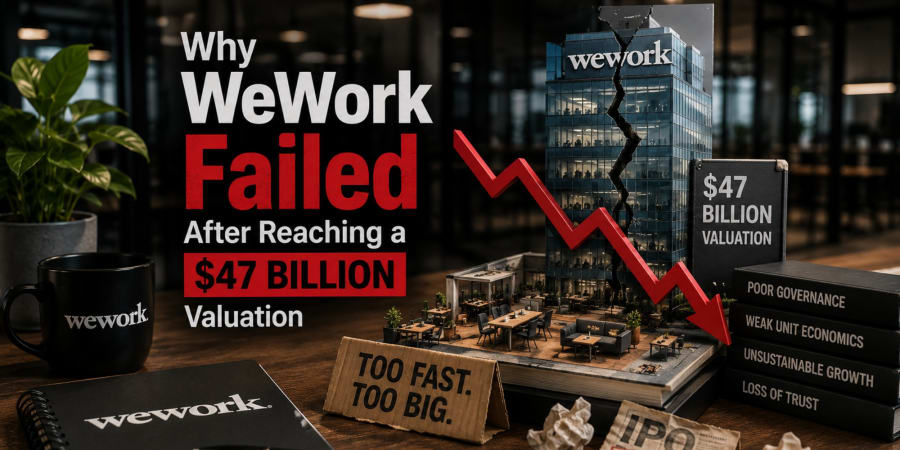
For years, WeWork looked unstoppable. Investors loved it, the media celebrated it, and startups around the world admired its growth. At its peak, WeWork was valued at an astonishing $47 billion. But within a short period, the company became one of the biggest startup collapses in modern business history.
Brief Summary: The Rise and Fall of WeWork
Founded in 2010
WeWork aimed to reinvent office spaces for startups and businesses.
Rapid Global Expansion
The company expanded across hundreds of cities worldwide.
$47 Billion Valuation
Investors poured billions into the company.
Failed IPO Attempt
Public investors questioned the company's financial model.
Massive Collapse
The valuation crashed and the company entered a long struggle for survival.
Table of Contents
- What Was WeWork?
- How WeWork Grew So Fast
- The Biggest Problems Behind the Growth
- Why Investors Lost Confidence
- Lessons Every Startup Founder Should Learn
- Key Takeaways
What Was WeWork?
WeWork offered flexible office spaces for startups, freelancers, and businesses.
The concept was simple.
Rent large office buildings, redesign them into modern workspaces, and lease smaller spaces to businesses.
The idea became extremely popular during the startup boom.
How WeWork Grew So Fast
Several factors helped WeWork grow rapidly:
Strong branding
Modern office design
Community-focused culture
Massive investor funding
Global expansion
For a few years, it seemed like the future of work.
Businesses wanted flexibility and startups loved the environment.
Growth attracts attention. Sustainable growth creates successful businesses.
The Biggest Problems Behind the Growth
1. Expansion Was Too Aggressive
WeWork opened locations worldwide at an incredible pace.
Growth became the priority over profitability.
2. The Business Model Had Risks
WeWork signed long-term leases but rented spaces through shorter-term agreements.
This created financial risk during economic slowdowns.
3. High Operating Costs
Maintaining premium office spaces across the world was expensive.
The company spent heavily while profitability remained elusive.
4. Valuation Outpaced Reality
Many investors valued WeWork as a technology company.
However, critics argued it was fundamentally a real-estate business.
5. Leadership Concerns
Questions about corporate governance and decision-making raised concerns among investors.
The Failed IPO That Changed Everything
When WeWork prepared to go public, investors gained access to detailed financial information.
Many became concerned about:
Losses
Debt
Governance issues
Long-term sustainability
The planned IPO collapsed.
Confidence disappeared rapidly.
The valuation dropped dramatically.
Why Investors Lost Confidence
Investors realized that growth alone was not enough.
Businesses need:
Profitable economics
Operational discipline
Strong leadership
Sustainable expansion
Without these foundations, growth can become dangerous.
Lessons Every Founder Should Learn
1. Growth Cannot Replace Profitability
2. Build Systems Before Scaling
Operations should grow alongside the business.
3. Investor Money Is Not a Business Model
Funding helps growth but cannot replace customer value.
4. Governance Matters
Leadership decisions affect long-term success.
5. Focus on Fundamentals
Customers, cash flow, and profitability remain critical.
Why WeWork Still Matters in 2026
Today many startups are chasing rapid growth, especially in AI and technology sectors.
WeWork remains a reminder that sustainable business fundamentals matter more than headlines.
The startup world continues to learn from its mistakes.
Key Takeaways
WeWork became one of the world's most valuable startups before experiencing a dramatic collapse.
The company expanded aggressively but struggled with profitability and governance.
The failed IPO exposed weaknesses that investors could no longer ignore.
Founders can learn valuable lessons about growth, leadership, and sustainability.
The Bottom Line
WeWork did not fail because it lacked ambition.
It failed because growth moved faster than the business fundamentals supporting it.
For entrepreneurs, this remains one of the most important startup lessons of the modern era.
Frequently Asked Questions
What was WeWork?
WeWork was a flexible office space company serving startups, freelancers, and businesses.
What was WeWork's highest valuation?
The company was valued at approximately $47 billion.
Why did WeWork fail?
Aggressive expansion, governance concerns, profitability challenges, and a failed IPO contributed to its decline.
What is the biggest lesson from WeWork?
Sustainable growth and strong business fundamentals matter more than valuation.