
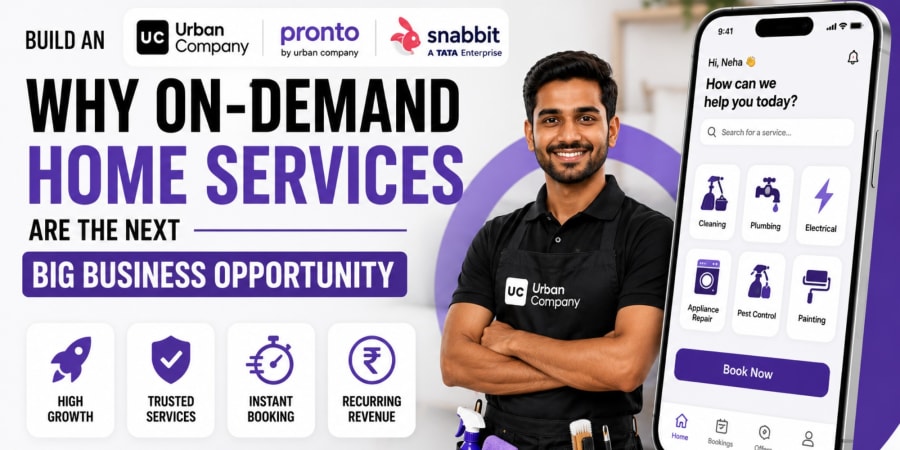
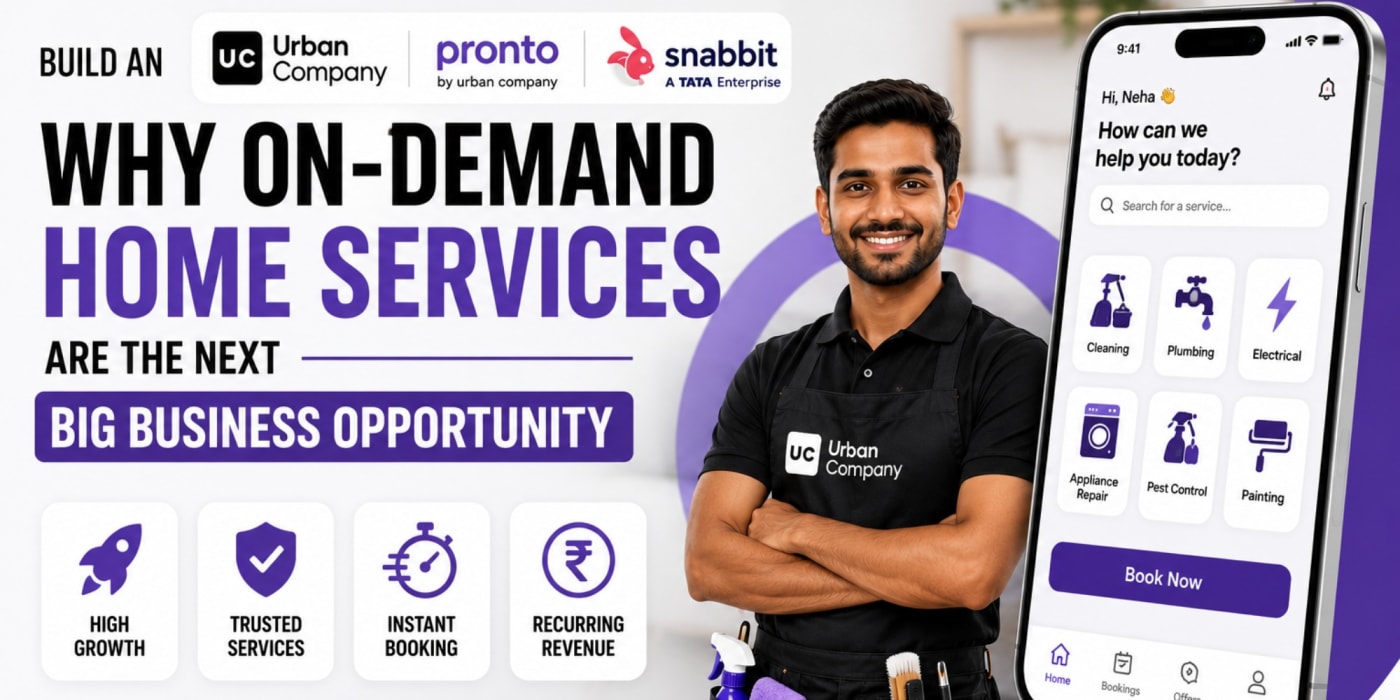
Finding a trusted electrician, plumber, cleaner, carpenter, beautician, or appliance repair technician once required countless phone calls, recommendations from neighbours, and uncertainty about pricing and quality. Today, companies like Urban Company, Pronto, and Snabbit have transformed this experience by making home services as easy as ordering food or booking a cab. With just a few taps, customers can book verified professionals who arrive at their doorstep within minutes or at a scheduled time.
However, despite the rapid growth of these platforms, the market is still far from reaching its full potential. India's home services industry remains highly fragmented, with millions of independent professionals still operating offline. This creates an enormous opportunity for entrepreneurs to build innovative home service platforms that offer better convenience, smarter technology, faster service, recurring subscriptions, and stronger customer experiences.
Table of Contents
- The Growth of India's Home Services Industry
- Why On-Demand Home Services Are Growing Rapidly
- Challenges Existing Platforms Still Face
- The Market Opportunity Goes Beyond Urban Company
- 15 Innovative Features That Can Differentiate Your Platform
- How Can This Business Generate Revenue?
- Technology Powering Modern Home Service Platforms
- Why This Is the Right Time to Build
- Business Lessons From Urban Company, Pronto, and Snabbit
- Future of the Home Services Industry
- Key Takeaways
- The Bottom Line
Brief Summary
India's Home Services Market Is Expanding Rapidly
Urbanization, busy lifestyles, digital adoption, and increasing trust in online platforms are driving consistent growth across the home services industry.
Consumer Expectations Have Changed
People no longer want to spend hours searching for reliable professionals. They expect verified experts, transparent pricing, digital payments, and fast doorstep service.
The Opportunity Is Bigger Than Individual Services
Modern platforms can combine home maintenance, beauty, repairs, healthcare, subscriptions, and recurring household services into one unified ecosystem.
Technology Is Creating Competitive Advantages
Artificial intelligence, GPS tracking, smart scheduling, cloud computing, and digital payments allow startups to deliver better customer experiences while improving operational efficiency.
The Market Is Still Far From Saturation
Although Urban Company, Pronto, and Snabbit have established strong brands, India's enormous and largely unorganized home services sector still provides significant room for innovative entrepreneurs.
The Growth of India's Home Services Industry
India's home services industry has evolved dramatically over the past decade. What was once an unorganized sector dependent on word-of-mouth recommendations has rapidly transformed into a technology-driven marketplace where customers can book skilled professionals within minutes.
Several factors have contributed to this transformation. Rapid urbanization has increased the number of apartment communities and gated societies. Dual-income households have reduced the time available for home maintenance. Smartphones and affordable internet have made digital platforms accessible to millions of users. At the same time, digital payment systems such as UPI have simplified transactions between customers and service professionals.
The rise of the gig economy
Unlike traditional businesses that rely on physical branches, modern home service platforms can expand into multiple cities using technology, standardized operating procedures, and verified service partners. This scalability has made the sector highly attractive to investors and entrepreneurs alike.
The future of home services isn't just about booking professionals online—it's about creating a trusted digital ecosystem that manages every aspect of household maintenance.
Why On-Demand Home Services Are Growing Rapidly
Consumer behavior has changed significantly in recent years. People value convenience more than ever before. Instead of spending an entire day searching for an electrician or negotiating prices with multiple technicians, customers now expect a professional to arrive at their doorstep quickly, complete the job efficiently, and offer transparent pricing.
This demand is particularly strong among working professionals, nuclear families, senior citizens, and young homeowners who prioritize convenience over traditional methods of finding local service providers.
Platforms like Urban Company introduced standardized pricing, verified professionals, digital payments, and customer reviews, helping users build confidence in booking home services online. Meanwhile, newer players such as Pronto and Snabbit are pushing the industry further by focusing on faster service delivery and hyperlocal availability.
Today's customers increasingly expect:
Fast bookings within minutes
Verified professionals
Transparent pricing
Real-time technician tracking
Secure online payments
Professional customer support
Flexible scheduling
Digital invoices
Guaranteed service quality
Easy rebooking
These expectations are transforming home services from an occasional requirement into a regular digital habit.
Challenges Existing Platforms Still Face
Despite the remarkable success of platforms like Urban Company, Pronto, and Snabbit, the home services industry still faces several operational and customer experience challenges. These platforms have undoubtedly transformed how people book household services, but no platform has completely solved every pain point.
Understanding these gaps is important because they represent opportunities for entrepreneurs to build better products instead of simply copying existing business models.
1. Inconsistent Service Quality
Even after professional verification and onboarding, service quality often varies between partners. Two technicians offering the same service may deliver completely different customer experiences, making consistency one of the industry's biggest challenges.
2. Last-Minute Partner Cancellations
Customers often schedule services around their busy routines. When a technician cancels at the last minute, it creates frustration and reduces trust in the platform.
3. Limited Instant Availability
Although many companies advertise quick bookings, immediate availability is still limited in several locations, especially during weekends, holidays, and peak hours.
4. Lack of Long-Term Relationship Management
Most platforms focus on one-time bookings. Customers who find an excellent maid, cleaner, electrician, or beautician often want the same professional every time, but current systems don't always make recurring relationships easy.
5. Emergency Service Limitations
Water leakages, electrical failures, AC breakdowns, and plumbing emergencies require immediate attention. Many platforms still struggle to guarantee professionals within a very short timeframe.
6. Technician Retention
Independent professionals frequently switch between platforms or continue working independently after building their customer base. Maintaining a reliable partner network remains an ongoing operational challenge.
7. High Customer Acquisition Costs
Every booking platform spends heavily on digital marketing, referral programs, and promotional discounts. Long-term profitability depends on improving customer retention rather than constantly acquiring new users.
8. Limited Coverage in Tier-2 and Tier-3 Cities
While metropolitan cities have multiple service providers, many smaller cities still lack reliable digital home service platforms, creating a significant expansion opportunity.
9. Limited Predictive Maintenance
Today's platforms usually react to problems after they occur. Very few help customers prevent issues through scheduled maintenance reminders for appliances, plumbing systems, electrical inspections, or air conditioners.
10. Fragmented Household Management
Families often use different vendors for cleaning, repairs, pest control, appliance servicing, and beauty services. There is still no single platform that manages every recurring household requirement seamlessly.
Each of these challenges creates opportunities for startups to build more intelligent, customer-centric, and technology-driven solutions.
The Market Opportunity Goes Beyond Urban Company
Many entrepreneurs think building an Urban Company-like application simply means creating another platform for electricians and plumbers. In reality, the opportunity is much larger.
The future belongs to platforms that become the operating system for every household.
Instead of offering only repairs, modern platforms can provide an entire ecosystem of home services under one application.
Your platform can include:
Electrician Services
Plumbing Services
AC Installation & Repair
Washing Machine Repair
Refrigerator Repair
Television Repair
RO Water Purifier Service
Home Deep Cleaning
Bathroom Cleaning
Kitchen Cleaning
Sofa Cleaning
Carpet Cleaning
Pest Control
Painting Services
Carpentry
Furniture Assembly
CCTV Installation
Smart Home Installation
Solar Panel Maintenance
EV Charger Installation
Gardening Services
Swimming Pool Maintenance
Home Interior Maintenance
Salon at Home
Spa at Home
Massage Therapy
Makeup Artists
Fitness Trainers
Yoga Trainers
Physiotherapists
Home Nurses
Elder Care
Baby Care
Pet Grooming
Laundry Pickup & Delivery
Cooking Services
Daily Maid Services
Office Cleaning
Commercial Maintenance
As customer trust increases, people become comfortable booking multiple services from the same platform instead of searching for different vendors every time.
This increases customer lifetime value while significantly reducing future acquisition costs.
The biggest opportunity isn't building another home service app. It's becoming the platform families depend on every week, every month, and eventually every day.
Even more importantly, recurring household services create stronger customer relationships than one-time emergency repairs.
Imagine a customer who books:
A maid every morning at 8:00 AM
Laundry pickup every Wednesday
Car wash every Sunday
Deep cleaning every month
AC maintenance every six months
Pest control every quarter
Salon services every month
Instead of earning revenue from one booking, the platform now generates predictable recurring income while making household management effortless for customers.
This shift from one-time bookings to subscription-based household management could define the next generation of home service businesses.
15 Innovative Features That Can Differentiate Your Platform
Launching another home service application with basic booking functionality is no longer enough. Customers now expect convenience, personalization, transparency, and reliability throughout the entire service journey. The next successful platform will combine artificial intelligence, automation, subscriptions, and customer-centric experiences to create long-term engagement instead of focusing only on one-time bookings.
1. AI-Based Professional Matching
Instead of assigning the nearest available technician, artificial intelligence can match customers with professionals based on their previous ratings, experience, specialization, language preferences, service history, and estimated arrival time.
This increases customer satisfaction while improving booking efficiency.
2. Fixed Professional Booking
Many customers prefer the same maid, beautician, cleaner, or electrician every time because they already understand the household requirements.
Allow customers to permanently assign their preferred professional for recurring services whenever available.
3. Monthly and Daily Subscription Services
This could become one of the platform's strongest differentiators.
Customers should be able to subscribe to recurring household services such as:
Daily Maid Service
Morning Cooking Service
Evening Cooking Service
Weekly Home Cleaning
Monthly Deep Cleaning
Weekly Laundry Pickup
Monthly Car Wash
Monthly Pest Control
Quarterly AC Maintenance
RO Water Purifier Maintenance
Instead of manually booking every visit, customers simply choose a schedule once and the platform automatically manages future appointments.
4. Automatic Replacement Partner
If a scheduled professional becomes unavailable due to illness, emergencies, or leave, the system should instantly allocate another verified partner without requiring the customer to create a new booking.
This improves reliability and builds trust.
5. Family Home Dashboard
Create a centralized dashboard where every household service is managed in one place.
Customers can monitor:
Upcoming Bookings
Completed Services
Subscription Plans
Payment History
Warranty Information
Professional Ratings
Maintenance Schedule
Instead of remembering multiple service dates, everything becomes organized digitally.
6. Home Maintenance Calendar
The application can automatically remind users when important maintenance tasks are due.
Examples include:
AC Service
Water Tank Cleaning
Pest Control
Chimney Cleaning
RO Filter Replacement
Electrical Inspection
Painting Schedule
This transforms reactive repairs into proactive home maintenance.
7. Emergency Express Booking
For urgent situations such as water leakage, electrical failures, gas leaks, or appliance breakdowns, customers should be able to request priority assistance with guaranteed arrival within a defined time frame.
Premium emergency bookings can also generate additional revenue.
8. AI Cost Estimator
Customers often hesitate to book services because they fear hidden charges.
An AI-powered estimator can calculate an approximate price after the customer uploads photos or describes the issue.
This improves pricing transparency before booking.
9. Live Technician Tracking
Allow customers to monitor the technician's live location, estimated arrival time, and booking progress just like food delivery and ride-hailing applications.
Real-time tracking reduces uncertainty while improving customer confidence.
10. Digital Home Service History
Every completed service should be permanently stored inside the customer's profile.
Examples include:
AC Repairs
Electrical Work
Painting History
Appliance Installations
Warranty Information
Invoices
Technician Notes
This creates a digital maintenance record for every home.
11. Apartment & Gated Community Management
Residential communities can schedule bulk services such as:
Water Tank Cleaning
Lift Maintenance
Garden Maintenance
Common Area Cleaning
Security Device Installation
Pest Control
This creates recurring business opportunities while reducing customer acquisition costs.
12. Video Consultation Before Booking
Customers can initiate a quick video consultation with a technician before confirming the booking.
This helps identify the actual problem, estimate pricing accurately, and avoid unnecessary service visits.
13. AI Service Recommendations
Based on previous bookings, appliance age, seasonal trends, and maintenance history, artificial intelligence can recommend relevant services automatically.
For example:
Summer → AC Maintenance
Monsoon → Pest Control
Festival Season → Deep Cleaning
Winter → Water Heater Service
Personalized recommendations increase repeat bookings while improving customer convenience.
14. Professional Growth Dashboard
Partners should receive detailed analytics showing earnings, completed jobs, customer ratings, attendance, cancellations, and performance improvements.
This motivates professionals to maintain higher service quality while increasing long-term engagement with the platform.
15. Home Membership Program
Introduce premium household memberships that include priority support, discounted services, free inspections, annual maintenance reminders, exclusive offers, and dedicated customer support.
Membership models improve customer retention while creating predictable recurring revenue.
The next generation of home service platforms won't simply help customers book professionals. They'll become intelligent household management systems that automate maintenance, simplify recurring services, and build long-term relationships with every family.
How Can This Business Generate Revenue?
One of the biggest strengths of an Urban Company, Pronto, or Snabbit-like platform is its ability to generate revenue from multiple sources rather than relying only on booking commissions. A diversified revenue model improves profitability, reduces business risk, and creates long-term financial sustainability.
The most successful home service businesses focus on increasing customer lifetime value instead of maximizing earnings from a single booking.
Potential revenue streams include:
Service Booking Commission
Monthly Subscription Plans
Annual Home Maintenance Packages (AMC)
Express Service Charges
Professional Registration Fees
Featured Professional Listings
Corporate Service Contracts
Apartment Community Partnerships
Home Cleaning Memberships
Beauty & Wellness Packages
Appliance Maintenance Plans
Product Marketplace Sales
Home Insurance Partnerships
Affiliate Commissions
In-App Advertising
Training & Certification Programs
Extended Warranty Services
By combining one-time bookings with recurring subscriptions and annual maintenance contracts, entrepreneurs can build a highly predictable and scalable revenue model instead of depending solely on customer acquisition every month.
Technology Powering Modern Home Service Platforms
Behind every successful on-demand home service platform is a powerful technology ecosystem that seamlessly connects customers, service professionals, administrators, and support teams. While users experience a simple booking process, dozens of intelligent systems work together in the background to ensure every booking is completed efficiently.
Modern platforms like Urban Company, Pronto, and Snabbit leverage advanced technologies to improve customer satisfaction, partner productivity, and business scalability.
Artificial Intelligence
Artificial intelligence is transforming how service requests are assigned and managed. Instead of manually allocating professionals, AI can consider factors such as distance, ratings, experience, workload, traffic conditions, and customer preferences before assigning the most suitable partner.
AI can also recommend seasonal services, predict maintenance schedules, estimate pricing, and automate customer support through intelligent chat assistants.
GPS and Real-Time Location Tracking
Location technology enables customers to view nearby professionals, monitor live technician movement, receive accurate arrival estimates, and improve trust throughout the booking journey.
For service providers, GPS optimization reduces unnecessary travel time, improves route planning, and allows more jobs to be completed every day.
Cloud Infrastructure
Cloud computing allows platforms to handle thousands of simultaneous bookings without affecting performance. As demand grows across multiple cities, cloud infrastructure ensures the application remains fast, secure, and highly available.
It also simplifies backups, scalability, software updates, and disaster recovery.
Digital Payments
Customers today expect flexible payment options including UPI, debit cards, credit cards, digital wallets, internet banking, and cash where applicable.
Integrated payment systems improve convenience while simplifying commission settlements for service professionals.
Notifications and Communication
Automated notifications keep customers informed throughout the service lifecycle.
Examples include:
Booking Confirmation
Partner Assigned
Technician On The Way
Service Started
Payment Successful
Review Request
Next Maintenance Reminder
Timely communication significantly improves customer confidence and reduces support requests.
Business Analytics
Every booking generates valuable business insights.
Analytics dashboards help businesses understand:
Peak Booking Hours
Most Popular Services
Customer Retention Rate
Average Order Value
Partner Performance
Cancellation Trends
Revenue Growth
Regional Demand
These insights enable businesses to make data-driven decisions instead of relying on assumptions.
Technology is no longer just supporting home service businesses—it has become the foundation that enables trust, efficiency, scalability, and customer satisfaction.
Why This Is the Right Time to Build
The demand for on-demand home services has never been stronger. Consumers have become increasingly comfortable using mobile applications for everyday activities, from ordering groceries and booking rides to consulting doctors and paying utility bills. Home services are naturally becoming part of this digital lifestyle.
Several market trends make this an ideal time for entrepreneurs to enter the industry.
Growing Urban Population
India's expanding urban population continues to increase demand for professional household services. Apartment living, smaller families, and busy work schedules have reduced the availability of traditional support systems.
Rise of Dual-Income Families
With both family members often working full-time, finding time for household maintenance has become increasingly difficult. Customers are willing to pay for convenience if it saves time and reduces stress.
Digital Trust Is Increasing
Consumers now confidently book transportation, healthcare, banking, education, food delivery, and shopping online. Home services are following the same trend as trust in digital platforms continues to grow.
Gig Economy Expansion
Thousands of skilled professionals are looking for flexible earning opportunities instead of traditional employment. Digital platforms help connect these professionals with customers while providing consistent work opportunities.
Recurring Revenue Opportunities
The next evolution of home services is moving beyond one-time bookings toward subscription-based household management.
Imagine customers scheduling:
Daily Maid Visits
Morning Cook Services
Weekly House Cleaning
Monthly Deep Cleaning
Quarterly Pest Control
Half-Yearly AC Maintenance
Annual Electrical Safety Inspection
Instead of repeatedly searching for professionals, customers receive reliable, scheduled services automatically.
This creates predictable monthly revenue while improving customer retention and long-term business stability.
Technology Has Become More Affordable
Cloud hosting, AI tools, GPS services, payment gateways, notification platforms, and automation technologies are now more accessible than ever before. Entrepreneurs can launch scalable businesses without investing in massive physical infrastructure.
The combination of rising customer demand, increasing digital adoption, and accessible technology creates one of the strongest opportunities in today's service economy.
Business Lessons From Urban Company, Pronto, and Snabbit
Every successful company teaches valuable business lessons beyond its products or services. Urban Company, Pronto, and Snabbit have each demonstrated different approaches to solving household service challenges.
1. Trust Is More Valuable Than Discounts
Customers invite service professionals into their homes. Verification, professionalism, transparent pricing, and consistent quality build stronger customer relationships than temporary promotional offers.
2. Standardization Creates Scalability
One of Urban Company's biggest strengths has been creating standardized service experiences. Customers know what to expect regardless of which professional they book.
Standard operating procedures, partner training, and quality control enable businesses to scale across multiple cities.
3. Speed Has Become a Competitive Advantage
Companies such as Pronto and Snabbit demonstrate that customers increasingly expect immediate solutions rather than waiting several days for appointments.
Fast response times improve customer satisfaction while increasing repeat usage.
4. Build Relationships, Not Transactions
The most valuable customers are those who continue using the platform every month.
Recurring subscriptions, loyalty programs, maintenance reminders, and personalized recommendations create stronger long-term relationships than one-time service bookings.
5. Empower Service Professionals
A platform grows only when its service partners succeed.
Fair commissions, continuous training, performance incentives, transparent earnings, and flexible schedules encourage professionals to remain active while consistently delivering better customer experiences.
6. Solve Bigger Household Problems
The future belongs to platforms that simplify household management rather than simply helping users book individual services.
The platform that manages every recurring household requirement—from repairs and maintenance to wellness, cleaning, and subscriptions—will create significantly higher customer lifetime value than businesses focused solely on individual bookings.
The Future of the Home Services Industry
The home services industry is still in its early stages of digital transformation. While platforms like Urban Company, Pronto, and Snabbit have changed customer expectations, the next decade will bring even greater innovation.
The future will not simply focus on booking professionals faster. Instead, it will revolve around intelligent household management, predictive maintenance, automation, and long-term customer relationships.
AI Will Become Every Home's Personal Assistant
Artificial intelligence will help homeowners maintain their properties more efficiently. Instead of waiting for appliances to fail, AI-powered platforms can remind customers when regular maintenance is due based on usage history, seasonal trends, warranty information, and previous service records.
For example, the application may automatically recommend:
AC Servicing Before Summer
Water Tank Cleaning Every Six Months
RO Filter Replacement
Pest Control Before Monsoon
Electrical Inspection Every Year
Chimney Cleaning Every Quarter
This proactive approach improves customer convenience while generating recurring business for the platform.
Subscription-Based Household Management Will Become Mainstream
One-time bookings will continue to exist, but recurring subscriptions are expected to become a significant revenue driver for future platforms.
Customers increasingly prefer predictable monthly plans instead of repeatedly searching for professionals.
A single subscription could include:
Daily Maid Services
Daily Cooking Assistance
Weekly Home Cleaning
Monthly Deep Cleaning
Quarterly Pest Control
AC Maintenance
Laundry Pickup
Gardening Services
Instead of managing multiple vendors, families will rely on one platform to organize every household service.
Smart Homes Will Create New Business Opportunities
As smart homes become more common, demand for installation, maintenance, and troubleshooting of connected devices will increase.
Future service categories may include:
Smart Door Lock Installation
Video Doorbell Setup
Home Automation Systems
Smart Lighting Configuration
Voice Assistant Integration
EV Charger Installation
Solar Panel Maintenance
Security Camera Monitoring
This opens entirely new revenue opportunities beyond traditional repair services.
Community-Based Services Will Grow
Apartment complexes and gated communities present an enormous business opportunity.
Instead of serving one customer at a time, platforms can manage entire residential communities through partnerships.
Services can include:
Common Area Cleaning
Garden Maintenance
Swimming Pool Maintenance
Lift Servicing
Building Painting
Water Tank Cleaning
Annual Safety Inspections
Community partnerships reduce customer acquisition costs while increasing operational efficiency.
Predictive Maintenance Will Replace Reactive Repairs
The future belongs to businesses that solve problems before customers notice them.
Using IoT devices, AI analytics, and historical service records, future platforms can predict appliance failures, schedule preventive maintenance, and reduce expensive emergency repairs.
Preventive maintenance creates better customer experiences while improving recurring revenue for businesses.
The companies that dominate the next decade won't simply connect customers with professionals. They'll become trusted household management platforms that simplify everyday living through technology, automation, and recurring services.
Key Takeaways
India's home services industry is undergoing a massive digital transformation driven by urbanization, changing consumer behaviour, and increasing trust in technology.
Companies like Urban Company, Pronto, and Snabbit have demonstrated that customers are willing to book verified professionals online when the experience is fast, transparent, and reliable.
However, the market remains far from saturated. Millions of skilled professionals continue operating offline, while customers still face challenges such as inconsistent service quality, limited recurring service options, and difficulty managing multiple household vendors.
The next generation of home service platforms has the opportunity to go beyond one-time bookings by offering subscription-based household management, AI-powered scheduling, predictive maintenance, smart home services, apartment community partnerships, and personalized customer experiences.
Entrepreneurs who focus on solving real customer problems instead of simply copying existing applications will be better positioned to build sustainable and scalable businesses.
The Bottom Line
Every successful business begins by solving a real-world problem more effectively than existing alternatives.
Urban Company introduced professionalism and standardization to an unorganized industry. Pronto demonstrated the importance of speed, while Snabbit highlighted how hyperlocal operations can improve customer convenience.
The next breakthrough in home services won't come from building another marketplace with the same features.
It will come from creating an intelligent household management platform that helps families schedule recurring services, manage trusted professionals, automate home maintenance, and simplify everyday living.
If you're planning to build an Urban Company, Pronto, or Snabbit-like application, don't focus on replicating today's platforms.
Build the platform that defines the future of home services by combining technology, trust, automation, and recurring customer relationships into one seamless ecosystem.
Looking to build a custom Urban Company, Pronto, or Snabbit-like application? Whether you're targeting a specific city, a niche service category, or a nationwide marketplace, investing in the right technology stack, user experience, and scalable business model can help transform your idea into a successful on-demand home services platform.
Frequently Asked Questions (FAQs)
1. What is an Urban Company-like app?
An Urban Company-like app is an on-demand home services platform that connects customers with verified professionals such as plumbers, electricians, carpenters, beauticians, cleaners, appliance repair technicians, painters, and other service providers. Customers can book services instantly or schedule appointments, make secure online payments, track professionals in real time, and review completed services through a single application.
2. How does a home services marketplace work?
A home services marketplace acts as a bridge between customers and service professionals. Customers browse available services, choose a convenient time slot, confirm their booking, make payments, and receive services at their doorstep. Service partners receive booking requests through a dedicated partner application, complete the assigned work, and receive payments after deducting the platform's commission.
3. Can I build an app similar to Urban Company, Pronto, or Snabbit?
Yes. Entrepreneurs can build a customized home services platform with features such as customer and partner mobile apps, admin dashboards, AI-powered partner allocation, live tracking, recurring subscriptions, digital payments, customer reviews, push notifications, loyalty programs, and business analytics. The platform can also be tailored for specific industries or cities instead of targeting every service category at launch.
4. Which services should be included in a home services app?
A modern home services platform can include:
- Plumbing
- Electrical Repairs
- Carpentry
- Painting
- Home Deep Cleaning
- Pest Control
- Salon at Home
- Massage & Wellness
- AC Installation & Repair
- Appliance Repair
- Laundry Pickup & Delivery
- Gardening
- Cooking Services
- Daily Maid Services
- Elder Care
- Baby Care
- Pet Grooming
- Smart Home Installation
5. How do home service platforms generate revenue?
Revenue is generated through multiple business models, including booking commissions, subscription plans, annual maintenance contracts, express booking fees, featured partner listings, premium memberships, corporate partnerships, advertising, affiliate commissions, extended warranties, and training programs for service professionals.
6. Why are subscription plans becoming popular in home service apps?
Subscription plans provide predictable revenue for businesses while making household management easier for customers. Instead of repeatedly booking individual services, customers subscribe to recurring plans for maid services, deep cleaning, AC maintenance, pest control, laundry, cooking assistance, or appliance servicing. This improves customer retention and creates long-term relationships.
7. What technologies are used to build a home services platform?
Modern platforms typically use Flutter or React Native for mobile applications, React.js or Next.js for web portals, Node.js, Laravel, Java, or .NET for backend development, PostgreSQL or MySQL databases, cloud hosting, payment gateway integrations, AI-powered recommendation systems, GPS tracking, push notifications, analytics dashboards, and third-party communication services.
8. Is the home services industry still growing?
Yes. The industry continues to expand due to rapid urbanization, increasing smartphone usage, digital payments, busy lifestyles, and growing consumer preference for convenient doorstep services. As more independent professionals join digital marketplaces, the industry is expected to witness sustained growth across metropolitan as well as Tier-2 and Tier-3 cities.
9. How can a new startup compete with established platforms?
Instead of replicating existing businesses, startups should focus on solving unmet customer needs. Opportunities include hyperlocal services, faster response times, recurring household subscriptions, AI-driven scheduling, predictive maintenance, gated community partnerships, niche service categories, and personalized customer experiences. Innovation and operational excellence often provide stronger competitive advantages than simply offering lower prices.
10. Is building an Urban Company, Pronto, or Snabbit-like app a good business opportunity?
Yes. The opportunity extends far beyond creating another booking application. Entrepreneurs who build a technology-driven household management platform with recurring services, intelligent automation, trusted professionals, and exceptional customer experiences can establish a scalable business in one of the fastest-growing sectors of the digital economy.
Conclusion
The on-demand home services industry is redefining how households access essential services. What began as a simple marketplace connecting customers with local professionals has evolved into a sophisticated digital ecosystem powered by artificial intelligence, automation, cloud computing, and mobile technology.
Urban Company, Pronto, and Snabbit have proven that customers value convenience, transparency, verified professionals, and seamless digital experiences. Yet the market remains full of untapped opportunities for businesses willing to innovate beyond traditional service marketplaces.
The next wave of successful platforms will focus on recurring household subscriptions, predictive maintenance, smart home integrations, community partnerships, and personalized customer experiences rather than merely facilitating one-time bookings.
For entrepreneurs, this represents an opportunity to build a scalable business that generates recurring revenue while solving real-world problems for millions of households.
Whether you start with one city or expand nationally, the future belongs to platforms that simplify everyday living—not just by connecting customers with professionals, but by becoming the trusted operating system for every modern home.