
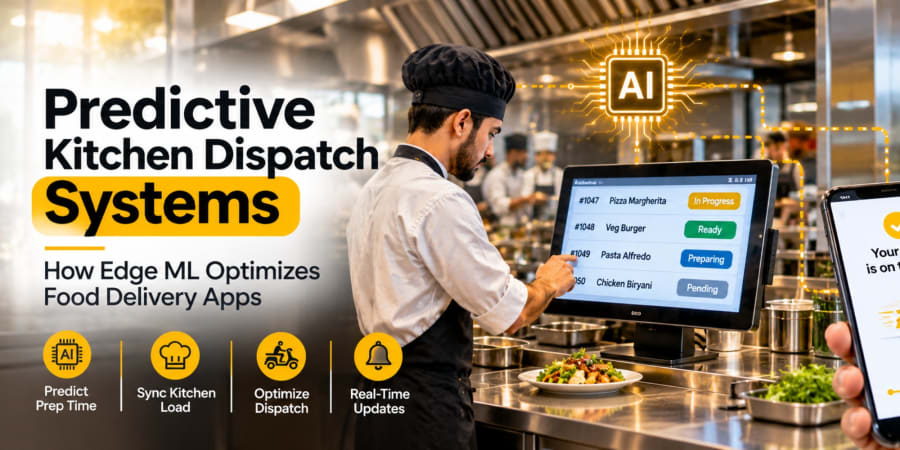
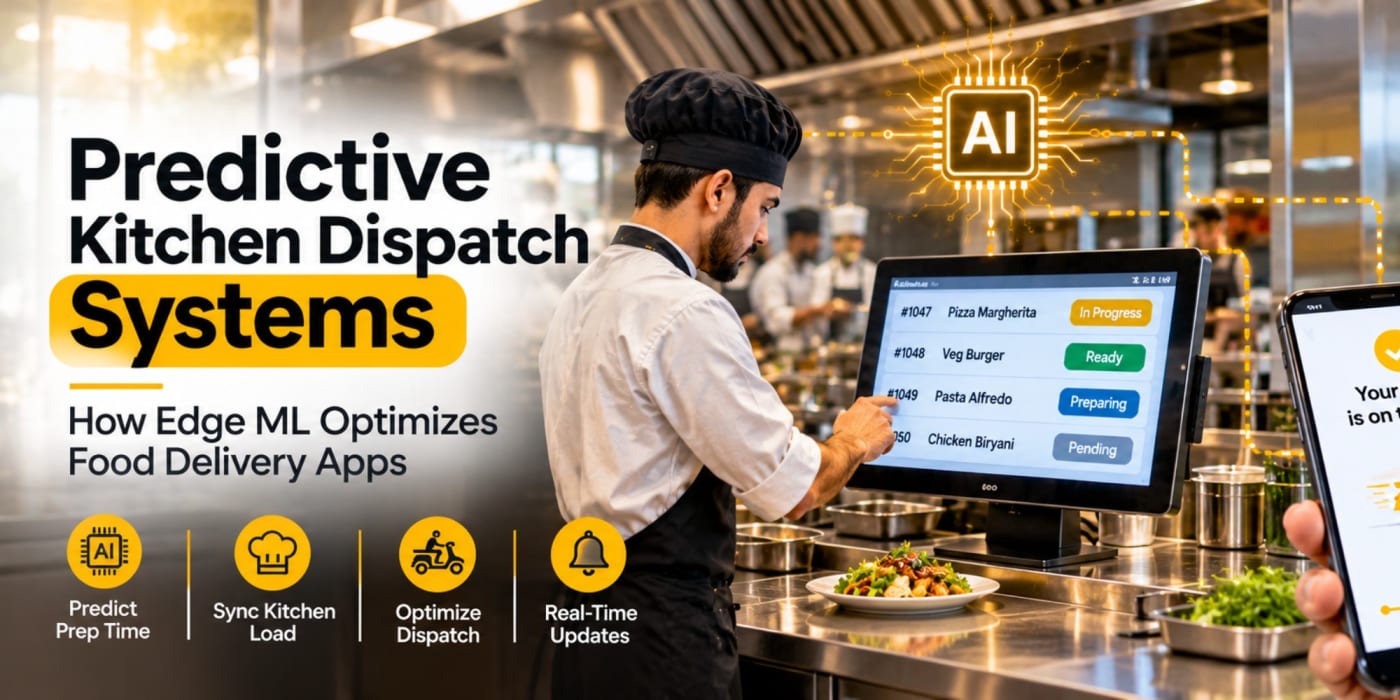
In today's on-demand food delivery industry, speed, accuracy, and customer satisfaction are essential for success. Customers expect their food to arrive fresh, hot, and on time. However, one of the biggest challenges restaurant delivery platforms face is accurately predicting how long an order will take to prepare.
Traditional food delivery applications often rely on fixed preparation times or basic estimates. These approaches fail to account for changing kitchen workloads, order complexity, ingredient availability, and delivery partner schedules. This is where Predictive Kitchen Dispatch Systems powered by Edge Machine Learning (Edge ML) are transforming restaurant operations.
By combining machine learning predictions, real-time Kitchen Display Systems (KDS), and intelligent driver dispatching, restaurants can synchronize food preparation and delivery more efficiently.
Table of Contents
- 1. What Are Predictive Kitchen Dispatch Systems?
- 2. How Edge ML Improves Food Preparation Time Predictions
- 3. Integrating Predictive Models with Kitchen Display Systems
- 4. Dynamic Driver Dispatching: Synchronizing Kitchen and Delivery Operations
- 5. Real-Time Mobile App Notifications and Order Tracking
- 6. Technical Architecture: Building an Edge ML-Powered Dispatch Platform
- 7. Challenges Developers Must Address
- 8. Business Benefits of Predictive Kitchen Dispatch Systems
- 9. The Future of AI-Powered Restaurant Applications
- 10. Conclusion
1. What Are Predictive Kitchen Dispatch Systems?
A Predictive Kitchen Dispatch System is an intelligent technology solution that estimates food preparation times and coordinates delivery partner assignments based on real-time kitchen activity.
Instead of assigning a fixed preparation duration to every order, the system analyzes multiple operational factors, including:
- Current kitchen workload and pending orders.
- Historical preparation times for individual menu items.
- Number of chefs and available kitchen stations.
- Order complexity and customization requirements.
- Peak-hour demand and restaurant traffic.
- Delivery partner availability and estimated travel time.
Using these insights, the system continuously updates preparation estimates and determines the most appropriate time to dispatch a delivery partner.
2. How Edge ML Improves Food Preparation Time Predictions
Machine learning models analyze historical and real-time restaurant data to predict how long an order will take to prepare. Edge ML takes this capability further by running lightweight machine learning models closer to the source of operational data, such as restaurant devices or local edge gateways.
This reduces dependence on continuous cloud communication and enables faster responses to changing kitchen conditions.
Key Advantages of Edge ML
- Low latency: Local predictions can be generated without waiting for every request to travel to a remote cloud server.
- Real-time responsiveness: Preparation estimates can adjust when kitchen workloads suddenly change.
- Improved reliability: Certain prediction functions can continue operating during temporary connectivity disruptions.
- Data efficiency: Only necessary updates and aggregated information need to be transmitted to cloud services.
- Scalability: Lightweight models can support multiple restaurant locations and kitchen devices.
For example, if a restaurant suddenly receives 25 orders during a lunch rush, an Edge ML model can evaluate the existing kitchen queue and update estimated preparation times rather than relying on a standard 15-minute estimate.
3. Integrating Predictive Models with Kitchen Display Systems (KDS)
A Kitchen Display System (KDS) helps restaurant staff manage incoming orders, monitor preparation progress, and coordinate kitchen activities. Integrating predictive ML models with KDS creates a smarter operational environment.
The predictive system receives information from the KDS and evaluates the current state of kitchen operations.
How the Integration Works
- Order Reception: A customer places an order through the restaurant's mobile application.
- KDS Synchronization: The order appears on the kitchen display with its menu items and preparation requirements.
- Data Analysis: The ML model evaluates kitchen workload, item complexity, historical preparation data, and staff availability.
- Time Prediction: The system generates an estimated preparation completion time.
- Dynamic Updates: When kitchen staff update order statuses, the model recalculates predictions where necessary.
- Driver Coordination: The dispatch engine uses the updated preparation estimate to determine when to assign or notify a delivery partner.
This integration ensures that kitchen teams, customers, and delivery partners work with synchronized order information.
4. Dynamic Driver Dispatching: Synchronizing Kitchen and Delivery Operations
One major inefficiency in food delivery occurs when drivers arrive before an order is ready. Early arrivals increase waiting time, reduce delivery partner productivity, and create congestion around restaurant pickup areas.
On the other hand, dispatching drivers too late can result in prepared food waiting for collection, potentially affecting food quality and customer satisfaction.
Predictive dispatch systems solve this problem by matching kitchen preparation estimates with driver availability and travel times.
Intelligent Dispatching Factors
- Predicted preparation completion: When the kitchen expects an order to be ready.
- Driver location: The current location of available delivery partners.
- Travel time: Estimated time required to reach the restaurant.
- Traffic conditions: Road congestion and potential delays.
- Driver availability: Existing assignments and delivery workload.
- Order readiness: Real-time updates from the KDS.
Example: If an order is expected to be ready in 18 minutes and a delivery partner needs approximately 8 minutes to reach the restaurant, the system can schedule dispatch around the preparation timeline, allowing for an appropriate operational buffer.
The objective is to minimize both driver waiting time and food holding time.
5. Real-Time Mobile App Notifications and Order Tracking
Predictive kitchen dispatching becomes even more effective when integrated with mobile application notification systems.
Customers should receive meaningful updates whenever their order progresses through different stages.
Important Notification Events
- Order confirmed successfully.
- Restaurant has started preparing the order.
- Estimated preparation time updated.
- Food preparation nearly completed.
- Delivery partner assigned.
- Delivery partner arriving at the restaurant.
- Order picked up and out for delivery.
Mobile applications can use notification services such as Firebase Cloud Messaging (FCM) to communicate these updates.
For developers, event-driven architecture is particularly useful. Instead of continuously polling the backend, the application can receive updates whenever an important order event occurs.
6. Technical Architecture: Building an Edge ML-Powered Dispatch Platform
Developing a predictive kitchen dispatch solution requires coordination between mobile applications, backend services, machine learning models, restaurant hardware, and delivery management systems.
Core Technology Components
- Mobile Application: Flutter or React Native for customer and delivery partner applications.
- Backend Services: Node.js, Python, or Java for order processing and dispatch management.
- Machine Learning: TensorFlow Lite, ONNX Runtime, or other lightweight inference frameworks for edge deployment.
- Kitchen Display Integration: APIs and WebSockets for real-time order status synchronization.
- Database: PostgreSQL, MongoDB, or Redis for order data, operational states, and caching.
- Cloud Infrastructure: AWS, Azure, or Google Cloud for centralized services, model management, and analytics.
- Notifications: Firebase Cloud Messaging for real-time customer and driver communication.
- Real-Time Communication: WebSockets, MQTT, or event streaming systems for operational updates.
Suggested System Workflow
Customer Mobile App
        |
        v
Order Management API
        |
        v
Restaurant Kitchen Display System
        |
        v
Kitchen Activity Data
        |
        v
Edge ML Prediction Engine
        |
        v
Preparation Time Estimation
        |
        v
Intelligent Dispatch Engine
        |
        +----------------------+
        |                      |
        v                      v
Driver Assignment       Customer Notifications
        |                      |
        v                      v
Driver Mobile App       Live Order Tracking
        |
        v
Restaurant Pickup
        |
        v
Customer Delivery
7. Challenges Developers Must Address
Although predictive dispatch systems offer significant operational benefits, building a reliable solution requires addressing several technical challenges.
Inconsistent Restaurant Data
Different restaurants may use different KDS platforms, menu structures, and order management systems. Standardized API integration and data normalization are essential.
Changing Kitchen Conditions
Kitchen workloads can change unexpectedly because of staff shortages, equipment problems, or sudden order surges. Models should support continuous recalibration using fresh operational data.
Prediction Accuracy
Preparation time estimates should be evaluated against actual completion timestamps. Developers should monitor prediction errors and improve models using historical performance data.
Network Connectivity
Restaurants may experience unreliable internet connections. Edge inference and local event buffering can help maintain essential operations during temporary outages.
System Synchronization
Customer apps, restaurant dashboards, delivery applications, and backend services must receive consistent order updates. Event-driven communication and reliable message processing help prevent conflicting order statuses.
8. Business Benefits of Predictive Kitchen Dispatch Systems
Predictive kitchen dispatching is not simply a technology upgrade. It can improve operational efficiency across the restaurant delivery ecosystem.
- Reduced driver waiting: Better synchronization between preparation and arrival times.
- Improved food freshness: Less time between food preparation and pickup.
- Better customer experience: More realistic delivery estimates and timely notifications.
- Optimized kitchen operations: Improved visibility into preparation bottlenecks and workload distribution.
- Higher delivery efficiency: Better coordination of delivery partner assignments.
- Data-driven decisions: Analytics that help restaurant operators identify recurring operational problems.
9. The Future of AI-Powered Restaurant Applications
The next generation of restaurant applications will move beyond basic order placement and delivery tracking. Predictive intelligence will become an integral part of restaurant operations.
Future systems may combine Edge AI, demand forecasting, automated kitchen workload balancing, computer vision, and intelligent delivery routing to create more autonomous restaurant ecosystems.
With privacy-conscious edge processing and continuously improving prediction models, restaurants can build faster, more responsive, and more scalable digital operations.
10. Conclusion
Predictive Kitchen Dispatch Systems powered by Edge ML represent an important evolution in restaurant technology. By connecting machine learning predictions with Kitchen Display Systems, driver dispatch engines, and mobile app notifications, businesses can coordinate food preparation and delivery more intelligently.
For mobile app developers and restaurant technology companies, this creates an opportunity to build solutions that go beyond traditional food ordering. The real competitive advantage lies in developing connected systems that understand kitchen activity, anticipate delays, and synchronize delivery operations in real time.
At NextCodeCompany, we help businesses explore intelligent mobile application development, AI-powered integrations, and scalable digital solutions that transform complex operational workflows into seamless user experiences.