
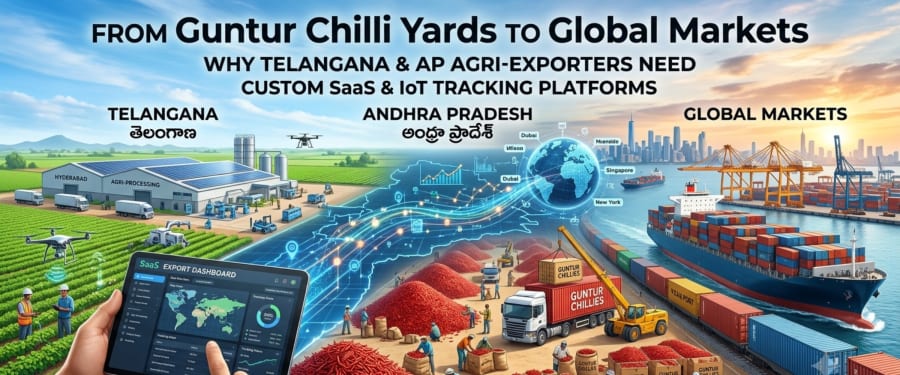
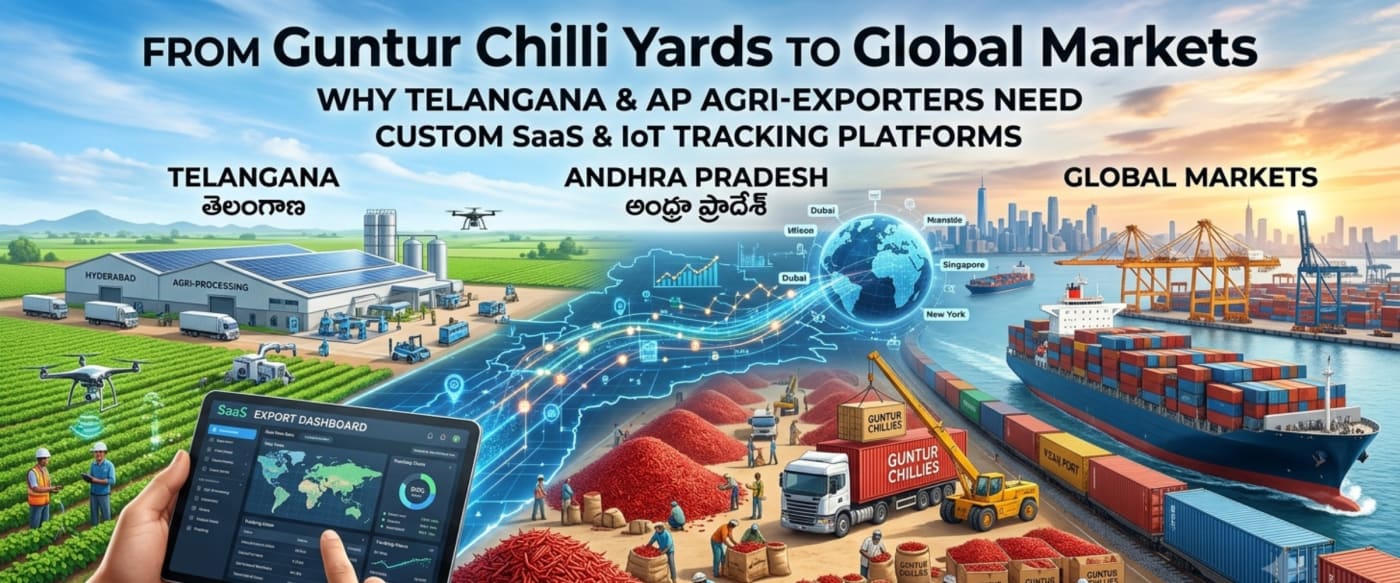
From Guntur's red chilli markets to the turmeric-growing regions of Nizamabad and the agricultural supply chains connecting Andhra Pradesh and Telangana to international buyers, South India's agricultural economy has enormous export potential.
But growing a quality crop is only the beginning. Agricultural exporters must preserve product quality during storage and transportation, coordinate multiple intermediaries, manage documentation, negotiate prices, and meet international buyer expectations.
For many businesses, these processes still involve disconnected spreadsheets, phone calls, paper records, and limited visibility into transportation conditions. The result can be avoidable wastage, pricing uncertainty, delayed shipments, and difficulties establishing buyer confidence.
Custom Software-as-a-Service (SaaS) platforms integrated with Internet of Things (IoT) technology offer a practical way forward. By connecting agricultural inventory, logistics, temperature monitoring, documentation, and buyer-seller networks, businesses can build a more transparent and responsive supply chain.
For exporters across Telangana and Andhra Pradesh, digital transformation is not simply about adopting another application. It is about connecting the entire journey of agricultural produce, from the farm and market yard to the warehouse, transport vehicle, port, and global buyer.
Table of Contents
- 1. The Hidden Challenges in Telangana and AP Agri-Exports
- 2. Perishable Wastage: When Poor Visibility Becomes Expensive
- 3. Middleman Pricing and the Need for Market Transparency
- 4. IoT Temperature Tracking: Monitoring Produce During Transit
- 5. Custom SaaS Platforms for Agricultural Supply Chains
- 6. Digital Documentation, E-Way Bills, and Export Readiness
- 7. Direct B2B Buyer-Seller Platforms
- 8. Lessons from Vietnam and Thailand
- 9. Building an Integrated Agri-Tech Solution
- 10. Business Benefits and Measuring Success
- 11. Frequently Asked Questions
- 12. Conclusion
1. The Hidden Challenges in Telangana and AP Agri-Exports
Agricultural exports involve several stakeholders working together. Farmers produce the crops, traders aggregate quantities, commission agents facilitate transactions, warehouses store inventory, transporters move consignments, processors prepare products, and exporters coordinate international orders.
Each participant handles a different part of the supply chain. However, when information is not shared effectively, businesses can lose visibility over the overall process.
Consider an agricultural exporter purchasing chilli from Guntur. The produce may pass through weighing, grading, storage, packaging, transportation, and export documentation before reaching an overseas customer.
At every stage, important information must be available:
- Where did the produce originate?
- What quantity was purchased and graded?
- What was the purchase price and storage cost?
- Where is the consignment currently located?
- Were the required temperature and storage conditions maintained?
- Which buyer ordered the shipment?
- What documentation is available for the consignment?
If these records are scattered across different systems, answering even basic operational questions can take considerable time.
Three major operational problems
Limited supply-chain visibility: Exporters may not have a consolidated view of inventory, vehicle movements, warehouse conditions, and delivery progress.
Information gaps between stakeholders: Farmers, traders, transporters, and buyers may maintain separate records, making it difficult to reconcile quantities, prices, and delivery commitments.
Delayed decision-making: Without timely information, businesses may discover quality issues, transportation delays, or inventory mismatches only after they have become expensive problems.
A connected digital platform can bring these activities into a shared operational environment.
2. Perishable Wastage: When Poor Visibility Becomes Expensive
Perishable agricultural products are vulnerable to changes in temperature, humidity, handling, and storage duration. Fruits, vegetables, dairy products, flowers, and certain processed agricultural goods can lose quality if they are exposed to unsuitable conditions.
Even commodities that are less perishable, such as dry chillies and turmeric, require appropriate moisture control, protection from contamination, and suitable storage conditions.
For exporters, quality deterioration can result in:
- Reduced market value and downgraded product quality.
- Rejected or discounted consignments.
- Additional sorting, processing, or repackaging costs.
- Customer complaints and commercial disputes.
- Losses caused by delayed deliveries or improper storage.
Why traditional monitoring is insufficient
Checking the condition of goods only when they leave a warehouse or reach their destination does not provide a complete picture of what happened during transportation.
A shipment might have experienced unsuitable conditions for several hours without anyone noticing. By the time the goods reach the buyer, the damage may already have occurred.
This creates a need for continuous or periodic monitoring, particularly for temperature-sensitive products.
The role of connected cold-chain infrastructure
Cold-chain infrastructure can include pre-cooling facilities, temperature-controlled storage, refrigerated vehicles, and suitable distribution arrangements. India's Ministry of Food Processing Industries supports integrated cold-chain projects covering these stages, from the farm gate to the consumer.
However, physical infrastructure becomes more useful when businesses can also monitor its operating conditions through digital systems.
Combining storage facilities with IoT sensors and centralized dashboards can provide better visibility into the movement and condition of agricultural consignments.
3. Middleman Pricing and the Need for Market Transparency
Multiple intermediaries can play legitimate roles in agricultural markets. They may provide aggregation, grading, financing, transportation, storage, market access, and risk management.
The problem arises when farmers, traders, and exporters lack access to consistent information about market prices, product quality, transaction costs, and buyer requirements.
Without reliable records, it can become difficult to understand how the final selling price relates to the original purchase price and the costs added throughout the supply chain.
How digital systems can improve pricing visibility
A custom agricultural SaaS platform can organize important commercial information, including:
- Daily commodity prices from available market data sources.
- Purchase prices and quantities recorded against individual suppliers.
- Quality grades, moisture levels, and inspection records.
- Storage, packaging, processing, and transportation expenses.
- Buyer quotations, negotiated rates, and confirmed orders.
- Historical transaction records for price comparisons.
For example, a chilli exporter could compare procurement costs across different suppliers, grades, and purchasing locations. The business could then estimate the cost of preparing a particular quantity for export.
This does not eliminate intermediaries or guarantee higher prices. Instead, it gives businesses better information for negotiating, planning purchases, and identifying opportunities for more direct commercial relationships.
Building trust through digital records
When transaction details, product specifications, and delivery commitments are documented consistently, participants have a clearer basis for resolving disputes and evaluating commercial opportunities.
Transparency should be designed around appropriate data permissions. A farmer does not necessarily need access to an exporter's confidential buyer contracts, and a buyer does not need unrestricted access to every supplier's commercial information.
4. IoT Temperature Tracking: Monitoring Produce During Transit
One of the most practical applications of IoT in agricultural logistics is real-time or periodic monitoring of transportation conditions.
IoT sensors installed in warehouses, refrigerated vehicles, or suitable storage containers can collect environmental information and transmit it to a digital platform.
How an IoT-enabled monitoring system works
- Sensor installation: Temperature and, where required, humidity sensors are installed at suitable monitoring points.
- Data collection: Sensors record environmental readings at configured intervals.
- Connectivity: Data is transmitted through available communication technologies such as cellular networks, Wi-Fi, or other suitable IoT connectivity.
- Cloud processing: A SaaS backend receives, stores, and processes the readings.
- Dashboard visualization: Authorized users can review current conditions, historical readings, and shipment information.
- Alerts: Configured notifications can be generated when readings cross predefined thresholds.
Example: Monitoring a temperature-sensitive shipment
Imagine an exporter transporting fresh agricultural produce from Andhra Pradesh to a distribution facility near a major port.
The exporter can configure the monitoring system around the product's specified storage requirements. If the sensor records a temperature outside the approved range, the platform can generate an alert for the responsible logistics team.
The team can investigate the situation, contact the transporter, and decide whether corrective action is required.
Importantly, the acceptable temperature range must be configured according to the commodity, packaging, and buyer requirements. A single temperature threshold is not suitable for every agricultural product.
What should the monitoring dashboard display?
- Shipment or vehicle identification.
- Current temperature and humidity readings, where available.
- Historical temperature trends.
- GPS location and route information, if GPS hardware is integrated.
- Time spent outside configured environmental limits.
- Alerts, acknowledgements, and corrective actions.
- Shipment delivery and inspection status.
Such a system can help exporters identify problems earlier and maintain supporting records for quality reviews and buyer discussions.
5. Custom SaaS Platforms for Agricultural Supply Chains
Agricultural exporters do not all operate in the same way. A chilli exporter may need procurement, grading, warehouse, and shipment records, while a fruit exporter may prioritize temperature monitoring, packaging, and delivery coordination.
This is why a configurable, custom-built SaaS platform can be more appropriate than trying to force every operation into a generic application.
Core modules of an agricultural SaaS platform
A. Farmer and supplier management
Maintain supplier profiles, farm or procurement locations, crop details, contact information, and purchase histories. Where appropriate, the system can maintain farm-level traceability records and supplier documentation.
B. Procurement and inventory management
Record incoming produce, quantities, grades, purchase prices, storage locations, and stock movements. This helps businesses understand how much inventory is available and where it is held.
C. Warehouse management
Track stock across warehouses, storage units, and batches. Connect inventory records with quality inspections and environmental monitoring data where sensors are available.
D. Fleet and shipment management
Maintain vehicle details, transporter information, dispatch schedules, consignment references, route information, and delivery status. GPS tracking can be integrated through compatible hardware or telematics providers.
E. IoT monitoring dashboard
Display sensor readings, historical trends, threshold alerts, and shipment-level environmental information. This module should also account for sensor failures and temporary network interruptions.
F. Export documentation management
Organize invoices, purchase orders, packing lists, shipping documentation, certificates, and transport records. Document workflows can help teams track preparation, verification, and completion.
G. Business intelligence and analytics
Provide dashboards for procurement costs, inventory movement, shipment delays, quality exceptions, supplier performance, and sales activity.
Instead of managing each activity through a separate application, businesses can use an integrated platform that connects operational information across departments.
6. Digital Documentation, E-Way Bills, and Export Readiness
Agricultural exports involve documentation at multiple stages. Errors or delays in document preparation can affect shipment schedules and create additional administrative work.
A digital platform can organize these records and help teams coordinate documentation more efficiently.
Understanding the difference between an e-Way Bill and a Bill of Lading
These documents serve different purposes and should not be treated as interchangeable.
e-Way Bill: Under India's GST framework, an e-Way Bill is an electronic document relating to the movement of goods in applicable cases. It contains details concerning the consignment and transportation. The official system supports online generation and API-based integration for eligible users.
Bill of Lading: A Bill of Lading is a shipping document issued in connection with the carriage of goods by sea. Depending on its form and applicable legal framework, it can serve as evidence of receipt of goods, evidence of the contract of carriage, and a document of title.
Electronic Bill of Lading (eBL): An electronic Bill of Lading is the digital form of the shipping document, subject to the relevant carrier, platform, and legal requirements.
What can a custom SaaS platform do?
- Store and organize consignment-related documentation.
- Maintain shipment references and document status.
- Connect relevant transport information with inventory and dispatch records.
- Support eligible e-Way Bill integrations through authorized APIs or service providers.
- Maintain export documentation checklists and approval workflows.
- Provide access to relevant records for authorized business users.
A custom platform should complement official government portals and authorized shipping systems, not attempt to replace them. Exporters should verify regulatory requirements and use approved integrations for document generation and submission.
7. Direct B2B Buyer-Seller Platforms
One of the opportunities in agricultural digitization is creating stronger connections between producers, aggregators, processors, exporters, and international buyers.
A dedicated B2B marketplace can make it easier for buyers to discover available products and for suppliers to present their offerings with consistent specifications.
What should an agricultural B2B marketplace include?
- Supplier profiles: Business information, product categories, operating locations, and relevant credentials.
- Product catalogues: Crop variety, grade, quantity, packaging, origin, and availability.
- Quality information: Inspection reports, laboratory certificates, and applicable quality standards.
- Buyer enquiries: Requirements, target quantities, destination markets, and delivery expectations.
- Quotation management: Supplier offers, buyer responses, and negotiation records.
- Order tracking: Confirmed orders, dispatch details, shipment status, and delivery updates.
- Communication: Structured enquiry and follow-up workflows.
Example: Connecting a Guntur chilli exporter with an overseas buyer
An exporter can list available chilli varieties with product specifications, grade information, packaging details, and available quantities.
An international buyer searching for a particular variety can submit an enquiry with the required quantity, quality parameters, and destination details.
The exporter can evaluate the enquiry, prepare a quotation, and continue the transaction through an agreed commercial process.
Such a marketplace does not automatically remove intermediaries or guarantee better prices. Its value lies in making product information easier to discover, improving communication, and creating additional opportunities for direct business relationships.
8. Lessons from Vietnam and Thailand
India is not alone in exploring digital transformation across agricultural supply chains. Countries in Southeast Asia provide useful examples of how mobile platforms, digital records, geospatial information, and traceability systems can support agricultural businesses.
However, the objective should not be to copy another country's model directly. The more useful approach is to understand the underlying capabilities and adapt them to local agricultural markets.
Vietnam: Digital agricultural ecosystems and market connectivity
Vietnam offers examples of platforms connecting agricultural production, quality management, traceability, and market access.
One example is VNPT Green, a digital agriculture ecosystem developed by VNPT. Its stated capabilities cover farm and production management, quality processes, traceability, and market connections. It is designed to serve agricultural businesses, cooperatives, exporters, buyers, and farming households.
Vietnam's Agribank also illustrates the importance of digital infrastructure in the agricultural economy. Its digital transformation includes online banking, payments, APIs, and digital financial services. It is important to distinguish this banking ecosystem from a dedicated agricultural traceability platform: they are complementary parts of a wider digital ecosystem, not the same product.
For Telangana and Andhra Pradesh, the lesson is that agricultural technology can connect operational information with financial services, business transactions, and market access.
Thailand: Smart Farmer initiatives and digital traceability
Thailand has pursued agricultural modernization through digital information systems, farmer-focused initiatives, and traceability programmes.
Its SGiFarm platform, developed by the Geo-Informatics and Space Technology Development Agency (GISTDA), provides farmers with tools to manage farm information and record production-related data using geospatial technology. The platform also supports traceability and product value-chain information.
Thailand has also developed agricultural traceability initiatives to help businesses respond to international market requirements. These efforts demonstrate the growing importance of being able to establish where agricultural products originate and how they move through supply chains.
What can South Indian exporters learn?
- Use mobile-friendly systems that farmers and small suppliers can operate easily.
- Connect product-origin records with procurement and warehouse information.
- Build traceability into the supply chain instead of adding it only at export time.
- Make quality and shipment information accessible to authorized buyers.
- Connect business operations with suitable digital payment and financial services.
- Design technology around local languages, connectivity conditions, and business practices.
Important note on profit claims: Digital platforms can contribute to better operational efficiency, reduced avoidable losses, and improved commercial visibility. However, there is no sufficiently established, comparable evidence in the sources reviewed to claim that Vietnam's or Thailand's digital agriculture initiatives have generally increased exporter profit margins by 18–22%. Actual financial improvements depend on the crop, implementation costs, adoption, market conditions, and operating model. Businesses should measure their own results rather than rely on a universal percentage.
9. Building an Integrated Agri-Tech Solution
A successful agricultural SaaS implementation should start with the business problem rather than the technology stack. Exporters do not need to digitize every activity at once.
A phased implementation can reduce complexity and help businesses understand which features provide measurable operational value.
Phase 1: Map the supply chain
Identify the major stakeholders, procurement locations, warehouses, transporters, processing units, and export destinations. Understand where information is currently recorded and where communication gaps occur.
Phase 2: Build the core SaaS platform
Begin with supplier management, procurement, inventory, warehouse records, shipment management, and reporting. Establish consistent data structures for batches, products, and consignments.
Phase 3: Integrate IoT devices
Choose suitable sensors based on the commodity and storage requirements. Connect the devices to the backend through secure APIs or an appropriate IoT communication layer.
Phase 4: Introduce buyer-seller connectivity
Build supplier catalogues, buyer enquiries, quotation workflows, and order management. Define which product and quality information can be shared publicly and which information should remain private.
Phase 5: Connect documentation workflows
Integrate relevant government or third-party systems where permitted. Establish document validation, access permissions, and approval processes.
Phase 6: Pilot and measure
Start with one commodity, a limited number of suppliers, and a selected logistics route. Evaluate the system's reliability and usefulness before expanding to additional products or locations.
Essential technology considerations
- Cloud infrastructure: A scalable environment for storing business and sensor information.
- Mobile applications: Simple interfaces for field staff, suppliers, and logistics teams.
- IoT integration: Reliable sensor connectivity and data processing.
- API architecture: Integration with authorized external platforms and services.
- Data security: Authentication, role-based permissions, encryption, and audit logs.
- Offline support: Suitable data capture and synchronization for locations with limited connectivity.
- Localization: Interfaces and workflows adapted to regional languages and operating conditions.
10. Business Benefits and Measuring Success
Technology adoption should be evaluated through measurable business improvements rather than the number of dashboards or sensors installed.
For agricultural exporters, useful indicators include:
- Post-harvest loss rate: Compare product losses before and after implementing improved monitoring and handling processes.
- Temperature compliance: Measure the percentage of monitored shipment time within the product's defined temperature range.
- Shipment visibility: Measure how many active consignments have accessible status and location information.
- Documentation turnaround: Track the time required to prepare and verify shipment documents.
- Procurement cost visibility: Evaluate how accurately the business can calculate product purchase and handling costs.
- Buyer conversion: Monitor enquiries, quotations, confirmed orders, and repeat purchases.
- Operating cost: Compare monitoring, storage, transport, and administrative expenses over time.
- Export profitability: Review actual net margins after accounting for implementation, maintenance, logistics, and transaction costs.
Start with a measurable business case
Consider an exporter handling multiple shipments of temperature-sensitive produce. Before implementing an IoT monitoring system, the business can record its existing loss rates, shipment delays, and quality-related complaints.
After a pilot implementation, the same indicators can be measured again. This helps determine whether the investment is delivering value and which parts of the system need improvement.
The same approach can be used for procurement transparency, documentation workflows, and B2B buyer acquisition.
11. Frequently Asked Questions
1. What is an agricultural SaaS platform?
An agricultural SaaS platform is cloud-based software that helps farmers, traders, cooperatives, warehouses, transporters, and exporters manage agricultural business activities. Depending on its modules, it may include procurement, inventory, traceability, logistics, reporting, and buyer-seller management.
2. How does IoT temperature tracking help agricultural exporters?
IoT sensors can collect temperature and humidity information from warehouses and transportation vehicles. When connected to a cloud platform, this data can help exporters monitor storage conditions, identify environmental exceptions, and maintain records for quality reviews.
3. Can IoT tracking reduce agricultural wastage?
IoT monitoring can help identify unsuitable storage or transportation conditions earlier, allowing teams to investigate and take corrective action. However, reducing wastage also requires suitable infrastructure, packaging, handling procedures, and trained personnel.
4. Can custom software connect farmers directly with international buyers?
A B2B agricultural marketplace can help suppliers publish product information and receive enquiries from potential buyers. It can support quotations, negotiations, and order tracking. Actual transactions still depend on buyer verification, product quality, regulatory compliance, logistics, and commercial agreements.
5. What is the difference between an e-Way Bill and an electronic Bill of Lading?
An e-Way Bill is an electronic document used under India's GST framework for applicable goods movements. An electronic Bill of Lading is a digital shipping document associated with the carriage of goods, generally by sea. They serve different purposes and are not interchangeable.
6. Is custom SaaS suitable for small agricultural exporters?
It can be, provided the implementation is aligned with the business's scale and budget. A small exporter might begin with procurement, inventory, shipment records, and basic reporting before investing in IoT integrations and a larger B2B marketplace.
7. What should exporters consider before installing IoT sensors?
They should evaluate the commodity's storage requirements, sensor accuracy, installation location, connectivity, battery life, calibration, data retention, and maintenance arrangements. The monitoring system should also account for periods when connectivity is unavailable.
8. How can Telangana and Andhra Pradesh agri-exporters begin digital transformation?
A practical starting point is to identify one high-value commodity or logistics route, map its supply chain, and introduce a digital workflow for inventory and shipment management. Temperature monitoring, traceability, documentation integration, and B2B marketplace capabilities can then be added in stages.
12. Conclusion
From the chilli markets of Guntur to the agricultural supply chains of Telangana and Andhra Pradesh, the future of agri-exports will depend not only on production capacity but also on the ability to preserve quality, manage logistics, maintain transparent records, and meet international buyer expectations.
Custom SaaS platforms and IoT integrations provide an opportunity to connect these activities. Real-time environmental monitoring, digital inventory management, shipment visibility, export documentation workflows, and B2B buyer-seller platforms can help businesses build more organized and transparent operations.
The opportunity is not to digitize everything overnight. It is to identify the most expensive information gaps, solve them through practical technology, and expand based on measurable results.
At NextCode, we believe technology should solve real problems, improve everyday experiences, and create practical value for businesses and communities. As a growing technology company, we focus on exploring thoughtful approaches, evaluating emerging technologies, and developing solutions aligned with real-world needs.
We value collaboration, transparent communication, and continuous improvement. If you are an agricultural exporter, logistics operator, FPO, or agribusiness exploring better ways to manage procurement, traceability, temperature monitoring, or export operations, we welcome a conversation about your challenges and the possibilities of custom digital solutions.
Ready to Explore Digital Transformation for Your Agri-Business?
Let's discuss how custom SaaS platforms, IoT integration, and connected business workflows could support your agricultural supply chain and export operations.
Contact NextCode