
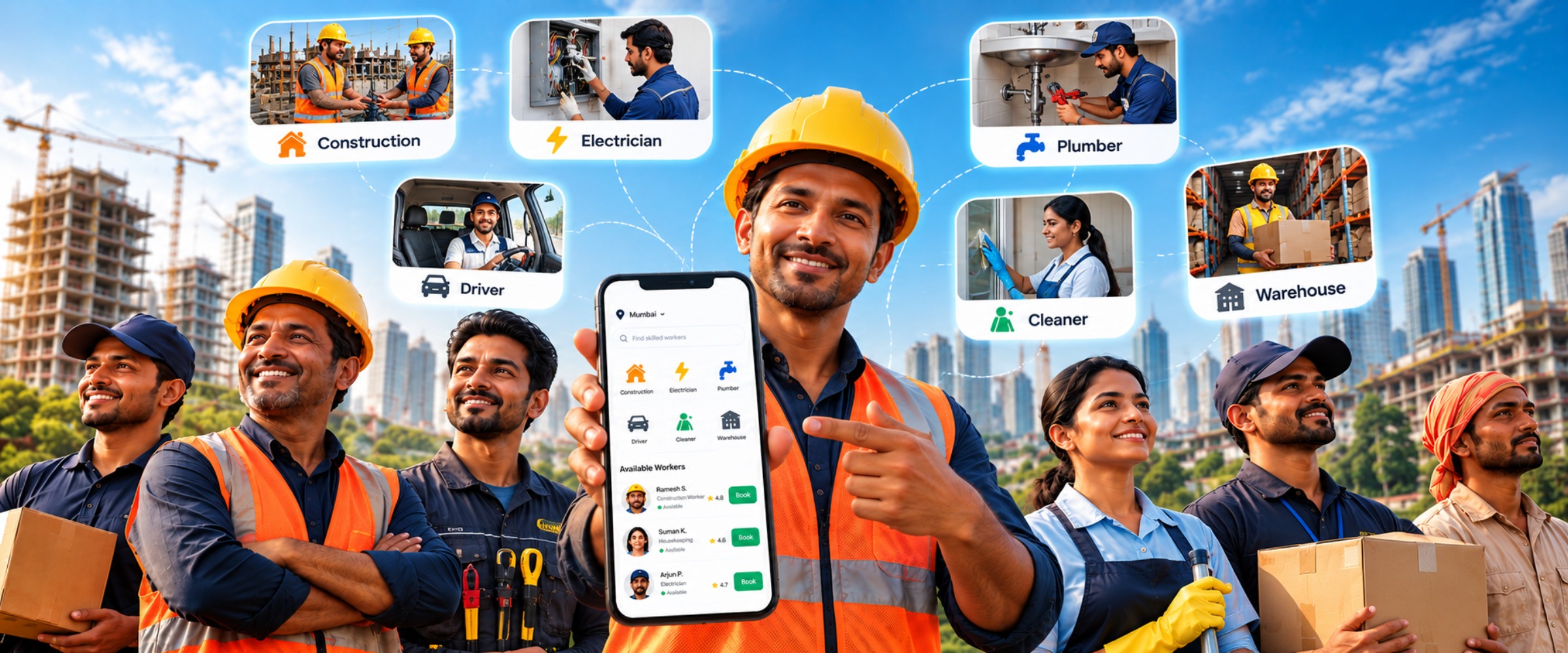
Brief Summary
India has one of the world's largest informal workforces, yet a large part of this labour market still operates through phone calls, personal contacts, contractors, local agents and word-of-mouth networks.
That creates a major digital opportunity.
Businesses regularly need skilled and semi-skilled workers for hourly, daily, shift-based, multi-day and project-based requirements. At the same time, millions of workers are looking for reliable opportunities, better utilisation of their skills and more consistent income.
The missing layer is a scalable digital workforce marketplace that can connect demand and supply efficiently.
This article examines the size of the opportunity, the existing problems, possible business models, low-commission economics, technology requirements and how a workforce platform could potentially build a ₹100+ crore annual revenue business at scale.
Table of Contents
- How Large Is India's Unorganised Labour Market?
- Where Is the Real Digital Opportunity?
- The Problem Businesses Face Today
- Why the Existing Labour Market Is Fragmented
- What a Digital Workforce Marketplace Could Change
- The Low-Commission Business Model
- How a Workforce Marketplace Could Reach ₹100+ Crore
- The Bigger Opportunity: B2B Workforce Demand
- Subscription and Recurring Revenue Opportunities
- Understanding the Unit Economics
- What Existing Platforms Tell Us
- Industries That Could Use the Platform
- How to Build the Market
- Key Challenges
- The Future of India's Workforce Market
- Key Takeaways
- Bottom Line
- Frequently Asked Questions
How Large Is India's Unorganised Labour Market?
The scale of India's informal workforce is difficult to ignore.
According to analysis published by NITI Aayog using PLFS 2023–24 data, India had approximately 634 million employed workers, of whom around 550 million were informally employed.
That means roughly 87% of employed workers were in informal employment.
The important point, however, is that 550 million workers should not be treated as the addressable market for a single business.
The actual digital opportunity is the portion of this workforce that can be organised around recurring business demand, verified skills, location, availability and transactions.
NITI Aayog's analysis also indicates that approximately 260 million informal workers were employed outside agriculture.
That creates a particularly interesting opportunity for digital workforce platforms serving businesses that need workers on demand.
The e-Shram portal also demonstrates the scale of India's effort to digitally identify and organise unorganised workers, with hundreds of millions of registrations on the platform.
Where Is the Real Digital Opportunity?
The opportunity is not simply to create another job portal.
A traditional job portal primarily connects employers and candidates for permanent employment.
The unorganised workforce market works differently.
A business may need:
- 10 workers for tomorrow's shift
- 5 electricians for a project
- 20 warehouse workers for a peak season
- Temporary construction labour for two weeks
- Drivers for a specific delivery requirement
- Technicians for multiple service locations
- Workers for hourly or daily requirements
- Skilled workers for project-based contracts
These requirements are often solved through local contractors, WhatsApp groups, phone calls and personal networks.
That is where the digital opportunity exists.
A workforce marketplace can turn this fragmented process into a structured transaction.
The Problem Businesses Face Today
For many businesses, finding workers is not necessarily the biggest problem.
The bigger problem is finding the right worker at the right location at the right time.
Businesses can face challenges such as:
- Unverified workers
- Unpredictable availability
- Last-minute cancellations
- Multiple phone calls to find workers
- Dependence on contractors
- Unclear pricing
- Poor attendance tracking
- Difficulty managing temporary workers
- Payment and settlement issues
- No central worker database
These problems become significantly larger when a company operates across multiple locations.
Why the Existing Labour Market Is Fragmented
India's labour market has historically grown through local relationships.
A worker may find opportunities through:
- A local contractor
- A friend or relative
- A previous employer
- A labour supplier
- A WhatsApp group
- A local agent
- Direct phone calls
This system works at a small scale, but it becomes inefficient when thousands of businesses and workers need to interact across different locations.
Digital infrastructure can introduce structured profiles, worker verification, location-based matching, availability, ratings, attendance, payments and business dashboards.
What a Digital Workforce Marketplace Could Change
Imagine a business opening an app or web dashboard and entering:
Location → Worker Type → Number of Workers → Date → Shift → Duration → Budget
The platform could then identify available workers based on location, skills, availability and verification status.
The business could select workers, confirm the requirement and manage the engagement digitally.
The worker could receive the assignment, accept it, complete the work and receive payment through the platform.
This creates a two-sided marketplace.
For Businesses
- Search and filter workers
- Location-based matching
- Skill verification
- Availability tracking
- Bulk worker booking
- Shift management
- Attendance tracking
- Digital payments
- Invoices and reports
- Worker performance history
For Workers
- Digital profile
- Skill selection
- Location preferences
- Availability calendar
- Job notifications
- Assignment management
- Earnings dashboard
- Digital payment history
- Ratings and reviews
- Work history
The Low-Commission Business Model
One of the interesting aspects of this market is that the platform does not necessarily need to charge a high commission.
A business could potentially operate with a relatively small transaction fee while generating substantial revenue through volume.
For example, consider a hypothetical commission structure:
| Commission | Example |
|---|---|
| 2% | Low platform fee designed for high transaction volume |
| 3% | Balanced marketplace monetisation |
| 5% | Higher monetisation with additional services |
The important concept is simple:
Low commission + very large transaction volume can create a large business.
How a Workforce Marketplace Could Reach ₹100+ Crore
Let's build a simple scenario model.
Assume:
- Average transaction value: ₹700
- 2 completed jobs per active worker per day
- 26 active days per month
One active worker would therefore generate approximately:
₹700 × 2 × 26 = ₹36,400 GMV per month
Or approximately:
₹4.37 lakh GMV per worker per year
Now consider different marketplace scales.
| Active Workers | Annual GMV | 2% Revenue | 3% Revenue | 5% Revenue |
|---|---|---|---|---|
| 10,000 | ₹436.8 Cr | ₹8.74 Cr | ₹13.10 Cr | ₹21.84 Cr |
| 25,000 | ₹1,092 Cr | ₹21.84 Cr | ₹32.76 Cr | ₹54.60 Cr |
| 50,000 | ₹2,184 Cr | ₹43.68 Cr | ₹65.52 Cr | ₹109.20 Cr |
| 100,000 | ₹4,368 Cr | ₹87.36 Cr | ₹131.04 Cr | ₹218.40 Cr |
Important: These are illustrative scenario calculations, not forecasts or guarantees. Actual results would depend on worker utilisation, average transaction value, geography, demand, cancellations, pricing, operating costs and the percentage of transactions processed through the platform.
But the mathematics demonstrates why a low-commission marketplace can become a large business when transaction volume reaches meaningful scale.
The Bigger Opportunity: B2B Workforce Demand
The consumer market is only one part of the opportunity.
The potentially larger opportunity is B2B.
Thousands of businesses regularly need temporary or flexible workers.
Potential customer categories include:
- Warehouses
- Manufacturing companies
- Construction companies
- Retail chains
- Logistics companies
- Restaurants
- Hotels
- Event companies
- Facility management companies
- Small and medium-sized businesses
Instead of acquiring every worker transaction individually, a platform could build recurring relationships with businesses.
A company may use the platform every week or every month.
That changes the economics of the marketplace.
Subscription and Recurring Revenue Opportunities
Transaction commissions do not have to be the only source of revenue.
A workforce platform could introduce business subscriptions.
For example:
| Businesses | Monthly Subscription | Annual Revenue |
|---|---|---|
| 5,000 | ₹2,000 | ₹12 Cr |
| 10,000 | ₹1,500 | ₹18 Cr |
| 50,000 | ₹1,500 | ₹90 Cr |
Subscription packages could include:
- Priority worker matching
- Bulk hiring
- Dedicated account management
- Advanced workforce analytics
- Attendance management
- Payroll integration
- Multiple business locations
- Advanced reporting
- API access
This creates a combination of transaction revenue + recurring subscription revenue.
Understanding the Unit Economics
Before scaling, a marketplace must understand its unit economics.
Suppose a worker generates ₹36,400 GMV per month.
At a 3% platform commission, the platform generates approximately:
₹1,092 per active worker per month.
At 50,000 consistently active workers, that would represent approximately:
₹5.46 crore in monthly commission revenue
or approximately:
₹65.52 crore annually.
Again, this is a mathematical scenario rather than a business forecast.
The actual business would need to account for customer acquisition costs, worker acquisition, verification, support, payment processing, technology infrastructure, refunds, incentives, operations and other expenses.
What Existing Platforms Tell Us
The broader market already provides evidence that digital platforms can organise fragmented service and workforce markets.
Urban Company's partner earnings data shows that platform-based service work can generate meaningful income for active service partners.
Urban Company's broader business performance also demonstrates that customers are willing to use digital platforms for services that were historically arranged through offline channels. In Q1 FY27, the company reported 13.2 million orders and ₹1,465 crore in consolidated net transaction value.
Meanwhile, Redseer's analysis of India's home-services market estimated the overall market at roughly ₹5.1–₹5.2 trillion in FY2025, while the online segment remained below 1% penetration.
The lesson is not that every workforce marketplace will replicate an existing platform.
The lesson is that large fragmented offline markets can gradually become organised through technology.
Industries That Could Use the Platform
A scalable workforce marketplace could potentially serve multiple industries.
Construction
Construction companies frequently need workers based on project requirements, location and timelines.
Warehousing and Logistics
Demand can increase during seasonal peaks, promotions and high-volume periods.
Manufacturing
Factories and production facilities may require temporary or additional workers during peak production periods.
Retail
Large retail operations can require temporary staff for inventory, stocking, events and seasonal demand.
Hospitality
Hotels, restaurants and catering companies may require flexible staffing based on bookings and events.
Events
Events can create short-duration requirements for setup, operations, logistics, cleaning and support roles.
How to Build the Market
The biggest challenge is not technology.
It is marketplace liquidity.
A workforce marketplace needs workers and businesses in the same location at the same time.
A practical strategy could therefore be:
Phase 1: Start With One Geography
Choose one city or a concentrated service area rather than launching everywhere.
Phase 2: Focus on a Few Worker Categories
Instead of listing every possible profession, build strong supply in selected categories.
Phase 3: Acquire Anchor Businesses
Target businesses with recurring workforce requirements.
Phase 4: Improve Worker Utilisation
The platform should focus on increasing completed jobs per active worker rather than simply increasing registrations.
Phase 5: Expand Geography
Once demand and supply are working consistently, expand into additional locations.
Key Challenges
The opportunity is large, but the business is not simple.
Worker Verification
Businesses need confidence that workers are genuine, available and appropriately skilled.
Quality Control
A poor worker experience can affect repeat business and marketplace trust
Supply-Demand Balance
Too many workers without jobs creates dissatisfaction. Too much demand without workers creates customer dissatisfaction.
Payment Reliability
Workers need predictable and transparent payments.
Customer Acquisition
Building both sides of the marketplace requires disciplined acquisition economics.
Operational Support
Real-world labour marketplaces cannot depend entirely on software. Disputes, cancellations, emergencies and verification issues require operational systems.
The Future of India's Workforce Market
The broader gig economy is also expanding.
According to NITI Aayog's gig economy analysis, India's gig workforce was estimated at 7.7 million workers in 2020–21 and was projected to reach 23.5 million by 2029–30.
At the same time, smartphone adoption, digital payments, location technology and online business operations are making it easier to coordinate workers digitally.
The next evolution may therefore not simply be about finding jobs online.
It could be about creating a complete digital operating layer for flexible work.
That means:
- Finding workers
- Matching workers
- Scheduling workers
- Tracking attendance
- Managing payments
- Monitoring performance
- Managing recurring workforce requirements
The companies that solve these operational problems can potentially build much deeper relationships with businesses than a traditional job portal.
Key Takeaways
- India has a very large informal workforce.
- A significant portion of informal employment exists outside agriculture.
- Businesses still rely heavily on fragmented offline labour networks.
- A digital workforce marketplace can organise demand and supply.
- Low commissions can work when transaction volumes become large.
- B2B recurring demand can create stronger marketplace economics.
- Subscriptions can add recurring revenue beyond transaction commissions.
- Worker verification, trust and marketplace liquidity are critical.
- AI can improve matching, forecasting and operational efficiency.
- The opportunity is not simply a job portal; it can become workforce infrastructure.
Bottom Line
India's unorganised labour market is enormous, but its digital transformation is still developing.
The opportunity is not necessarily to build another recruitment website.
The bigger opportunity is to create infrastructure that makes flexible work easier to discover, book, manage, verify and pay for.
If a platform eventually reaches tens of thousands of active workers and thousands of recurring business customers, even a relatively small commission can create significant revenue.
The scenario calculations in this article show how a marketplace could potentially cross ₹100 crore in annual revenue at sufficient transaction scale.
But the real competitive advantage would come from solving the difficult operational problems: trust, verification, availability, matching, payments, worker retention and recurring business demand.
For entrepreneurs and existing businesses, this is an important signal.
Large offline markets do not need to become completely digital overnight. They only need the right digital layer to start becoming organised.
Frequently Asked Questions
What is unorganised labour in India?
Unorganised or informal labour refers broadly to workers operating outside formal employment arrangements and institutions. It includes many workers across agriculture and non-agricultural sectors.
How large is India's informal workforce?
NITI Aayog's analysis of PLFS 2023–24 data estimated approximately 550 million informally employed workers out of around 634 million employed workers.
Can a labour marketplace become a ₹100 crore business?
It is mathematically possible under sufficiently large transaction volumes and suitable unit economics. For example, the scenario in this article shows that 100,000 active workers generating the assumed transaction volume could produce more than ₹100 crore in annual platform revenue at a 3% commission. This is a scenario calculation, not a forecast.
Does a workforce marketplace need to charge high commissions?
Not necessarily. A platform could potentially use low transaction commissions and combine them with subscriptions, premium services, enterprise plans and other revenue streams.
What businesses can use a workforce marketplace?
Potential users include construction companies, warehouses, manufacturers, retailers, logistics companies, hotels, restaurants, event companies and other businesses requiring flexible staffing.
What technology is required?
A serious platform may require worker and business applications, an admin dashboard, location-based matching, verification, payments, attendance, notifications, analytics and eventually AI-powered matching and demand forecasting.
What is the biggest challenge?
Marketplace liquidity and trust are among the biggest challenges. The platform must have enough reliable workers and enough recurring business demand within the same geographic areas.