
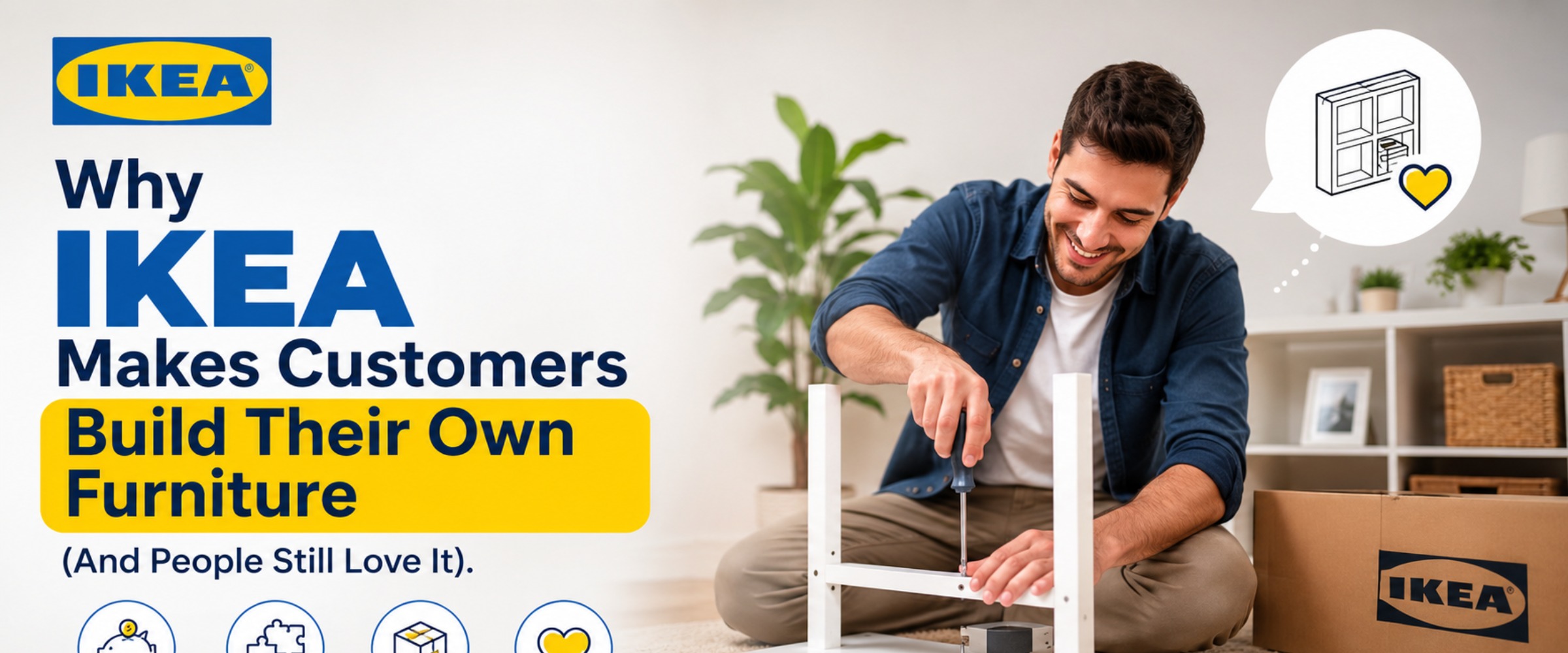
Have you ever spent hours assembling a piece of IKEA furniture and wondered why the company doesn't simply sell it ready-made? At first glance, IKEA's business model seems strange. Customers visit the store, pick up flat-packed furniture, transport it home, and then spend time assembling it themselves. Most businesses try to make life easier for customers, yet IKEA asks customers to do part of the work. Surprisingly, this strategy has helped IKEA become one of the world's largest furniture retailers. The reason goes beyond cost savings. It is rooted in human psychology and a fascinating concept known as the IKEA Effect.
Brief Summary: The IKEA Effect
Customers Assemble Their Own Furniture
IKEA products are designed for self-assembly.
People Value Their Own Effort
Customers tend to appreciate products they help create.
Lower Business Costs
Flat-pack furniture reduces transportation and storage expenses.
Higher Customer Satisfaction
Assembly creates a sense of achievement and ownership.
A Global Competitive Advantage
The strategy helped IKEA become one of the world's largest furniture brands.
Table of Contents
What Is the IKEA Effect?
The IKEA Effect is a psychological principle that explains why people place a higher value on things they help create.
When individuals invest their own effort into building, assembling, or customizing something, they develop a stronger emotional connection to it.
Think about it this way.
A chair assembled by someone else is just a chair.
A chair that you spent an hour building suddenly feels like an achievement.
The effort creates attachment.
Psychologists have found that people often overvalue products they have personally contributed to creating, even when those products are identical to ones built by others.
People value what they help create.
Why Customers Love Building Furniture
1. It Creates a Sense of Achievement
Completing a furniture assembly project feels rewarding.
Even a simple bookshelf can create a feeling of accomplishment when the final screw is tightened and everything fits together.
That sense of achievement becomes part of the product experience.
2. It Builds Emotional Ownership
People naturally feel more connected to things they have invested effort in.
After spending time assembling furniture, customers often feel that the product is uniquely theirs.
The furniture becomes more than a purchase.
It becomes something they helped create.
3. It Makes the Product Feel More Valuable
When customers invest time and effort, the perceived value of the product increases.
This is one reason why many IKEA customers proudly show off their furniture despite spending less money than they might have at premium furniture retailers.
How IKEA Benefits From This Strategy
Lower Transportation Costs
Flat-packed furniture takes up far less space than fully assembled products.
A truck can carry significantly more products, reducing transportation expenses.
Lower Storage Costs
Warehouses and retail stores can store more inventory in the same amount of space.
This improves efficiency and lowers operational costs.
Global Scalability
Because products are compact, IKEA can distribute furniture more efficiently across countries and continents.
This has been a major factor in its international growth.
Higher Profit Margins
Reduced logistics costs allow IKEA to offer affordable pricing while maintaining profitability.
Customers receive lower prices while IKEA improves operational efficiency.
The Genius Behind IKEA's Business Model
Most companies try to eliminate customer effort.
IKEA found a way to turn customer effort into a competitive advantage.
Instead of viewing assembly as a disadvantage, the company transformed it into part of the customer experience.
The result is a business model that combines:
Cost efficiency
Customer engagement
Emotional attachment
Strong brand loyalty
Very few companies manage to achieve all four simultaneously.
Business Lessons From IKEA
1. Involve Customers
Customers become more engaged when they participate in the process.
2. Allow Customization
People value products more when they can personalize them.
3. Create Interactive Experiences
The more involved customers are, the stronger their emotional connection becomes.
4. Focus on Psychology
Successful businesses understand that purchasing decisions are often emotional rather than purely logical.
5. Turn Weaknesses Into Strengths
What appears inconvenient can become a major differentiator when executed correctly.
Why Competitors Struggle to Copy IKEA
Many furniture companies can copy IKEA's products.
Few can copy IKEA's entire system.
The company combines:
Affordable prices
Efficient logistics
Modern design
Customer participation
Consumer psychology
This combination creates a powerful competitive advantage that is difficult to replicate.
Key Takeaways
IKEA's success is not just about selling furniture.
It is about understanding human behavior.
The company discovered that customers often value products more when they invest effort into creating them.
By combining psychology with operational efficiency, IKEA transformed a simple furniture retailer into one of the world's most successful brands.
The Bottom Line
Most businesses look for ways to remove effort from the customer journey.
IKEA took the opposite approach.
It asked customers to participate.
What seemed like an inconvenience became one of the company's greatest strengths.
The lesson is simple: People value what they help create.
That insight helped IKEA build a global business empire and remains one of the most fascinating examples of consumer psychology in action.
Frequently Asked Questions
What is the IKEA Effect?
The IKEA Effect is a psychological principle where people place higher value on products they help create or assemble themselves.
Why does IKEA make customers assemble furniture?
Self-assembly reduces transportation and storage costs while increasing customer engagement and perceived value.
Why do customers enjoy assembling IKEA furniture?
Assembly creates a sense of accomplishment, ownership, and emotional attachment to the product.
How does IKEA benefit from flat-pack furniture?
Flat-pack furniture reduces logistics costs, improves storage efficiency, and supports global scalability.
What is the biggest lesson businesses can learn from IKEA?
Customer participation can create stronger emotional connections and make products feel more valuable.