
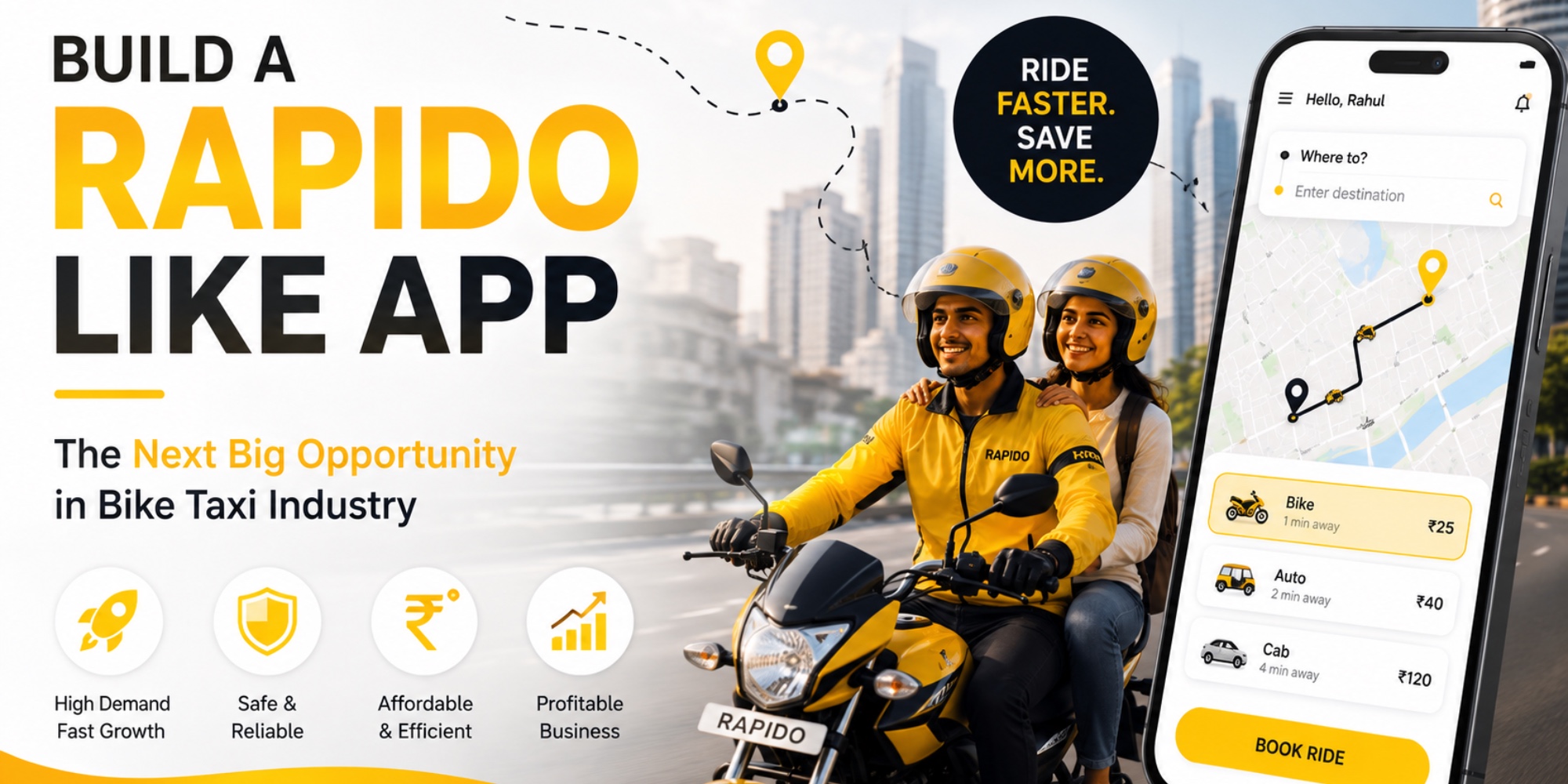
Urban transportation is changing faster than ever. Long traffic jams, rising fuel prices, and increasing demand for affordable transportation have made bike taxis one of the fastest-growing mobility segments in India. Companies like Rapido proved that people don't always need expensive cab rides—sometimes they simply need the fastest and most affordable way to travel. But despite their success, the market is still far from saturated, creating enormous opportunities for entrepreneurs willing to build the next generation of mobility platforms.
Table of Contents
- The Growth of India's Ride-Hailing Industry
- Why Bike Taxi Apps Are Growing Faster Than Traditional Cabs
- Current Challenges in Existing Ride-Hailing Apps
- The Market Opportunity Is Bigger Than Ride Booking
- 10 Unique Features That Can Make Your App Stand Out
- How Can This Business Generate Revenue?
- Why This Is the Right Time to Build
- Business Lessons From Rapido
- Key Takeaways
- The Bottom Line
Brief Summary
India's Mobility Market Is Growing Rapidly
Urban transportation demand continues to increase every year.
Bike Taxis Solve Real Problems
They reduce travel time, lower costs, and improve accessibility.
Technology Is Transforming Transportation
AI, GPS, digital payments, and analytics are creating smarter ride experiences.
Regional Opportunities Still Exist
Many Tier-2 and Tier-3 cities remain underserved.
Innovation Can Differentiate New Platforms
Future success will come from solving problems that existing platforms haven't fully addressed.
The Growth of India's Ride-Hailing Industry
India's ride-hailing industry has witnessed remarkable growth over the past decade. Rapid urbanization, increasing smartphone adoption, affordable internet, digital payment infrastructure, and changing consumer behavior have completely transformed how people travel.
Today, millions of Indians use ride-booking applications every day for commuting to work, colleges, shopping malls, railway stations, airports, hospitals, and entertainment destinations.
According to industry reports, India's ride-hailing market is expected to continue growing significantly over the next decade as more cities adopt digital transportation services.
The expansion of metro cities into surrounding suburbs and the rapid growth of Tier-2 and Tier-3 cities have further increased demand for affordable transportation.
Transportation is no longer just about getting from one place to another. It has become an on-demand digital service.
Why Bike Taxi Apps Are Growing Faster Than Traditional Cabs
Traditional taxis work well for long-distance travel.
However, bike taxis solve a completely different problem.
They are designed for speed.
In crowded cities, bikes can navigate traffic much faster than cars.
Users choose bike taxis because they:
Save travel time
Cost significantly less than cabs
Reduce waiting time
Reach narrow streets easily
Offer better last-mile connectivity
For riders, the platform also creates flexible earning opportunities with lower investment compared to owning a taxi.
Current Challenges in Existing Ride-Hailing Apps
Although companies like Rapido, Uber, and Ola have transformed urban transportation, customers still experience several pain points.
Some of the most common challenges include:
Frequent ride cancellations
Surge pricing during peak hours
Long waiting times in smaller cities
Limited driver availability during emergencies
Safety concerns
Poor customer support
No personalized ride plans
Lack of affordable subscription options
These problems present a huge opportunity for entrepreneurs to build something better instead of simply copying existing platforms.
The Market Opportunity Is Bigger Than Ride Booking
A modern mobility application should not stop at bike taxi bookings.
It can evolve into a complete transportation ecosystem.
Your platform can include:
Bike Taxi Booking
Cab Booking
Auto Rickshaw Booking
Parcel Delivery
Medicine Delivery
Courier Services
Food Pickup
Corporate Employee Transport
School Transportation
Rental Bikes
Adding multiple services increases customer lifetime value while creating additional revenue streams.
Unique Features That Can Make Your App Stand Out
1. AI-Based Ride Matching
Automatically match riders with the most suitable drivers based on traffic, ratings, demand, and estimated arrival time.
2. Smart Fare Prediction
Allow users to view predicted fare changes before booking, helping them choose the best travel time.
3. Family Travel Account
Parents can book rides for children and elderly family members while tracking them in real time.
4. Women Safety Mode
Enable female passengers to request verified female riders where available and activate additional safety monitoring.
5. AI Route Optimization
Use artificial intelligence to calculate safer and faster routes based on live traffic conditions.
6. Subscription Plans
Offer monthly travel passes with discounted rides for daily commuters.
7. Ride Sharing
Connect passengers travelling in the same direction to reduce costs and increase driver earnings.
8. Carbon Footprint Tracker
Show users how much carbon emission they save by choosing shared or electric rides.
9. Driver Rewards Program
Reward top-performing drivers with bonuses, badges, insurance benefits, and higher visibility.
10. AI Customer Support
Provide instant support using AI chatbots while escalating complex issues to human agents.
How Can This Business Generate Revenue?
A successful mobility startup should have multiple revenue sources instead of depending only on ride commissions.
Potential revenue streams include:
Ride Commission
Driver Registration Fees
Subscription Memberships
Corporate Contracts
Delivery Charges
In-App Advertising
Insurance Partnerships
Priority Driver Listings
Convenience Fees
Affiliate Services
Diversifying income sources improves profitability and business sustainability.
Why This Is the Right Time to Build
The mobility industry is entering its next phase of innovation.
Customers now expect:
Faster bookings
Better pricing transparency
Enhanced safety features
Smarter recommendations
Integrated digital payments
Personalized travel experiences
Artificial intelligence, GPS technology, cloud infrastructure, and digital payments have significantly reduced the barriers to building scalable mobility platforms.
Rather than competing directly with Rapido in every city, entrepreneurs can focus on underserved regions, niche customer segments, and innovative service offerings.
Business Lessons
Solve One Problem Really Well
Rapido focused on affordable and faster urban transportation before expanding into other services.
Technology Is Only the Beginning
Customer experience, driver satisfaction, pricing strategy, and operational efficiency determine long-term success.
Think Beyond Today
The future of mobility includes electric vehicles, AI-powered dispatching, autonomous technologies, and integrated urban transportation.
Key Takeaways
India's ride-hailing market continues to grow rapidly.
Bike taxis have become one of the fastest-growing transportation segments because they solve real urban mobility problems.
Although established players dominate major cities, there is still enormous opportunity to build innovative mobility platforms that offer better safety, smarter technology, subscription models, and specialized transportation services.
The next successful mobility startup won't simply copy Rapido.
It will identify gaps in the market and create solutions customers genuinely value.
The Bottom Line
Every successful startup begins by solving a real problem.
Rapido solved affordability and traffic congestion.
The next generation of mobility startups can solve personalization, sustainability, safety, and intelligent transportation.
If you're planning to build a Rapido-like application, don't aim to become another Rapido.
Build the platform that defines the future of mobility.