

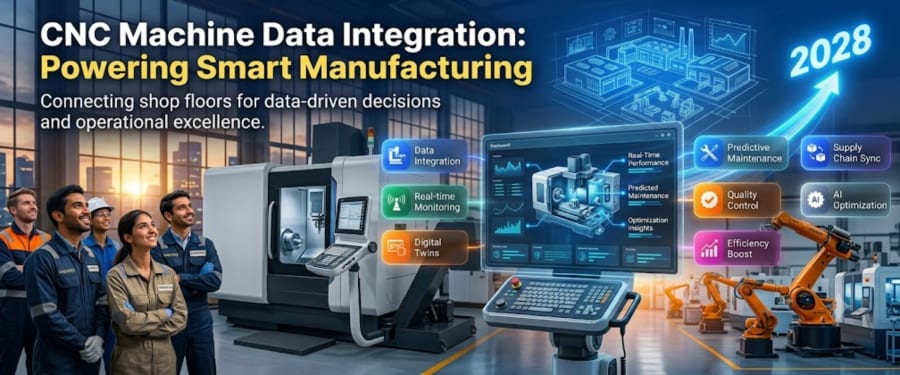
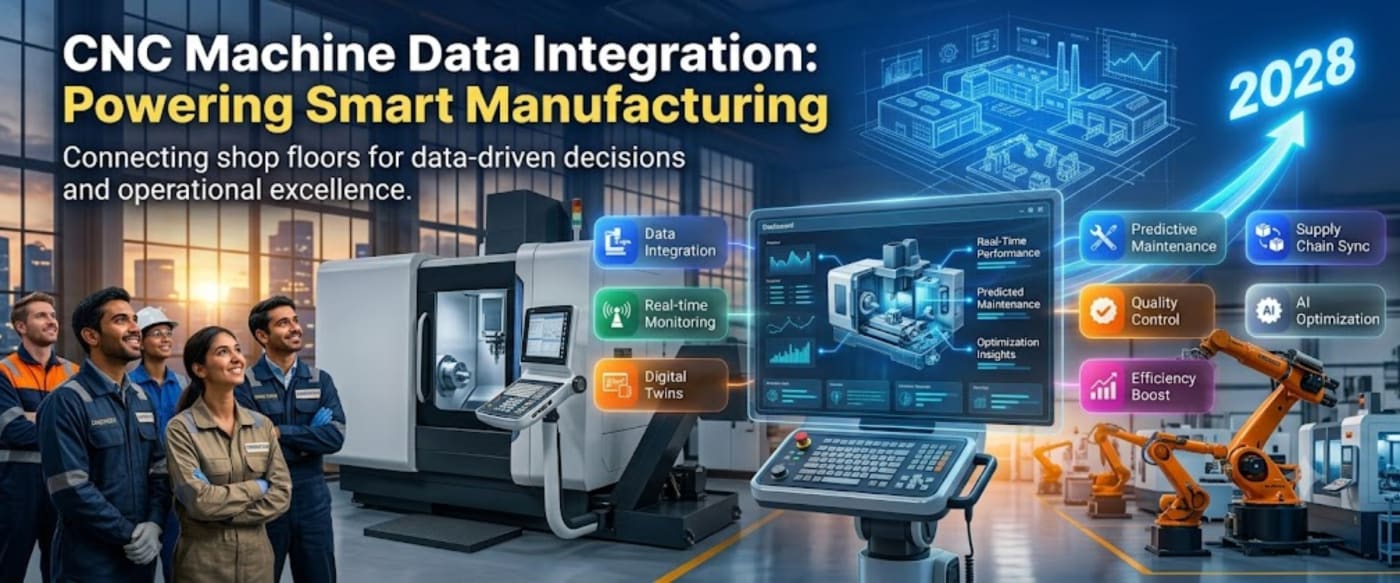
Modern manufacturing depends on more than the performance of individual machines. To maintain productivity, manufacturers need visibility into production output, machine downtime, maintenance requirements, and operational costs. However, in many factories, this information is scattered across CNC machine controllers, spreadsheets, paper records, and disconnected software systems.
CNC machine data integration helps bring these separate sources together. By connecting computer numerical control (CNC) machines with software applications, databases, and reporting dashboards, manufacturers can create a more connected view of their production operations.
For businesses looking to improve operational visibility, this does not necessarily mean replacing existing machinery or investing in a complete manufacturing execution system (MES). A focused integration project can start by collecting selected machine data, presenting it in a central dashboard, and gradually adding maintenance alerts, production reporting, and analytics.
In this article, we explore how CNC machine data integration works, which technologies make it possible, and how connected software solutions can help manufacturers link production, maintenance, and reporting.
Table of Contents
- What Is CNC Machine Data Integration?
- Why Manufacturers Need Connected Machine Data
- What Data Can CNC Machines Provide?
- How CNC Machine Connectivity Works
- Connecting CNC Data with Production Monitoring
- Using Machine Data for Maintenance Planning
- Automating Manufacturing Reports
- Building Dashboards and Manufacturing Analytics
- How to Implement CNC Data Integration
- Common Integration Challenges
- How NextCode Can Help Build CNC Integration Solutions
- Frequently Asked Questions
- Conclusion
1. What Is CNC Machine Data Integration?
CNC machine data integration is the process of collecting information from CNC machines and connecting it with software systems used to manage manufacturing operations.
A CNC machine uses programmed instructions to control machining processes such as milling, turning, drilling, and cutting. Depending on the controller, machine configuration, and available interfaces, it may expose information about its operating state, program execution, alarms, production cycles, and other operational parameters.
Integration software collects the relevant information, processes it, and makes it available to other applications.
A connected CNC data solution may include:
- Machine connectivity: Collecting data from compatible CNC controllers, gateways, or monitoring devices.
- Data processing: Converting machine signals and events into structured records.
- Centralised storage: Saving historical information for analysis and reporting.
- Production monitoring: Displaying machine status, cycle activity, output, and downtime.
- Maintenance support: Using operating hours, alarms, and other indicators to support maintenance planning.
- Reporting and analytics: Creating production summaries and operational performance reports.
The goal is to make useful manufacturing information accessible without requiring operators and managers to manually gather data from multiple sources.
2. Why Manufacturers Need Connected Machine Data
Many manufacturing businesses have invested in capable CNC equipment but still face challenges when trying to understand what is happening across the production floor.
Disconnected Production Records
Operators may record completed parts, rejected components, and downtime in spreadsheets or paper logs. These records can be useful, but manual entry takes time and may introduce inconsistencies.
Limited Machine Visibility
When production managers cannot view machine status remotely, they may need to contact operators or walk across the factory to understand whether a machine is running, idle, or stopped.
Reactive Maintenance
Maintenance teams may rely on fixed service intervals or respond only after a problem occurs. Without accessible operating-hour and alarm data, it can be harder to prioritise inspections and identify recurring issues.
Time-Consuming Reporting
Production reports often require information from machine logs, shift records, quality systems, and planning tools. Bringing these sources together manually can delay decision-making.
Difficulty Comparing Performance
When different machines record production data in different formats, comparing utilisation, cycle times, downtime, or output can become complicated.
Connecting these data sources creates an opportunity to improve visibility and consistency. It also gives manufacturers a foundation for more advanced analysis when reliable historical data becomes available.
3. What Data Can CNC Machines Provide?
The information available from a CNC machine depends on its controller, model, configuration, licensing, and connectivity options. Not every machine exposes every data point, so the first step is to identify what can be collected safely and reliably.
Machine Operating Status
Operating status can indicate whether a machine is running, idle, stopped, in alarm, or in another controller-defined state. These signals can help teams understand machine availability and investigate periods of inactivity.
Production and Cycle Data
Depending on the available interface, a system may capture program execution events, cycle start and completion times, part counts, and cycle duration. Some information, such as good-part counts and scrap quantities, may need to come from an operator interface or a separate production system.
Alarm and Event History
Machine alarms and event records can help maintenance teams identify recurring stoppages and understand when particular problems occur.
Operating Hours and Usage
Runtime information can support maintenance scheduling and equipment utilisation analysis. The exact meaning of runtime should be defined carefully because powered-on time, cycle time, cutting time, and productive time are not necessarily the same.
Quality and Process Information
Some environments can connect machine records with inspection results, part identifiers, tool information, or process measurements. This usually requires integration with quality management systems, production databases, or additional sensors.
By combining these data sources, manufacturers can build a more complete picture of production activity. The key is to document where each data point originates and what it actually represents.
4. How CNC Machine Connectivity Works
Connecting a CNC machine to a software platform requires a suitable method for communicating with its controller or associated equipment. The right approach depends on the age of the machine, supported interfaces, factory network, and data requirements.
Controller Interfaces and APIs
Some CNC controllers provide supported interfaces, software development kits, or APIs for accessing machine information. These can offer a structured way to retrieve status and operational data, subject to the controller's capabilities and licensing.
Industrial Communication Protocols
Manufacturing environments may use industrial communication standards and protocols such as OPC UA, where supported by the controller or an appropriate gateway. These technologies can help different systems exchange structured machine data.
MTConnect
MTConnect is a manufacturing interoperability standard designed to make equipment data accessible in a consistent format. A compatible adapter or agent may be needed to expose data from a particular machine or controller.
IoT Gateways and Edge Devices
For machines that do not provide a convenient direct connection, an industrial gateway or edge device may collect available signals and forward them to an application. The gateway may read supported controller interfaces or use approved sensors and inputs.
Legacy Machine Integration
Older machines may not offer modern networking features. In some cases, additional sensors can monitor signals such as machine activity or cycle completion. These measurements may provide useful operational information, although they do not necessarily reveal detailed internal controller data.
A typical data flow looks like this:
- The CNC controller or connected sensor generates machine data.
- A supported interface, adapter, or gateway collects the information.
- An integration service validates and normalises the incoming records.
- The application stores the data in a database or time-series data store.
- Dashboards, alerts, and reporting services use the processed information.
This architecture allows manufacturers to add software capabilities while keeping existing CNC equipment in place. Actual implementation depends on the interfaces and permissions available for each machine.
5. Connecting CNC Data with Production Monitoring
Production monitoring turns machine data into information that supervisors and production managers can use throughout a shift.
A production monitoring dashboard can display:
- Current machine status
- Active alarms and recent stoppages
- Cycle start and completion events
- Actual production against planned output, where planning data is available
- Runtime and downtime summaries
- Production performance by machine, shift, or work order
Understanding Downtime
Machine state data can help identify when a machine stops running. However, a stopped machine does not automatically mean a production failure. It may be waiting for material, undergoing a tool change, being set up for another job, or paused for a planned break.
For useful reporting, manufacturers should define downtime categories and connect machine events with production schedules or operator-entered reasons where necessary.
Measuring Overall Equipment Effectiveness
Overall Equipment Effectiveness (OEE) is a common manufacturing metric that combines availability, performance, and quality.
In simplified terms:
- Availability: The proportion of planned production time during which equipment is available for production.
- Performance: How actual production speed compares with the expected production rate.
- Quality: The proportion of produced parts that meet the required quality criteria.
OEE calculations depend on reliable definitions of planned production time, ideal cycle time, total output, and good parts. Machine data can supply some of these inputs, while scheduling and quality systems may provide the rest.
When these sources are aligned, production teams can use OEE and related metrics to investigate performance losses and identify areas for improvement.
6. Using Machine Data for Maintenance Planning
Unplanned machine downtime can disrupt production schedules, delay orders, and increase maintenance costs. CNC machine data integration can help maintenance teams move from scattered records toward a more organised maintenance process.
Operating-Hour-Based Maintenance
Machine runtime or cycle counts can help trigger service reminders based on usage. For example, an application could notify the maintenance team when a machine reaches a configured operating-hour threshold.
Alarm Monitoring
Repeated alarms or unusual event patterns can be recorded and reviewed. A dashboard can help maintenance staff identify which machines generate the most alarms and investigate recurring problems.
Maintenance History
Connecting machine events with maintenance work orders creates a record of equipment problems, inspections, repairs, and component replacements. This information can help teams understand whether certain issues return after maintenance.
Predictive Maintenance Opportunities
Predictive maintenance uses data to estimate the likelihood of equipment problems before they cause a failure. Depending on the equipment and available measurements, this may involve vibration, temperature, spindle-load trends, operating history, or other indicators.
However, collecting machine data alone does not automatically create a reliable predictive maintenance system. Predictive models generally require suitable historical data, well-defined failure records, validation, and ongoing monitoring.
A practical starting point is often condition monitoring and rule-based alerts. More advanced predictive analytics can be introduced when sufficient data and evidence support their use.
7. Automating Manufacturing Reports
Production reporting helps manufacturers understand whether operations are meeting targets and where delays or inefficiencies occur. When information is collected automatically, reports can be generated with less manual consolidation.
Shift Production Reports
Reports can summarise machine runtime, completed cycles, recorded output, downtime events, and active alarms during a shift. Where data is incomplete, the report can clearly identify missing information rather than presenting estimates as confirmed results.
Daily and Weekly Performance Reports
Managers can review production trends across days, shifts, machines, or work orders. Historical comparisons can help identify recurring stoppages and changes in output.
Maintenance Reports
Maintenance summaries can show operating hours, alarm frequency, upcoming service thresholds, open maintenance tasks, and equipment downtime associated with reported problems.
Management Reporting
Higher-level reports can consolidate production performance, downtime, quality data, and maintenance activity. This gives managers a broader view of operations without requiring them to gather every record manually.
Scheduled Reports and Notifications
Software can generate reports at configured intervals and distribute them to authorised users. Alerts can also be sent when selected thresholds are exceeded or when a machine stops unexpectedly.
Automated reporting is most useful when the underlying data definitions are consistent. For example, teams should agree on what counts as a completed part, how downtime is classified, and whether the figures represent live readings or final shift records.
8. Building Dashboards and Manufacturing Analytics
A central dashboard provides a convenient way to view information collected from multiple CNC machines and connected systems.
Rather than forcing users to interpret raw machine signals, a well-designed application presents relevant information in a format suited to each role.
Operator View
Operators may need a simple view of current machine status, production progress, active alarms, and fields for recording downtime reasons or quality checks.
Production Manager View
Production managers may need comparisons across machines and shifts, planned-versus-actual output, downtime summaries, and performance trends.
Maintenance Team View
Maintenance staff may need alarm history, usage counters, service reminders, machine issue records, and links to maintenance tasks.
Business and Operations View
Business leaders may prefer higher-level summaries of production performance, recurring stoppages, equipment usage, and trends that affect delivery schedules.
Depending on the requirements, a CNC data platform can also integrate with existing systems:
- ERP systems: To connect production activity with orders, inventory, and business planning.
- MES platforms: To link machine events with work orders, production routing, and shop-floor execution.
- CMMS software: To connect machine usage and alarms with maintenance work orders and service history.
- Quality management systems: To compare machine and production records with inspection results and defect information.
Integration should be designed around the manufacturer's existing workflow. In many cases, connecting a small number of high-value data points is more useful than trying to integrate every system at once.
9. How to Implement CNC Data Integration
A phased approach can help manufacturers manage technical complexity, control costs, and validate the value of CNC data integration before expanding the solution.
Step 1: Define the Business Objective
Start by identifying the problem to solve. Is the priority to monitor machine status, reduce manual reporting, improve maintenance planning, or compare production performance? A clear objective helps determine which data needs to be collected.
Step 2: Assess the Existing Machines
Document the machine models, controller types, supported interfaces, available network connections, and any licensing requirements. This assessment helps establish what data can be accessed and which integration methods are realistic.
Step 3: Select a Pilot Machine
Choose one machine or a small production area for the initial implementation. A pilot allows the team to test connectivity, validate data accuracy, and collect feedback from operators and managers.
Step 4: Build the Data Collection Layer
Develop or configure the required connectors, gateways, or integration services. Normalise timestamps, machine identifiers, status codes, and event formats so the application can process the information consistently.
Step 5: Create the Database and Dashboard
Store relevant machine events and measurements in an appropriate database. Develop a dashboard that focuses on the selected business objective rather than displaying every available data point.
Step 6: Validate the Data
Compare application readings with the CNC controller, operator logs, and other trusted records. Check for missing events, duplicate records, timestamp differences, and incorrect status mappings before using the data for operational decisions.
Step 7: Add Alerts and Reports
Once the data is reliable, introduce features such as downtime notifications, shift summaries, runtime-based maintenance reminders, and scheduled reports.
Step 8: Expand and Improve
After the pilot demonstrates value, extend the integration to additional machines or systems. More advanced analytics can be considered when sufficient high-quality historical data is available.
Security should be included throughout the project. Industrial networks should be segmented appropriately, access should follow least-privilege principles, and machine interfaces should be read-only wherever possible for monitoring use cases. Any control-related integration requires separate safety and engineering review.
10. Common Integration Challenges
Although CNC machine data integration can create significant opportunities, implementation requires attention to both technical and operational details.
Different Controller Manufacturers
Factories often operate equipment from multiple manufacturers, with different controller capabilities and data formats. A connector that works for one machine may not work for another.
Practical approach: Assess each controller individually and use standard interfaces or suitable adapters wherever possible.
Legacy Equipment
Older CNC machines may not support direct digital connectivity or detailed data access.
Practical approach: Consider supported controller interfaces, industrial gateways, or carefully selected external sensors. Document any limitations in the information collected.
Inconsistent Data Definitions
Different systems may use different definitions for machine idle time, downtime, cycle completion, and good-part counts.
Practical approach: Create a shared data dictionary and agree on calculation rules before developing dashboards and reports.
Network Reliability
Temporary network outages can interrupt data collection and create gaps in reporting.
Practical approach: Use suitable buffering and retry mechanisms where supported, monitor connector health, and make missing data visible to users.
Cybersecurity Risks
Connecting industrial equipment to business networks can increase the attack surface if connectivity is not carefully designed.
Practical approach: Use network segmentation, controlled access, secure authentication, encrypted communication where supported, and documented change procedures. Avoid exposing machine controllers directly to public networks.
Unclear Project Scope
Attempting to connect every machine and business system in the first phase can increase complexity and delay delivery.
Practical approach: Begin with a small set of machines, data points, and measurable outcomes. Expand only after the initial implementation is validated.
11. How NextCode Can Help Build CNC Integration Solutions
Manufacturers do not always need to begin with a large, complex industrial software platform. A focused application that connects selected machine data with production monitoring and reporting can be a practical first step.
As a software development startup, NextCode can work with manufacturers to plan and build the application layer of a CNC data integration solution. The exact scope depends on the machine controllers, available interfaces, factory infrastructure, and business requirements.
Machine Data Integration Services
We can develop integration services that retrieve data from compatible APIs, industrial gateways, or supported machine interfaces. The collected information can then be transformed into a consistent format for use by other applications.
Web-Based Production Dashboards
We can build dashboards that display machine status, production activity, downtime events, and historical trends. Role-based views can help operators, production managers, and maintenance teams access the information relevant to their work.
Maintenance Monitoring Applications
We can develop features for tracking machine usage, recording alarms, creating service reminders, and maintaining equipment history. Where a manufacturer already uses a maintenance platform, the solution can be designed to exchange data with it if suitable integration interfaces are available.
Automated Reports and Alerts
We can implement scheduled production summaries, configurable alerts, and downloadable reports. These features can reduce repetitive reporting tasks and make operational information easier to review.
Database and API Development
We can build the backend services and database structures required to store machine events, retrieve historical records, and share information between authorised applications.
Phased Development and Integration
Our recommended approach is to begin with a clear use case and a manageable pilot. We can first focus on connectivity and data validation, then add dashboards and reporting, and later explore analytics or predictive maintenance where the data supports it.
This approach allows manufacturers to evaluate the software against their real production needs before committing to a broader rollout. Hardware compatibility, controller access, industrial networking, and safety-critical control work should be assessed with the relevant equipment providers and qualified industrial engineering specialists.
Looking to Connect Your CNC Machines with Business Software?
From machine data dashboards and production reporting to maintenance monitoring and API integrations, NextCode can help you plan and develop software solutions around your manufacturing requirements.
Discuss Your Project12. Frequently Asked Questions
1. What is CNC machine data integration?
CNC machine data integration connects information from CNC controllers or associated devices with software applications, databases, dashboards, and reporting systems. It helps manufacturers monitor production activity and use machine information more effectively.
2. What data can be collected from a CNC machine?
Depending on the controller and available interfaces, data may include machine status, program execution, cycle events, operating hours, alarms, and selected process measurements. Part counts, quality results, and downtime reasons may require additional systems or operator input.
3. Can older CNC machines be connected to a dashboard?
Potentially, yes. The available options depend on the machine and controller. Supported interfaces, gateways, or external sensors may provide some data, but older machines may not expose the same level of detail as newer equipment.
4. What is the difference between CNC monitoring and CNC integration?
CNC monitoring focuses on observing machine status and performance. CNC data integration connects machine information with other systems, such as production planning, maintenance software, databases, and business reporting tools.
5. Can CNC data integration support predictive maintenance?
Yes, it can provide part of the foundation. Reliable predictive maintenance usually requires suitable historical operating data, maintenance and failure records, relevant sensor measurements, and validated analysis. Monitoring and rule-based alerts are often useful starting points.
6. What is OEE in CNC manufacturing?
Overall Equipment Effectiveness (OEE) combines availability, performance, and quality into a manufacturing performance metric. Calculating it accurately requires agreed definitions and reliable production, timing, and quality data.
7. Is CNC machine data integration secure?
It can be designed securely using industrial network segmentation, controlled access, appropriate authentication, secure communication, and monitoring. Machine controllers should not be exposed directly to public networks, and control-related changes require appropriate safety review.
8. How long does CNC data integration take?
The timeline depends on the number of machines, controller interfaces, data requirements, network conditions, and reporting needs. A pilot involving one compatible machine and a focused dashboard is generally more manageable than a multi-site integration project, but a realistic timeline requires an initial technical assessment.
9. Can CNC data be integrated with ERP or maintenance software?
Yes, where suitable APIs, connectors, or supported integration methods are available. Machine events can be linked with production orders, maintenance work orders, inventory records, or other business information, subject to the capabilities of the existing systems.
10. How should a manufacturer get started?
Start by defining the business problem, assessing machine connectivity, selecting a pilot machine, and identifying a small set of useful data points. Validate the collected information before expanding to automated reporting, maintenance alerts, or advanced analytics.
13. Conclusion
CNC machine data integration helps manufacturers connect production activity, maintenance information, and operational reporting. By collecting reliable machine data and presenting it through useful applications, businesses can improve visibility, reduce manual reporting effort, and make better-informed decisions about their operations.
The most effective approach is not necessarily to build the largest system immediately. Manufacturers can begin with a specific challenge, such as monitoring machine status or automating shift reports, and expand the solution as their requirements and data maturity develop.
For NextCode, this is an opportunity to develop practical software that connects industrial data with everyday manufacturing workflows. Through compatible machine integrations, web dashboards, databases, reporting tools, and maintenance monitoring applications, we can help manufacturers explore a structured path toward more connected operations.
The foundation is straightforward: understand the equipment, collect the right data, validate its accuracy, and build software that helps people use it. With that foundation in place, manufacturers can progressively explore more advanced analytics and smarter production management.