

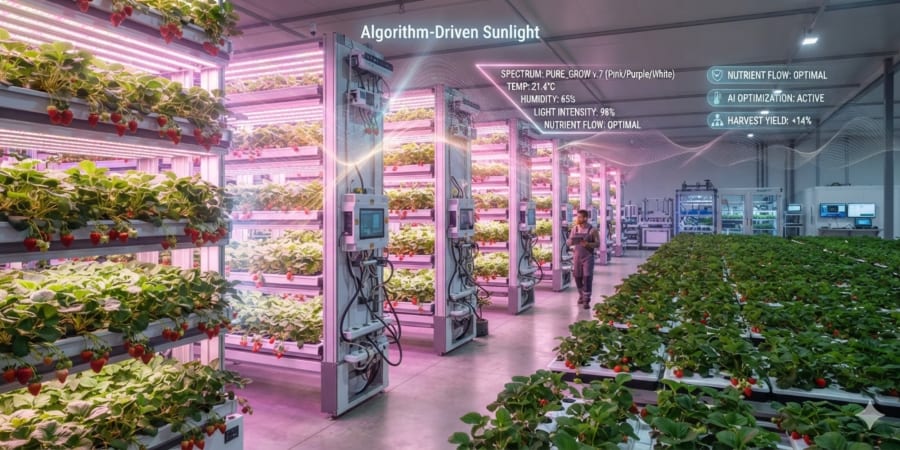
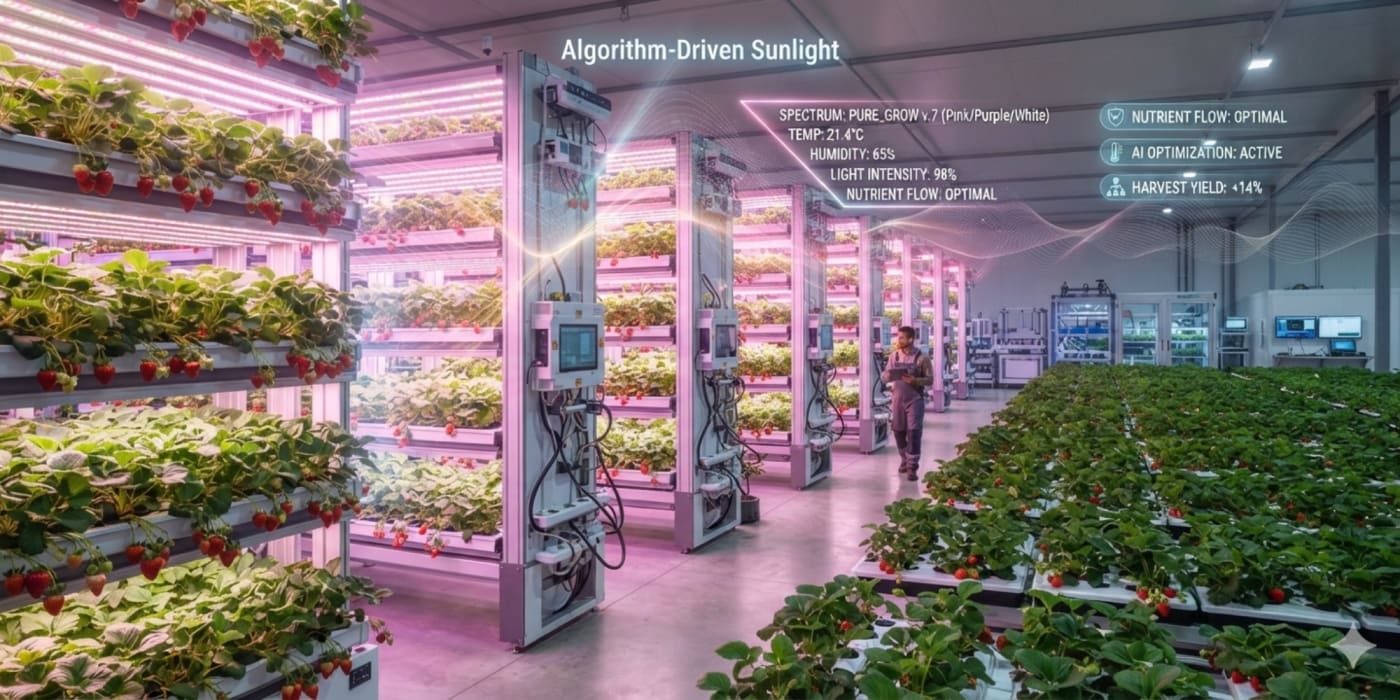
Imagine growing strawberries indoors without depending on natural sunlight, seasonal changes, or unpredictable weather. Instead, every plant receives carefully controlled light designed to support its growth, flowering, fruit development, and flavour.
This is becoming an exciting area of agricultural innovation in South Korea and Japan, where controlled-environment agriculture and vertical farming are exploring advanced LED lighting systems, environmental sensors, and artificial intelligence (AI) to improve crop production.
Unlike traditional greenhouse lighting, which often focuses primarily on providing sufficient brightness, modern smart lighting systems can adjust light intensity, duration, and spectral composition according to the needs of the crop.
For strawberry growers, this creates an opportunity to investigate how different light wavelengths influence plant development, fruit quality, sugar accumulation, and overall production efficiency.
But how does AI decide which light a strawberry plant needs? And can adjusting LED wavelengths really make strawberries sweeter? Let's explore the technology behind algorithm-driven lighting in indoor strawberry farms.
1. The Rise of Indoor Strawberry Farming in Korea and Japan
South Korea and Japan are recognised for their technology-driven approaches to agriculture. Limited agricultural land, changing weather patterns, labour challenges, and strong demand for premium-quality produce have encouraged interest in controlled-environment agriculture.
Vertical farming offers a way to grow crops in stacked indoor systems where temperature, humidity, irrigation, nutrients, and lighting can be carefully managed.
Strawberries are particularly interesting for indoor cultivation because they are high-value fruits with specific requirements for flowering, pollination, fruit development, and temperature management.
In conventional farming, plants depend on natural sunlight, which changes throughout the day and across seasons. Indoor farms can use programmable LED systems to provide more consistent lighting conditions and experiment with different light spectra.
The combination of vertical farming, LED technology, and AI-based monitoring can help growers develop more precise cultivation strategies while collecting valuable information about plant performance.
2. Understanding the Science of Light and Plant Growth
Light is one of the most important environmental factors influencing plant growth. Plants use light energy during photosynthesis to convert carbon dioxide and water into carbohydrates that support development and fruit production.
However, plants do not respond equally to every wavelength. Different regions of the light spectrum influence photosynthesis, plant architecture, flowering responses, and other physiological processes.
The visible light spectrum is commonly measured in nanometres (nm). In horticultural lighting, researchers and growers often focus on photosynthetically active radiation (PAR), conventionally covering wavelengths from 400 to 700 nm.
Understanding how plants respond to different wavelengths allows growers to design lighting programmes based on crop requirements rather than simply increasing brightness.
Why Light Quality Matters
Light quality refers to the spectral composition of the light reaching a plant. Two LED systems can deliver similar overall light intensity while producing different biological responses because their wavelength distributions differ.
For strawberry cultivation, the objective is to provide a suitable lighting environment that supports healthy leaves, efficient photosynthesis, balanced plant development, flowering, and fruit quality.
3. How Different LED Wavelengths Affect Strawberries
Modern horticultural LED systems can combine different colours of light to create customised spectral recipes. The ideal combination depends on the strawberry variety, growth stage, environmental conditions, and production objectives.
3.1 Blue Light: Supporting Leaf Development and Plant Structure
Blue light, generally within approximately 400–500 nm, plays an important role in plant development.
It influences stomatal behaviour, leaf development, chlorophyll-related processes, and plant morphology. In controlled growing environments, blue light can help regulate compact plant architecture and support healthy vegetative growth.
For strawberry farms, the appropriate blue-light proportion can contribute to a balanced canopy and help maintain conditions suitable for photosynthesis.
3.2 Red Light: Supporting Photosynthesis and Biomass Production
Red light, approximately 600–700 nm, is strongly absorbed by photosynthetic pigments and is commonly used in horticultural LED systems.
Red wavelengths can support photosynthesis and influence plant development. When combined with blue light, red LEDs can provide an effective lighting spectrum for indoor crop production.
However, using red light alone is not necessarily optimal. The right balance depends on the crop and the intended production outcome.
3.3 Far-Red Light: Influencing Plant Development
Far-red light, commonly considered around 700–750 nm, interacts with the plant's phytochrome system, which helps regulate responses to the light environment.
It can influence leaf expansion, plant architecture, and flowering-related responses in certain conditions. Its effects depend on the strawberry cultivar and the interaction with other wavelengths.
Far-red light is therefore a potential tool for fine-tuning plant development rather than a universal method for improving fruit sweetness.
3.4 Green Light: Improving Light Distribution Within the Canopy
Green light, approximately 500–600 nm, can penetrate deeper into some plant canopies than strongly absorbed blue and red wavelengths.
This can help distribute light to leaves that receive less direct illumination. In dense indoor growing systems, canopy light distribution is important because lower leaves may otherwise receive insufficient light.
3.5 Ultraviolet Light: A Potential Tool for Fruit Quality Research
Ultraviolet-A and ultraviolet-B radiation are studied for their influence on plant stress responses and secondary metabolites. Carefully controlled UV exposure may affect compounds associated with plant defence, pigmentation, and fruit quality.
However, UV exposure must be managed carefully because excessive levels can damage plant tissues and reduce productivity. It should not be treated as a guaranteed way to increase strawberry sugar content.
4. How AI Optimises LED Lighting for Strawberry Farms
Traditional LED lighting systems often operate using fixed schedules. A grower may program lights to switch on and off at specific times or maintain a constant intensity throughout a production cycle.
AI-powered lighting systems can take a more adaptive approach. By analysing sensor information and crop performance, an intelligent controller can recommend or adjust lighting conditions according to predefined cultivation goals.
4.1 Collecting Plant and Environmental Data
Smart farms use sensors to monitor growing conditions, including:
- Air temperature and relative humidity.
- Carbon dioxide concentration.
- Light intensity and spectral distribution.
- Growing medium moisture and nutrient conditions.
- Water temperature and irrigation activity.
- Plant growth and canopy development through cameras.
This information helps build a picture of the growing environment and how plants respond to changing conditions.
4.2 Analysing Growth Patterns
AI models can analyse historical and real-time data to identify relationships between lighting conditions and plant development.
For example, a model may compare different lighting treatments and examine their association with leaf development, flowering time, fruit size, harvest weight, and measured fruit quality.
Computer vision can also help estimate plant growth, identify visible stress symptoms, and monitor fruit development.
4.3 Adjusting Light Intensity and Spectrum
Based on sensor readings and validated cultivation strategies, an intelligent lighting controller can adjust:
- Red and blue LED output.
- Light intensity during different growth stages.
- Daily light duration and timing.
- Supplemental far-red or other spectral channels where appropriate.
- Lighting schedules in response to temperature and other environmental conditions.
For example, a farm may use one lighting programme during vegetative growth and another during flowering or fruit development. The changes should be based on cultivar-specific trials rather than assumptions that one spectrum works for every strawberry variety.
4.4 Learning From Every Growing Cycle
AI systems can compare production results across multiple growing cycles. Over time, this information can help growers identify which lighting strategies are associated with better fruit quality, consistent yields, and efficient energy use.
The system can then support more informed cultivation decisions. Human growers remain essential for reviewing recommendations, validating results, and managing unexpected crop conditions.
5. Can AI-Controlled Lighting Make Strawberries Sweeter?
One of the most interesting goals in precision strawberry farming is improving fruit sweetness without compromising size, texture, appearance, or yield.
Strawberry sweetness is influenced by several factors, including soluble sugars, organic acids, cultivar genetics, maturity at harvest, temperature, water availability, and growing conditions.
Light affects photosynthesis, which supplies carbohydrates used by the plant. This creates a potential connection between lighting strategies and the development of sugars in strawberry fruit.
Understanding Brix Levels
Growers commonly use a measurement called degrees Brix (°Bx) to estimate soluble solids in fruit juice. It is often used as an indicator of sweetness, although it measures total soluble solids rather than sugar alone.
A refractometer can provide a quick Brix measurement. For a more detailed understanding of fruit composition, laboratory testing can separately measure individual sugars and organic acids.
How Lighting May Influence Sweetness
Appropriate lighting can support photosynthesis and carbohydrate production. The resulting sugars may contribute to fruit development, depending on how the plant distributes and uses those carbohydrates.
Light spectrum, intensity, and daily light integral can influence plant physiology. However, increasing light intensity does not automatically increase fruit sweetness. Excessive lighting can increase energy consumption, heat load, and plant stress.
The most effective approach is to evaluate lighting alongside temperature, irrigation, nutrient management, cultivar selection, and fruit maturity.
How AI Can Help Optimise Fruit Quality
AI can analyse growing conditions alongside Brix measurements, fruit size, acidity, harvest dates, and yield records.
By comparing different cultivation treatments, growers can identify lighting strategies associated with their preferred balance of sweetness, texture, productivity, and energy efficiency.
This is an optimisation process rather than a guaranteed sweetness formula. Controlled trials are necessary to establish whether a particular lighting recipe produces repeatable improvements.
6. Innovations in South Korea and Japan
South Korea and Japan provide interesting examples of how technology can be integrated into modern agriculture. Both countries have invested in smart farming approaches, including controlled growing environments, robotics, sensors, and digital monitoring.
South Korea: Smart Farming and Controlled Environments
South Korea has been expanding its smart agriculture ecosystem through technology-assisted cultivation and controlled-environment farming initiatives.
Indoor farms can use environmental sensors, automated irrigation, climate control, and LED lighting to manage crop production. AI and data analytics can support decision-making by identifying patterns in plant growth and environmental conditions.
For strawberry cultivation, these technologies offer opportunities to improve consistency, monitor fruit development, and investigate how lighting conditions affect crop quality.
Japan: Precision Agriculture and Advanced Horticultural Technology
Japan has a strong interest in agricultural automation and high-value crop production. Its controlled-environment agriculture sector explores technologies such as LED horticultural lighting, environmental monitoring, automated cultivation systems, and robotics.
Strawberries are an important premium fruit category in Japan, making fruit appearance, flavour, and quality especially relevant to indoor cultivation research.
Precision lighting can help growers manage seasonal production conditions and investigate how different spectral combinations influence plant development and fruit characteristics.
What These Markets Can Teach Other Countries
The broader lesson from technology-driven farming in Korea and Japan is that successful indoor agriculture requires more than installing LED lights.
It involves integrating lighting, environmental control, crop science, data collection, automation, and continuous experimentation into a coordinated production system.
7. The Role of Sensors and Smart Farm Technology
AI-powered lighting becomes more useful when connected to a wider smart farm ecosystem. Sensors provide the information needed to understand growing conditions and evaluate the effects of lighting changes.
Environmental Sensors
Temperature, humidity, CO₂, and growing medium sensors help monitor conditions that influence photosynthesis, transpiration, and plant development.
Light Sensors
Light sensors measure the amount of light reaching the crop. Horticultural systems may use quantum sensors to measure photosynthetic photon flux density (PPFD) and calculate daily light integral (DLI).
Computer Vision Cameras
Cameras can capture plant images and help AI systems monitor leaf growth, flowering, fruit development, and visible signs of stress or disease.
Farm Management Software
A central software platform can collect sensor readings, manage lighting schedules, store crop records, and present recommendations through dashboards.
When these technologies work together, growers gain a more complete understanding of how their crops respond to changing conditions.
8. Benefits of AI-Driven Lighting in Vertical Farming
More Precise Crop Management
Lighting programmes can be adjusted according to crop stages and environmental conditions rather than relying entirely on fixed schedules.
Consistent Growing Conditions
Controlled LED systems help reduce dependence on changing natural sunlight and support more predictable indoor growing environments.
Improved Crop Quality Research
Growers can compare spectral treatments and analyse their relationship with fruit sweetness, size, colour, and other quality indicators.
Potential Energy Optimisation
AI-based scheduling can help avoid unnecessary lighting and coordinate light delivery with crop requirements. Energy savings depend on the lighting hardware, climate system, electricity prices, and control strategy.
Data-Driven Decision-Making
Historical growing data helps farmers understand which conditions produce desirable outcomes and improve cultivation strategies over time.
9. Challenges of Implementing AI Lighting Systems
Although intelligent lighting offers significant potential, implementing it successfully requires careful planning.
Initial Investment
Commercial LED systems, environmental sensors, controllers, cameras, software, and climate management equipment can require substantial investment.
Energy Consumption
Indoor farms depend on electricity for lighting, cooling, ventilation, and other systems. Lighting optimisation must consider the total energy requirements of the facility.
Crop-Specific Requirements
Different strawberry cultivars may respond differently to light intensity and spectral composition. A lighting strategy that works well for one variety may not produce the same results for another.
Data Quality and Model Accuracy
AI recommendations are only as reliable as the data used to develop and operate the models. Poor sensor calibration, incomplete records, and insufficient crop trials can lead to unreliable decisions.
Integration Complexity
Lighting systems must work with irrigation, climate control, monitoring, and farm management platforms. Integration challenges can make implementation more complex.
10. The Future of Intelligent Strawberry Farming
The future of indoor strawberry production may involve increasingly integrated systems that combine AI, robotics, advanced horticultural lighting, and predictive analytics.
Instead of relying on one fixed lighting recipe, farms may use crop-specific models that account for plant variety, growth stage, environmental conditions, and desired fruit characteristics.
Future systems could also combine computer vision with fruit quality measurements to identify relationships between plant appearance, growing conditions, and harvest outcomes.
Digital twins of indoor farms may help growers simulate changes to lighting, temperature, humidity, and irrigation before implementing them in actual production environments.
The long-term opportunity is to move from simply growing strawberries indoors to managing each stage of production with greater precision.
11. Frequently Asked Questions (FAQs)
1. What is AI-driven lighting in vertical farming?
AI-driven lighting uses artificial intelligence, sensors, and automated controllers to adjust LED light intensity, spectrum, and timing according to crop requirements. It helps indoor farms manage lighting conditions using plant and environmental data.
2. How do LED wavelengths affect strawberry growth?
Different LED wavelengths can influence photosynthesis, leaf development, plant structure, and flowering responses. Blue and red light are commonly used in horticultural lighting, while green, far-red, and ultraviolet wavelengths may have additional effects depending on the crop and growing conditions.
3. Can changing LED light colours make strawberries sweeter?
Lighting can influence photosynthesis and carbohydrate production, which may affect fruit development and sugar accumulation. However, sweetness also depends on cultivar genetics, temperature, irrigation, maturity, and other growing conditions. No single LED colour guarantees sweeter strawberries.
4. What does Brix mean in strawberry farming?
Brix (°Bx) is a measurement of soluble solids in fruit juice and is commonly used as an indicator of sweetness. It does not measure sugar alone, so laboratory analysis may be needed to determine the exact sugar composition of strawberries.
5. Why are South Korea and Japan investing in smart farming?
Both countries are exploring agricultural technologies to improve production efficiency, address labour challenges, and support controlled cultivation. Smart farming technologies include sensors, automated climate systems, LED lighting, robotics, and data analytics.
6. What is the role of AI in an indoor strawberry farm?
AI can analyse environmental and crop data, identify growth patterns, support lighting adjustments, monitor plant health, and help growers evaluate fruit quality. It can also assist with irrigation and climate management when integrated with suitable farm systems.
7. What is the difference between PPFD and DLI?
PPFD measures the amount of photosynthetically active photons reaching a surface per second, usually expressed in micromoles per square metre per second. DLI measures the total amount of photosynthetic light received over an entire day.
8. Are vertical strawberry farms more sustainable than traditional farms?
Vertical farms can use space efficiently and provide greater control over water and growing conditions. However, their sustainability depends on electricity sources, cooling requirements, equipment efficiency, water management, and overall production performance.
9. Can AI-controlled LED systems operate without human intervention?
AI systems can automate many lighting adjustments and environmental controls, but human supervision remains important. Growers need to validate recommendations, monitor unusual conditions, maintain equipment, and make decisions that require agricultural expertise.
10. What technologies are needed to build an AI-powered strawberry farm?
A typical system may include horticultural LED lights, environmental sensors, cameras, automated controllers, irrigation equipment, climate management systems, data platforms, and AI software. The exact setup depends on farm size, crop variety, production goals, and budget.
12. Conclusion
Algorithm-driven lighting is opening new possibilities for indoor strawberry cultivation. By combining LED technology, AI, environmental sensors, and crop science, vertical farms can explore more precise ways to manage plant growth and fruit quality.
The experiences and technology developments emerging from South Korea and Japan demonstrate the potential of data-driven agriculture. Carefully managed light spectra can support photosynthesis and influence plant development, while AI can help growers analyse results and refine cultivation strategies.
Although no lighting formula guarantees sweeter strawberries, intelligent lighting systems provide a valuable foundation for testing and improving fruit quality under controlled conditions.
As smart agriculture continues to evolve, the combination of AI and horticultural lighting could help create more efficient, consistent, and data-driven strawberry production systems.
Ready to Explore AI-Powered Agriculture Solutions?
Discover how AI, intelligent automation, IoT sensors, and custom software can transform modern agricultural operations. From smart farm monitoring to predictive analytics and automated environmental controls, the right technology can help build more efficient growing systems.
NextCode can help you explore and develop custom digital solutions that connect data, automation, and intelligent decision-making for your business.
Talk to Our Experts