
Category: Industrial Technology
Manufacturing businesses are under increasing pressure to improve production visibility, reduce operational delays and make faster, data-driven decisions. However, many factories still operate with disconnected ERP systems, production software, machine data and manual reporting processes.
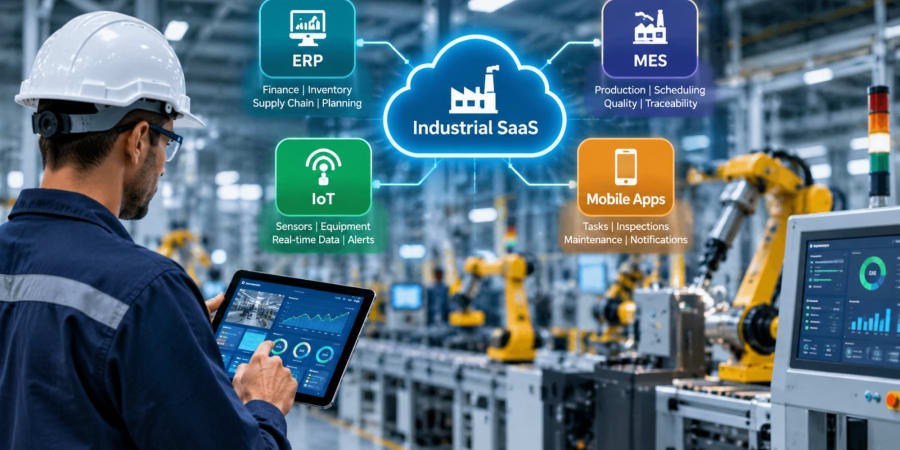
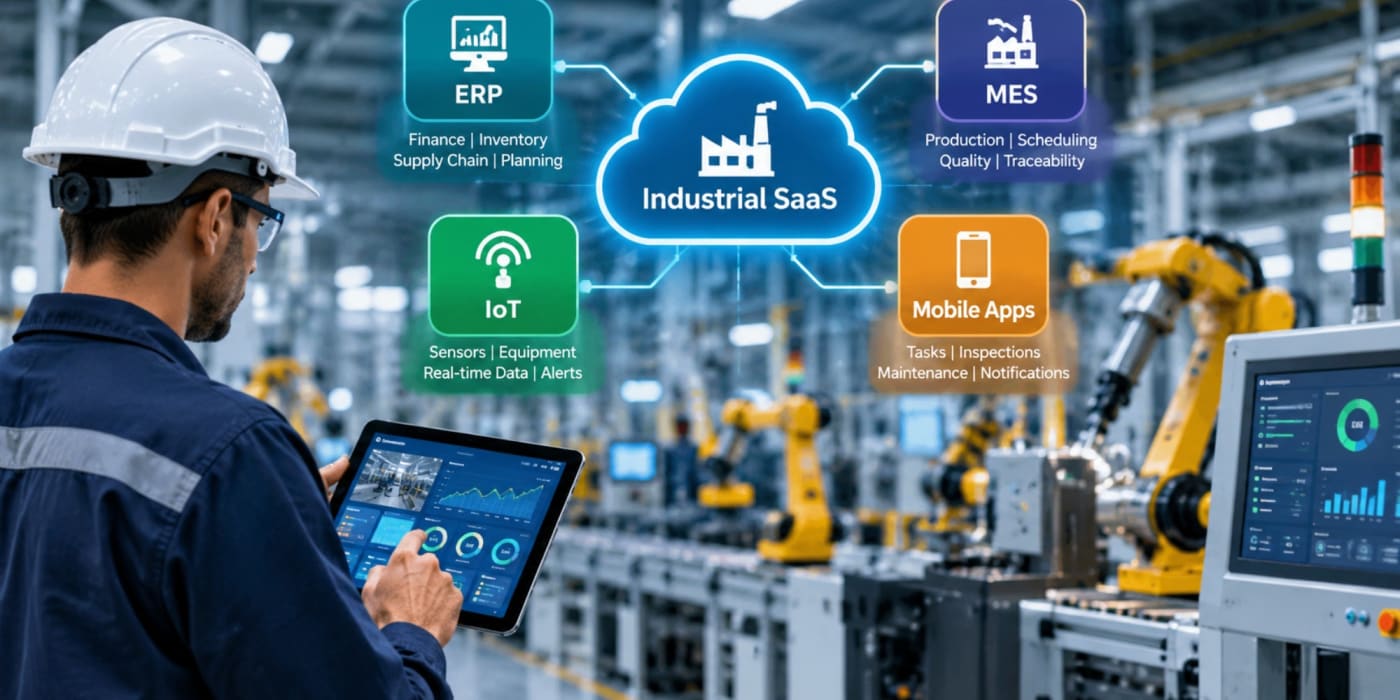
Industrial SaaS architecture provides a practical approach to connecting these systems. By integrating Enterprise Resource Planning (ERP), Manufacturing Execution Systems (MES), Industrial Internet of Things (IIoT) devices and mobile applications, businesses can create a more connected manufacturing environment.
1. What Is Industrial SaaS Architecture?
Industrial Software as a Service (SaaS) is a software delivery model that allows manufacturing businesses to access operational applications through secure networks, often using a cloud-hosted platform. Depending on the design, the platform may also support on-premises systems, edge computing and hybrid infrastructure.
Unlike a standalone business application, an industrial SaaS platform can connect production systems, business data, connected equipment and mobile interfaces through a common integration architecture.
A typical industrial software ecosystem includes:
- ERP: Purchasing, finance, inventory, orders and business planning.
- MES: Production execution, work orders and shop-floor performance.
- Industrial IoT: Machine sensors, equipment telemetry and operational events.
- Mobile applications: Worker tasks, inspections, maintenance requests and alerts.
- Integration services: APIs, event processing, data transformation and system connectivity.
- Analytics: Dashboards, reports, operational trends and decision support.
The objective is not necessarily to replace every existing system. It is to connect the right systems so that information can move securely and consistently between departments.
2. Why Manufacturing Systems Need Integration
Many manufacturing organisations have invested in ERP software, production systems, machines and accounting tools over several years. The challenge is that these tools may use different data formats, databases, interfaces and reporting methods.
Disconnected systems can create problems such as:
- Production teams working with outdated work orders.
- Inventory figures that do not match actual shop-floor consumption.
- Maintenance teams receiving machine alerts too late.
- Supervisors preparing production reports manually.
- Managers lacking a consolidated view of downtime and output.
- Quality records being stored separately from production batches.
An integrated architecture can reduce repeated data entry, improve information consistency and make relevant operational information available to authorised users.
The value depends on the quality of the underlying data, the reliability of integrations and how effectively employees use the system.
3. Understanding the Industrial SaaS Architecture
A robust industrial SaaS platform is usually organised into layers. Each layer has a defined responsibility, making the system easier to maintain, extend and integrate with existing factory infrastructure.
Layer 1: Equipment and data sources
This layer includes PLCs, sensors, CNC machines, production equipment, barcode scanners, weighing systems and existing industrial applications. Connectivity depends on the equipment and supported communication protocols.
Layer 2: Edge connectivity and gateways
Edge gateways collect and process data close to the equipment. They can help manage intermittent connectivity, protocol translation, local buffering and time-sensitive operations. Critical machine-control functions should remain within appropriately designed control systems rather than depending solely on a remote cloud service.
Layer 3: Integration and API services
APIs, connectors and message brokers help exchange information between ERP, MES, IoT platforms and mobile applications. Event-driven integration can distribute production events and alerts without requiring every application to repeatedly poll every other system.
Layer 4: Industrial SaaS application services
This layer contains business logic for production tracking, inventory visibility, maintenance workflows, quality records, workforce management and notifications.
Layer 5: Data storage and analytics
Transactional databases, time-series storage and reporting services support different data needs. A clear data model, appropriate retention policies and consistent timestamps are essential for reliable reporting.
Layer 6: Web dashboards and mobile apps
Managers, supervisors, engineers and authorised workers access relevant functions through role-specific dashboards and mobile interfaces. Access should reflect each user's responsibilities.
This layered approach helps teams develop the platform in stages without tightly coupling every component to a single application.
4. The Role of ERP Integration in Manufacturing
ERP systems provide the business foundation for many manufacturing organisations. They typically manage purchase orders, suppliers, inventory, finance, customer orders and resource planning.
Connecting ERP with industrial SaaS can help align business plans with actual production activities.
Examples of ERP integration
- Synchronising approved production orders with the MES.
- Sharing material availability and inventory status.
- Recording production consumption and completed quantities.
- Exchanging supplier, purchase order and delivery information.
- Making approved production and cost reports available to managers.
Integration methods may include vendor APIs, webhooks, supported connectors, middleware, controlled database interfaces or scheduled data exchanges. The correct method depends on the ERP product, licensing, version and infrastructure.
A reliable implementation should define which system owns each business record. For example, ERP may remain the authority for financial transactions, while MES owns detailed production execution records.
5. Connecting MES with Shop-Floor Operations
A Manufacturing Execution System helps coordinate and record production activities. It can manage work orders, routing, operator activity, work-in-progress, production quantities and quality checkpoints.
Connecting MES to ERP and industrial SaaS helps translate business requirements into operational activities and report execution results back to planning systems.
Practical MES integration features
- Work-order assignment and status tracking.
- Production quantity and rejection recording.
- Machine downtime and reason-code capture.
- Batch, serial number and component traceability.
- Digital inspection forms and quality approvals.
- Shift-level output and production summaries.
For example, a precision component manufacturer may receive a work order through ERP, execute the operation on the shop floor, record output through MES and present authorised production updates on a supervisor's mobile dashboard.
The result is a more consistent link between planned production and actual manufacturing activity.
6. Integrating Industrial IoT and Machine Data
Industrial IoT connects equipment and sensors to systems that collect, interpret and use operational data. Depending on the installation, information may include machine status, temperature, vibration, cycle counts, energy consumption and equipment alarms.
Important IoT integration capabilities
- Real-time or near-real-time machine status monitoring.
- Alerts when monitored values cross configured thresholds.
- Equipment utilisation and downtime analysis.
- Historical trend analysis for maintenance planning.
- Energy and resource consumption reporting.
- Contextual links between machine events and production orders.
Protocols and technologies may include OPC UA, MQTT and industrial gateway integrations. The selection should account for the existing equipment, cybersecurity requirements, network design and data latency.
IoT data becomes more useful when it is connected to production context. A machine stoppage, for example, is easier to investigate when it can be related to a work order, product, shift and maintenance history.
7. Why Manufacturing Needs Mobile Applications
Factory teams cannot always rely on desktop workstations to access operational information. Mobile applications can bring selected workflows closer to the people carrying out the work.
Useful features for industrial mobile apps
- Secure worker login and role-based access.
- Assigned tasks, work orders and shift information.
- Production quantity, scrap and rejection entry.
- Equipment maintenance requests and fault reporting.
- Barcode or QR code scanning for parts and inventory.
- Digital quality inspection checklists.
- Notifications for approvals, delays and equipment alarms.
- Supervisor dashboards and shift handover reports.
Offline-first capabilities may be useful in areas with weak network coverage. In such cases, the app should store approved data locally, synchronise when connectivity returns and handle conflicting updates safely.
Mobile applications should complement established production and safety procedures, not bypass machine interlocks or other safety-critical controls.
Businesses planning these capabilities can explore custom mobile app development and custom software development services. Replace these example paths with the verified Next Code Company service URLs before publication.
8. How Data Flows Across the Industrial SaaS Platform
Successful integration requires clearly defined data flows, system ownership and error-handling rules. A typical production workflow may look like this:
- ERP creates and approves a production order.
- An integration service sends the required order details to MES.
- MES schedules or releases the work for shop-floor execution.
- Machines and gateways provide supported operational events.
- MES records quantities, work progress and quality information.
- The integration layer sends approved updates to ERP.
- The SaaS dashboard combines relevant business and production information.
- Mobile apps display assigned tasks, alerts and authorised updates.
Not every event should be sent to every system. A well-designed architecture uses data contracts, validation, timestamps, event identifiers and appropriate retry mechanisms to prevent duplicated or inconsistent records.
Illustrative technology stack
- Web frontend: React or Next.js.
- Mobile frontend: React Native, Flutter or native development.
- Backend: Node.js, .NET, Java or another suitable server framework.
- APIs: REST APIs, webhooks and selected event-driven interfaces.
- Data: PostgreSQL or another transactional database, with time-series storage where needed.
- IoT connectivity: Supported industrial gateways, OPC UA and MQTT where appropriate.
- Infrastructure: Cloud, on-premises or hybrid deployment based on operational requirements.
These are example technology choices, not a mandatory stack. Existing systems, integration constraints, team expertise and security requirements should guide architecture decisions.
9. Industry Use Cases and Business Benefits
Precision engineering and component manufacturing
Connect work orders, machine activity, inspection records and component traceability. This can help teams investigate production issues and maintain more consistent records.
Food and beverage manufacturing
Link batch records, production planning, inventory and quality checks. Traceability and appropriate storage controls are especially important for products with expiry dates and food safety requirements.
Pharmaceutical and medical manufacturing
Support controlled workflows, authorised approvals, equipment records and audit trails. Applicable validation, electronic record and regulatory requirements must be assessed for the intended environment.
Aerospace component manufacturing
Connect production orders, serialised components, inspection records, calibration data and supplier documentation. Security, configuration control and customer-specific quality requirements should be considered from the design stage.
Potential business benefits
- Less manual data entry and repeated reporting.
- Improved visibility across production and inventory.
- Faster access to maintenance and quality information.
- More consistent work-order and traceability records.
- Better coordination between office and shop-floor teams.
- A scalable foundation for future analytics and automation.
These are potential benefits, not guaranteed outcomes. Measure improvements against a baseline, such as reporting time, downtime, inventory discrepancies or first-pass yield.
10. Security, Scalability and Reliability
Industrial SaaS platforms connect business-critical data with operational environments. Security and reliability therefore need to be considered throughout architecture, implementation and maintenance.
Security considerations
- Role-based access control and least-privilege permissions.
- Multi-factor authentication for appropriate user groups.
- Encryption in transit and at rest where supported.
- Audit logs for sensitive changes and approvals.
- Secure API credentials, secrets management and key rotation.
- Network segmentation between enterprise IT and operational technology.
- Backups, tested recovery procedures and incident response planning.
Scalability considerations
A platform may begin with one factory and later expand to multiple production sites. Tenant isolation, configurable workflows, site-level permissions, observability and carefully managed data retention can support that growth.
Multi-tenant SaaS is not always the right deployment model. Some industrial customers may require dedicated environments, on-premises components or hybrid deployments due to security, latency, contractual or operational constraints.
11. Implementation Roadmap: From Concept to Deployment
Phase 1: Assess business and technical requirements
Document existing ERP and MES products, machine interfaces, network conditions, data owners, user roles and the business problems the platform must solve.
Phase 2: Select a focused pilot
Start with a defined use case, such as work-order visibility, downtime reporting, maintenance requests or quality inspections. Avoid integrating every factory system in the first release.
Phase 3: Design the architecture
Define integration boundaries, API contracts, event flows, deployment options, identity management, data retention and failure-handling requirements.
Phase 4: Build and integrate the MVP
Implement the minimum viable platform, including the required interfaces, data exchange, role-specific screens and operational monitoring. Test with representative equipment and realistic data.
Phase 5: Validate and pilot
Test access controls, connectivity failures, duplicate events, data reconciliation, recovery and user workflows. Train the pilot team and collect feedback before wider rollout.
Phase 6: Measure and expand
Compare outcomes with the baseline. Expand to more lines, machines or facilities when the initial use case is reliable and its benefits justify the additional investment.
A phased approach makes it easier to manage integration risk, demonstrate value and prioritise subsequent investments.
12. The Future of Industrial SaaS Architecture
Industrial platforms are evolving beyond basic dashboards and data collection. Several technology directions may create new opportunities for manufacturers.
AI-assisted operational insights
AI can help identify patterns in production and maintenance data, summarise reports or flag unusual behaviour. Reliable results depend on data quality, appropriate evaluation and human oversight.
Predictive maintenance
Historical machine data and sensor measurements can support maintenance models that estimate equipment risk or detect early warning signals. Model performance must be validated against real operating conditions.
Digital twins and simulation
Digital representations of machines, production lines or facilities can support monitoring, analysis and selected simulation use cases where adequate data and suitable models are available.
Edge computing and hybrid architecture
Processing selected data closer to machines can reduce communication delays and support local operation during network interruptions. Cloud services can provide centralised analytics and multi-site visibility.
Composable industrial software
Modular services and well-defined APIs can allow manufacturers to extend existing systems gradually instead of replacing the entire technology environment at once.
The strongest long-term strategy is to build a secure and maintainable integration foundation before introducing more advanced automation.
13. Frequently Asked Questions
What is industrial SaaS architecture?
Industrial SaaS architecture is a software design that connects business applications, production systems, connected equipment and user interfaces through secure integration services and shared operational data.
What is the difference between ERP and MES?
ERP manages business processes such as finance, procurement, inventory and order planning. MES manages production execution, work-in-progress, shop-floor activities and manufacturing performance.
Can industrial SaaS integrate with existing ERP software?
Yes. Integration may use supported APIs, vendor connectors, middleware, event messaging or controlled data exchanges. Feasibility depends on the existing ERP product and its integration capabilities.
How does IoT help manufacturing operations?
Industrial IoT can provide machine status, sensor readings and equipment events for monitoring, alerts, maintenance planning and operational analysis.
Do factories need a mobile app if they already have ERP?
Not every factory needs a separate mobile app. However, a purpose-built application can make selected workflows easier for shop-floor workers, technicians and supervisors who need access to tasks, inspections, alerts or production updates while away from a desktop.
How should a manufacturer begin an industrial SaaS project?
Start by identifying a measurable operational problem, mapping existing systems and selecting a manageable pilot. Define integration, security and reliability requirements before expanding to additional workflows.
14. Conclusion: Build a Connected Manufacturing Ecosystem
Industrial SaaS architecture creates opportunities to connect ERP, MES, IoT devices and mobile applications into a coherent operational environment. Rather than relying on isolated tools and manual reporting, manufacturers can establish a consistent foundation for production visibility, traceability and data-driven decision-making.
Success depends on selecting the right use case, integrating existing systems carefully, protecting operational data and designing for the realities of the factory floor.
Whether a business needs a production tracking application, an industrial IoT dashboard, a supplier portal or a broader SaaS platform, a phased implementation can help align technology investment with measurable operational needs.
Planning an Industrial SaaS or Manufacturing App?
Next Code Company helps businesses explore custom software, mobile application and SaaS development opportunities. If you are planning to connect ERP, MES, IoT devices and factory workflows, discuss your requirements with our team.
Let's explore a practical architecture for your manufacturing operations.